
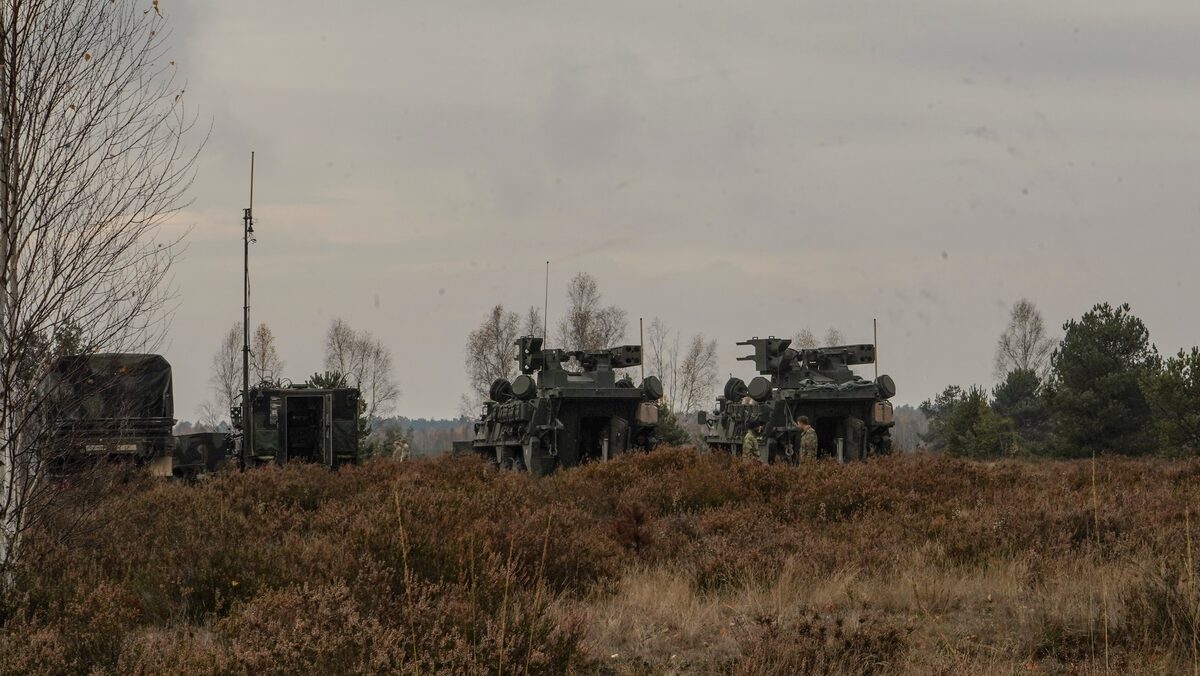
From Nov. 2 to 6, a U.S. Army air defense battery on Poland's Baltic coast spent a week assessing the FD-1 Interceptor, an FPV interceptor drone launched from a Stryker-based SGT Stout air defense vehicle and flown out over the sea. The hardware gets the attention. Read the Army's own account closely, though, and the drone looks like the smaller part of the story. What the unit says it was building is a repeatable way to turn ordinary air-defense crewmembers into competent first-person-view (FPV) drone pilots, and then to hand that method to the rest of U.S. Army Europe and Africa.
The event, called Operation Audacious Fury, took place at Ustka Training Area. A 10th Army Air and Missile Defense Command (AAMDC) statement first appeared on Nov. 6, and the Army.mil version of the article, by Capt. Zemas Andargachew, is dated Nov. 9. The Army describes it as an internal assessment by a USAREUR-AF theater divisional air defense battalion, and the release presents it as nothing more than that.
Who ran it, and what they were trying to prove
The Tactics, Integration and Employment (TIE) Battery of 5th Battalion, 4th Air Defense Artillery Regiment led the assessment. The battery falls under the 52d ADA Brigade and 10th AAMDC. According to the release, the stated goal was to "establish cost-effective, lower-tier kinetic magazine depth against Group 1-3 and massed UAS threats."
Each part of that phrase means something specific. "Lower-tier" puts the effort at the bottom of the air defense stack, against small and mid-size drones. "Kinetic" means the drone is destroyed physically, not jammed or spoofed. "Magazine depth" is the core issue: a short-range air defense vehicle carries a limited number of shots, and a massed drone attack is designed to use them up. Army Recognition describes the FD-1 launch from SGT Stout as a possible lower-cost option alongside the Stinger missiles and 30 mm cannon fire the vehicle already carries. The aim, it says, is an additional kinetic layer against Group 1-3 drones approaching a defended position simultaneously.
Lt. Col. John Verwiel, the battalion commander, framed it as a cost-exchange problem. "There are a lot of systems that we can use to get after defeating the massed UAS threats while staying on the right side of the cost-curve, so we don't expend our exquisite munitions ineffectively," he said in the release.
The logic is simple: a missile should not be spent on a target that costs a small fraction of it, especially when dozens of those targets may follow. An interceptor drone launched from the same vehicle, if it works, keeps the missiles for the threats that justify them.
The drone, briefly
The Army release says little about the FD-1 itself. Army Recognition reports that it is developed by Mountain Horse Solutions and that it "reportedly" exceeds 265 km/h, with range beyond 20 km when used with an external antenna. Those figures do not appear in the Army's statement, and nothing in the Army's account indicates the assessment validated them.
What the Army does confirm is the launch platform and the setting. A photo caption has the interceptor launched from a SGT Stout on Nov. 6, and the release quotes a platoon sergeant saying soldiers are flying drones into the Baltic Sea.
The certification table is the real deliverable
The most consequential line in the release comes from Staff Sgt. Felix Aguilar, a platoon sergeant with TIE Battery, not the battalion commander. Aguilar described the work as developing tactics, techniques and procedures (TTPs) along with a "training tabling certification system to get an operator with no knowledge or skills in flying an FPV drone to become a skilled operator."
"Tabling" is Army shorthand for gunnery qualification, in which crews move through a fixed sequence of graded tables. Building an FPV interceptor certification in that format suggests, though the release does not say so, that the Army may want to treat drone interception as a skill every crew qualifies on rather than a specialty held by a few enthusiasts.
Aguilar said soldiers have now certified on the SGT Stout. The release also says TIE Battery soldiers will be the trained trainers who pass that knowledge, training and certification to other units under USAREUR-AF. Defence Industry Europe's account matches: the Army expects the battery to train and certify operators in other units across the command.
Verwiel set out his priorities in one sentence: "standardize the training for it, standardize the engagement process, and then get it out to the force at scale to defeat that mass problem."
That puts the training first, the engagement process second and scale third. The specific drone is not on the list. One reasonable reading is a unit that expects interceptor hardware to keep changing and wants a training and engagement approach that can outlast any single vendor, though the release does not state that.
What the Army did not publish
The release is clear about intent and says nothing about results. None of the four accounts reviewed here includes:
- Engagement outcomes. There are no kill counts, intercept rates or descriptions of the targets. The Army says soldiers are flying drones into the Baltic, not whether those flights involved live intercepts of representative Group 1-3 targets.
- Cost per shot. The whole case rests on staying "on the right side of the cost-curve," yet no unit cost for the FD-1 is published. The cost-exchange argument has not been quantified in public.
- Training time. Aguilar's system is meant to take an operator from no FPV skill to skilled, but the release does not say how many hours or flights that takes, or what the pass criteria are. Those numbers decide whether the approach can work at scale.
- A procurement or adoption decision. This was an internal battalion-level assessment. Nothing in the release commits the Army to buying FD-1s or fielding the concept on SGT Stout fleets.
- Mass. The goal was "massed UAS threats," but the accounts do not describe how many interceptors a crew can control or launch in quick succession, or how one vehicle handles a raid of simultaneous targets.
Those gaps are normal for an early, unit-led assessment. They do mean the claims that matter most, that the system is cheaper per kill and works against a real raid, remain claims for now.
Why It Matters
Short-range air defense units face simple arithmetic. They carry a finite number of expensive interceptors, and an adversary using cheap drones in numbers can run that supply down faster than it can be replenished. A drone-on-drone layer launched from the same vehicle is one of the more direct answers available, and Audacious Fury shows a battalion in Europe working the problem directly.
The more durable result may be institutional. An FPV interceptor depends heavily on the skill of the person flying it, and the Army cannot rely on a handful of skilled pilots to defend every position. A gunnery-style certification table, with a TIE Battery acting as trained trainers, is how a niche skill can become a force-wide one. If that pipeline holds up, the Army could in principle swap in a different interceptor later without rebuilding the training base from scratch.
Whether this goes beyond one battalion depends on the data the release leaves out: intercept rates, real cost per engagement and how long it takes to certify a crew. Until those are published, Audacious Fury is best read as a promising way of building training doctrine, with the drone at the center of the photos playing a supporting role.
Sources
- US Army Air defenders assess drone interceptor (Army.mil, via Wayback Machine snapshot)
- U.S. Army tests FD-1 interceptor as a lower-cost option against massed drone attacks (Defence Industry Europe)
- US Army Launches FD-1 Drone Interceptor From Stryker Air Defense Vehicle Against Mass Drone Attacks (Army Recognition)
- U.S. Army Air Defenders In Europe Assess C-UAS Interceptor (Defcon Level, reproducing 10th AAMDC statement)
