
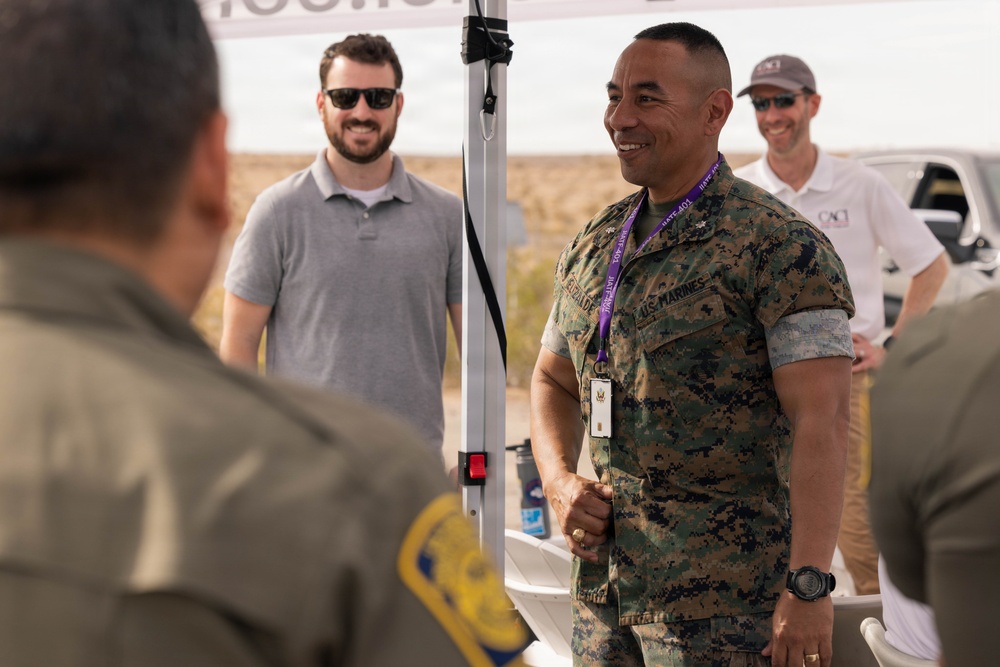
The drone threat on the U.S.-Mexico border is overwhelmingly about watching, not attacking, according to the officer who commands the military task force there. Speaking at Yuma Proving Ground during the Falcon Peak 26.2 counter-drone event, Maj. Gen. Curtis Taylor, who commands Joint Task Force-Southern Border (JTF-SB), said the dominant use of drones along the line is surveillance in support of human trafficking.
"The predominant drone threat that we see along the southern border of the United States is very simply reconnaissance to support human trafficking," Taylor said, adding that it "accounts for 95% to 98% of the drone activity that we observe," according to DefenseScoop.
The numbers
JTF-SB gave a one-month tally. Between Aug. 22 and Sept. 22, the task force detected at least 378 drones. Of those, Taylor said, there were 75 "turn-backs," 15 "engagements" and one "capture." Those three categories account for 91 of the 378 detections; the sources do not say what happened with the rest.
- Detected: at least 378 drones (Aug. 22 to Sept. 22)
- Turn-backs: 75
- Engagements: 15
- Captured: 1
A separate Zetik summary of Fox News reporting on the same figures describes them as cartel drones and says DHS warned that hostile surveillance of U.S. personnel "ends here." The same summary says Border Patrol sees cartels using drones mainly for reconnaissance, including tracking agents and soldiers, and that Yuma has hosted three weeks of military counter-drone testing. Note the window: the Zetik piece counts from Aug. 22 to "Thursday," while the DefenseScoop account gives the end date as Sept. 22.
What the drones look like
Brig. Gen. Brian Filler, JTF-SB's deputy commanding general, said the task force is seeing "largely, commercial off-the-shelf available drones" that "almost always have a payload of a surveillance device, [perhaps] a camera." That profile fits the reconnaissance assessment. Filler added, "We know there's some higher-end capability, but that's not the predominance of what we see." He also said the detections and engagements of the past month reflect trends that are "increasing at a rate that's very noticeable."
Taylor said no lethal drones have been seen on the southern border to date, though he noted that does not mean the capability does not exist. He also voiced concern about lessons from the Russia-Ukraine war spreading to the cartel fight in this hemisphere. That is a stated worry, not an observed change in cartel behavior.
What is not explained
The headline claim carries a gap. DefenseScoop reported that Taylor and Filler did not specify how the task force directly links these drones to human trafficking. Filler said only that an "incredibly involved intelligence process" goes into characterizing the drones, and that he sometimes sees a drone launch followed by movement across the border. The 95-98% figure is Taylor's characterization of the activity, and the public reporting does not show the method behind it. Readers should treat it as the commander's assessment rather than a published dataset. The same caution applies to the "cartel" label used in some coverage of the same tally.
The counter-drone toolkit
JTF-SB's arsenal includes the Army's AMP-HEL laser, the handheld DroneBuster, and the Pitbull drone jammer, per DefenseScoop. U.S. Northern Command's Sept. 4 operational update, read through a Wayback Machine mirror of the original page, adds detail on the laser. AMP-HEL was first employed in border operations on Aug. 24, and as of Sept. 4 the task force had defeated 11 cartel-linked unmanned aircraft with it. The Army acquired AMP-HEL in September 2025.
The same release says JTF-SB has defeated more than 300 UAS this calendar year using kinetic and non-kinetic systems, including more than 100 in August alone. It also says more than 8,000 service members are deployed with the task force along approximately 1,954 miles of border. Gen. Gregory Guillot, commander of NORAD and U.S. Northern Command, is quoted describing the combined approach as "delivering a new layer of homeland defense capability."
The two sets of numbers measure different things and should not be added together. NORTHCOM's "defeats" count covers the calendar year and includes kinetic and non-kinetic means. The 75 turn-backs, 15 engagements, and one capture are a snapshot of a single month, and the sources do not say how those categories map onto the defeat total.
Why It Matters
The task force, activated under Northcom in early 2025, covers 1,954 miles of border, and its leaders are describing a threat that is high in volume but, so far, not lethal. If that description holds, it would argue for counter-UAS systems that can detect and handle large numbers of small camera drones, though Taylor's Russia-Ukraine comment shows planners are also watching for a shift toward armed use.
The reconnaissance framing may also carry policy weight, since tying drone activity to human trafficking can be used to argue for more detection and defeat capability along the border. That makes the unexplained part of the claim, how the link is established, the piece to watch. Until officials show their work, the 378 figure is a count of detections reported by the task force, while the 95-98% split is the commander's read on what those drones were doing.
Sources
- Task force says drone threats on US-Mexico border increasingly linked to human trafficking (DefenseScoop)
- USNORTHCOM Operational Update: Cartel Drone Defeats at the Southern Border, Sept. 4, 2026 (northcom.mil, via Wayback Machine mirror)
- DHS Warns After 378 Cartel Drones Hit Southern Border, Prompting Wider Counter-Drone Push (Zetik)
