
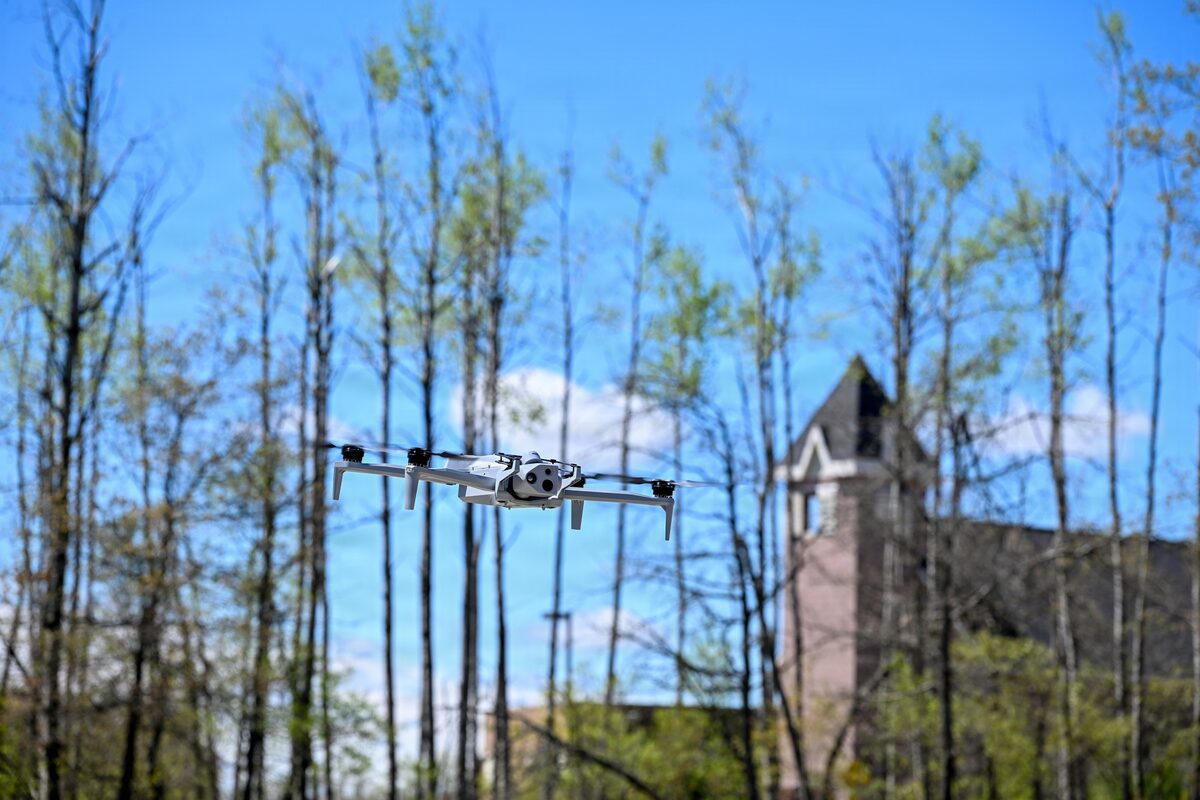
A National Guard training site in Michigan's northern Lower Peninsula, better known for decades of infantry maneuvers and the biannual Northern Strike exercise, has quietly become one of the U.S. Army's preferred places to point lasers and microwave emitters at drones. Camp Grayling Joint Maneuver Training Center — anchor installation of the National All-Domain Warfighting Center (NADWC) — is now running directed-energy counter-UAS testing under a Pentagon initiative designed to let contractors and program offices evaluate emerging weapons in conditions that look like a real fight, not a sanitized test cell.
The latest round, detailed in a Sept. 24 report on DVIDS, describes NADWC inviting defense contractors to evaluate high-energy laser counter-UAS systems, high-power microwave systems, and integrated air and missile defense architectures across nearly 148,000 acres of maneuver space, backstopped by more than 17,000 square miles of special-use airspace at the nearby Alpena Combat Readiness Training Center. That invitation is coordinated through the National All-Domain Warfighting Center's Joint Experimentation Warfighting Laboratory (JEWL), which helps companies define test requirements and match them to range conditions.
That activity builds directly on a smaller, more targeted exercise the Michigan Department of Military and Veterans Affairs (DMVA) publicized on Sept. 16: a week-long Denied, Disrupted, Intermittent and Limited (DDIL) testing environment run Sept. 13-18 under the Army's Permissive Range Initiative (PRI), in partnership with the Army Test and Evaluation Command (ATEC) and the Threat Systems Management Office (TSMO). Participating companies — Eagle NXT, Noah Labs, Archangel Response Corps and Superfocus AI — put drones running autonomous reasoning software through jammed, GPS-denied scenarios there, and the Sept. 24 DVIDS report cites that event as a proof point for the range's ability to support directed-energy and counter-UAS testing more broadly.
What Actually Happened at Camp Grayling
According to the DMVA release, the DDIL event put drones through autonomous reasoning software while they flew over a simulated urban environment, working through three scenarios of increasing difficulty built around target discrimination — the ability of a system to correctly distinguish threats from clutter or non-hostile traffic in a cluttered, GPS-denied setting. The same event also folded in a Positioning, Navigation and Timing (PNT) and RF DDIL environment, effectively jamming the position and communications links a drone or counter-drone system would normally rely on, to see whether the software could keep functioning anyway.
That is the core value proposition NADWC is selling to the Pentagon and to industry: a range large and remote enough that testers can legally jam GPS, saturate radio spectrum and fire directed-energy weapons outdoors, at range, against real flying targets — something most contractors cannot do on a corporate test range or in a lab. Col. Lucas Lanczy, Camp Grayling's commander, is quoted in both the Sept. 16 and Sept. 24 releases making the same underlying point: the base's terrain and largely unencumbered access to spectrum let units and vendors run scenarios that would be difficult or impossible to replicate elsewhere.
How Camp Grayling Got Here
The current wave of directed-energy testing did not appear out of nowhere. It follows a formal Pentagon decision, reported by Stars and Stripes (via MLIVE and Tribune News Service) on Feb. 4, 2026, to designate NADWC and Camp Grayling as a federal drone testing and training site. That designation came after months of advocacy from Michigan's congressional delegation — U.S. Sens. Elissa Slotkin and Gary Peters, and U.S. Rep. Jack Bergman — who pushed the Defense Department to formalize what the base had already been doing informally.
Camp Grayling had a head start. Stars and Stripes describes NADWC as the largest joint training range east of the Mississippi River, and notes the site includes a dedicated 60-mile-long, 6-mile-wide corridor built specifically for drone flight testing. The base had already hosted Pentagon and defense-contractor drone testing during Northern Strike, the semi-annual multinational exercise run out of Camp Grayling and Alpena, and each Michigan National Guard installation allows companies to rent range space for commercial drone testing on top of that military use.
In other words, the Permissive Range Initiative work and the directed-energy testing reported this month are less a sudden pivot than an expansion of infrastructure and authorities that were already accumulating at the site — formalized by a federal designation, then quickly populated with ATEC-run test events.
Why a "Permissive" Range Matters
The Army's framing of PRI as a "permissive" range is a clue to what makes Camp Grayling valuable. Most U.S. ranges capable of testing directed-energy weapons or full-spectrum RF jamming against airborne targets are either tightly scheduled military-only facilities or constrained by proximity to civilian airspace and populated areas. A range with 148,000 acres of land, a purpose-built 60-mile drone corridor and access to tens of thousands of square miles of adjoining special-use airspace at Alpena gives testers room to run realistic, sustained scenarios — including deliberately degrading GPS and RF links, something that cannot be done casually near an airport or a city.
That matters specifically for counter-UAS systems built around lasers and microwave emitters, which the Pentagon has spent several years trying to move from demonstration units toward fielded systems. Testing them against real drone traffic in a jammed, GPS-denied "urban" scenario is a meaningfully different validation step than shooting at a target drone flying a preprogrammed racetrack over an empty range — it's closer to what a base defense system would actually face.
Why It Matters
Counter-drone systems built on directed energy — lasers that can strike from a distance without expending consumable ammunition, and high-power microwave emitters that can disable multiple drones at once with a single pulse — are widely viewed as a necessary counter to the cheap, swarming drone threats U.S. forces have watched proliferate in recent conflicts. But those systems have historically been hard to validate outside limited demonstrations, in part because there are few U.S. ranges that combine the physical space, the spectrum access and the regulatory latitude to run them against realistic, GPS-denied, jammed-RF conditions.
Camp Grayling's emergence as a hub for that testing — backed by a formal Pentagon site designation, an established relationship with ATEC and TSMO, and a growing roster of participating companies — gives the services and vendors a repeatable venue to move directed-energy counter-UAS technology from prototype demonstrations toward fielding decisions. For Michigan, it also represents a return on a monthslong congressional push to convert an existing National Guard training asset into federal testing infrastructure, with a growing roster of defense contractors now running test events there.
Sources
- Michigan's NADWC Positions Camp Grayling for Directed Energy Weapons Testing and Experimentation — DVIDS, Sept. 24, 2026
- Michigan NADWC Hosts Denied, Disrupted, Intermittent and Limited (DDIL) Testing Environment as Part of Army Permissive Range Initiative — Michigan DMVA, Sept. 16, 2026
- Michigan site based at Camp Grayling chosen for military drone testing — Stars and Stripes, Feb. 4, 2026
