
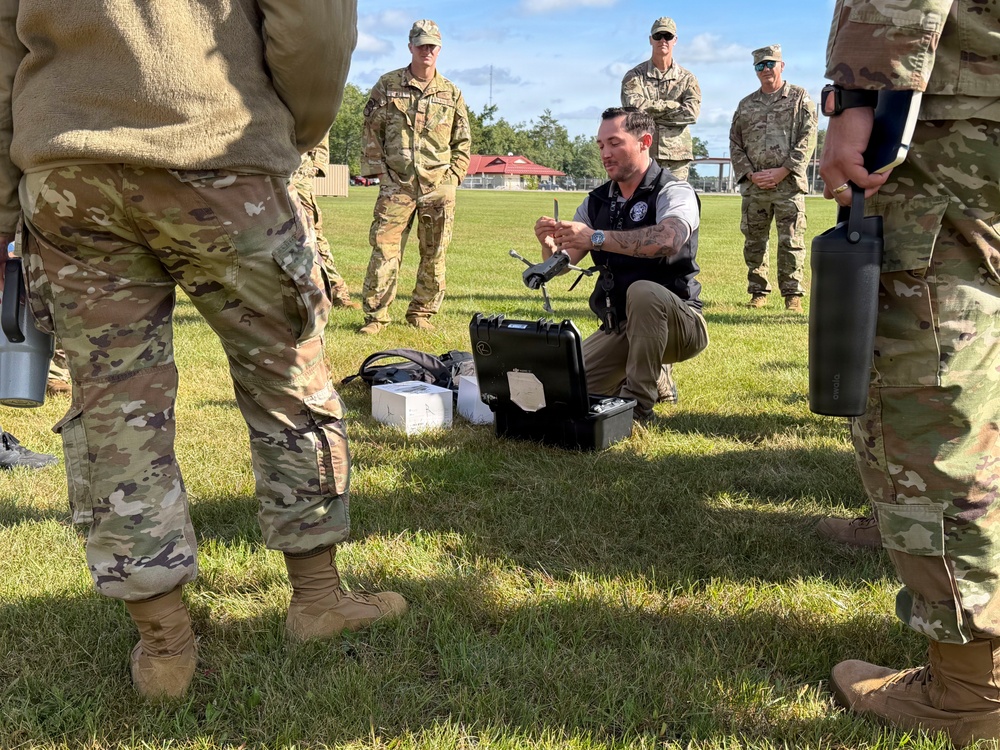
At a Sept. 22 city council meeting in Pflugerville, Texas, an Amazon executive told members that the company's delivery drones cannot take pictures. Amazon's own public Prime Air operations page, as quoted by DroneXL, describes something different: cameras that may record the people, pets and cars near a delivery point, with the images used to improve Amazon services.
The two statements are not necessarily incompatible, and the gap between them is easy to state. Whether they can be reconciled matters, because Amazon is considering drone deliveries in this Austin suburb, and the council heard the pitch about four weeks after it dropped a surveillance vendor.
What Amazon told the council
According to Community Impact's Sept. 24 report, Sam Bailey, Amazon's senior manager of economic policy, presented Prime Air to the council on Sept. 22. He said Amazon has delivered by drone since 2022, that the aircraft, the MK30, is 100 percent electric, and that it carries items up to 5 pounds, delivering in 60 minutes or less within a 7.5-mile radius of the fulfillment center.
The drones do have forward- and rear-facing cameras and sensors, Bailey acknowledged. But he described them narrowly: "It can't scan faces, look at license plates, or take pictures or images... strictly there for safe navigation and obstacle avoidance." Community Impact also reported that flight monitors cannot see live footage.
Council member Kimberly Holiday responded: "We're going to need you to prove that for us, with the surveillance stuff... With everything that just went on with Flock."
What Amazon's own page says
DroneXL reports that Amazon's public Prime Air drone delivery operations page, live as of Sept. 28, says MK30 cameras may record "people, pets, cars, and objects near the delivery or landing location," and that Amazon uses the images to improve "drone delivery and other Amazon services." We did not independently load that page, so the wording here is DroneXL's quotation of it.
According to DroneXL, the page offers an opt-out at your own address but none for a neighbor's, meaning people near someone else's delivery point.
Community Impact reports that Prime Air operates under an FAA Part 135 Air Carrier Certificate, and the FAA decision describes the MK30 as operating beyond visual line of sight under that certificate and a Section 44807 exemption.
Read side by side, "can't take pictures or images" and "may be recorded" describe the same cameras in different terms. One statement says the sensors exist only for navigation. The other, as DroneXL quotes it, says imagery is collected and used to improve "other Amazon services," a phrase that goes further than obstacle avoidance. DroneXL, which framed the contradiction on Sept. 28, argued the two statements can both be true only if "take pictures" means something narrower than "record"; that is its own analysis. DroneXL also cites Amazon spokeswoman Lindsay Hamilton, quoted by the New York Times in September, as saying "the images sit on encrypted drives that only authorized staff can access." We have not independently obtained a response from Amazon on how the two descriptions fit together.
The operating envelope: the FAA's Texas decision
The scale of what is planned comes from the FAA. On Feb. 5, 2026, the agency issued a Finding of No Significant Impact and Record of Decision for Amazon Prime Air's multi-metro Texas operations. It amends Prime Air's operations specifications (B050) to authorize deliveries from 22 locations in Texas. Two of them are in Pflugerville: STX6 at 18625 Schultz Lane, and AUS2 at 2000 East Pecan Street, both ZIP 78660.
The document lays out what Prime Air anticipates: up to 1,000 delivery flights per operating day, seven days a week, from each of the 22 sites, which works out to about 365,000 operations per year per site. Operations would run from 7 a.m. to 10 p.m. The MK30's range is 7.5 miles from a site, and the potential operating area is 174 square miles. The FAA found no significant impacts and prepared no environmental impact statement. Expansion beyond the 22 locations may require additional OpSpecs amendments and NEPA review.
Those are anticipated figures for the approved envelope, not counts of flights that have happened. But they frame the practical question for residents: a camera-equipped aircraft that may record whatever sits near a drop point, flying on the order of a thousand deliveries a day from a single site, is a very different privacy proposition from an occasional pilot program.
The Flock backdrop
Holiday's reference to Flock explains the tone of the exchange. DroneXL, citing Community Impact, reports that Pflugerville's council voted unanimously on Aug. 25 not to renew its Flock Safety license-plate-reader contract after outside agencies searched the city's camera data nearly 1.6 million times in six months. We did not read the underlying Flock article, so that figure is DroneXL's sourcing.
DroneXL also reports that council member David Rogers identified the site under discussion as the lot north of the STX6 warehouse at 18625 Schultz Lane, south of Toll Road 45, and that the council of Richardson, Texas, asked Amazon the same camera question in March.
Why It Matters
Drone delivery is moving from pilot to infrastructure, and local governments are being asked to accept it largely on the operator's description of what the aircraft do. In Pflugerville, that description came from Amazon's senior manager of economic policy at a council meeting, and per DroneXL it did not match the operator's own published language. Council members who had just cut ties with a surveillance vendor over data-access concerns noticed, and asked for proof.
The distinction is not academic. Whether a drone "takes images" and whether it "records" people near a delivery point are the same question asked two ways. Navigation cameras whose images are kept and used for service improvement, as DroneXL's reading of Amazon's page implies, create a data set, regardless of whether anyone monitors a live feed or the system scans faces. The Flock episode showed how data collected for one purpose can be searched by others; the natural questions for Prime Air are what is retained, for how long, who counts as authorized staff, and whether non-customers near a drop point have any recourse.
Bailey's statement that monitors cannot see live footage answers one question, not the others. Councils in Pflugerville and Richardson have now asked the same thing, and a documented answer would settle it faster than dueling descriptions.
Sources
- FAA Finding of No Significant Impact / Record of Decision, Amazon Prime Air multi-metro Texas (Feb. 5, 2026)
- Amazon outlines potential drone delivery service for Pflugerville (Community Impact, Sept. 24, 2026)
- Amazon Told Pflugerville Drones Take No Images. Its Own Site Disagrees (DroneXL, Sept. 28, 2026)
