
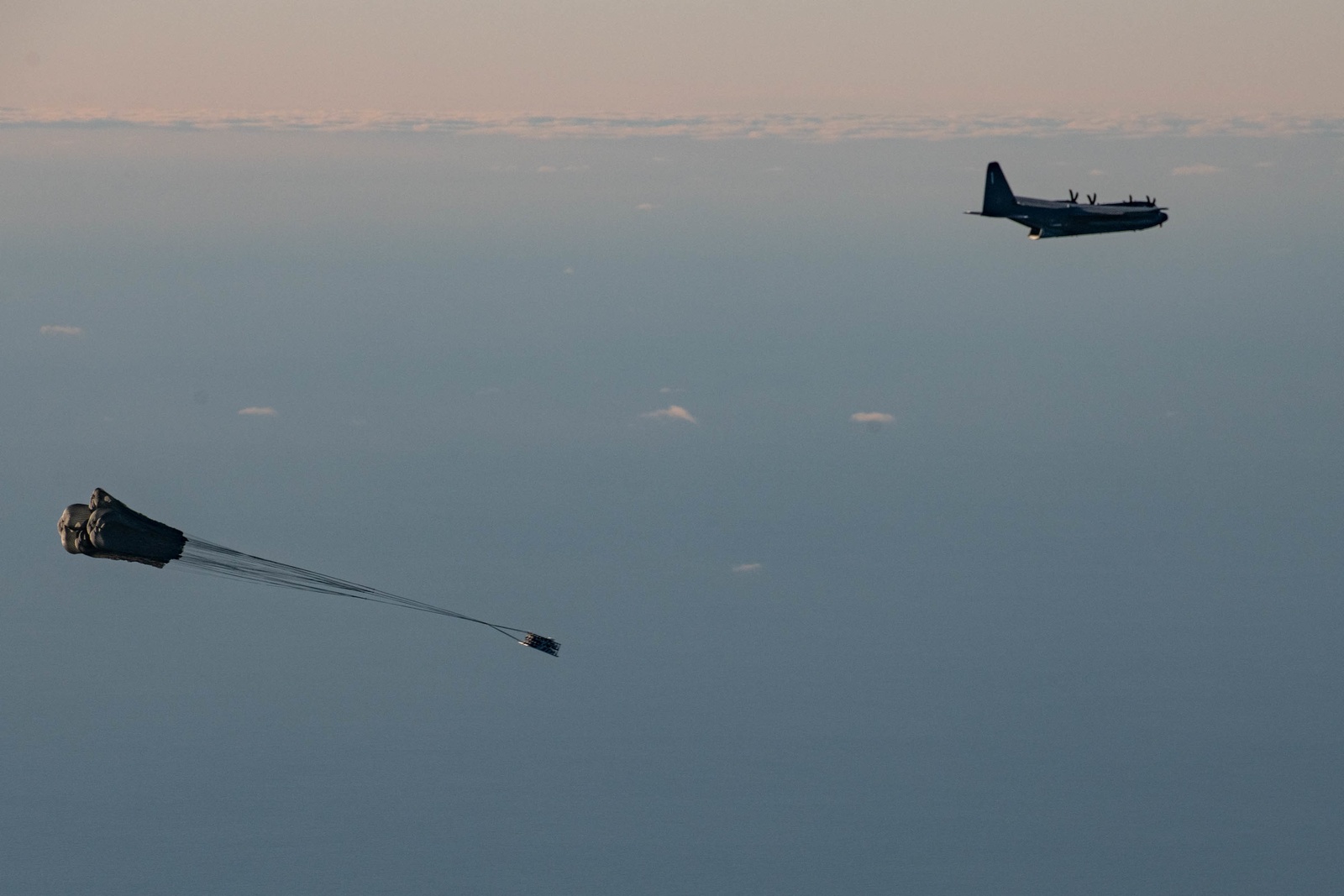
The Department of the Air Force has published a small-business research solicitation seeking a capability that reads more like a script for a near-future base-defense scenario than a typical procurement notice: drone swarms that launch from cargo and tanker aircraft mid-flight, autonomously organize themselves into coordinated formations, and then loiter over a designated patch of ground to watch for threats — all without a human flying any single vehicle.
The topic, DAF26BX06-DV026, titled "Ground and Air Launched Drone Swarms Create a Self-Protecting Perimeter Using Autonomous AI," appeared on SAM.gov as part of the Department of the Air Force's 2026 SBIR Commercial Solutions Opening, Release 6. It is a narrowly scoped ask on paper — build a swarm that can be launched from a mobility aircraft, fly itself, and guard a perimeter — but the operational picture behind it is a familiar one to anyone tracking Air Force basing strategy: forward locations that need protection fast, without the footprint of a permanent garrison.
What the Solicitation Actually Asks For
According to the SBIR topic breakdown published by drone-industry tracker DroneIntelligence.ai, the requirement centers on two connected capabilities. First, the drones have to survive and stabilize after being released from a moving aircraft — specifically mobility platforms like the C-130 Hercules and KC-135 Stratotanker — and transition from that release into coordinated, swarm-level flight without individual operator input. Second, once airborne and organized, the swarm has to actually do something useful: monitor and defend a designated ground perimeter using onboard visual and thermal sensors, passing what it observes back over encrypted military communications links. That combination — air-launch survivability plus autonomous coordination plus a persistent defensive-sensing mission — is what separates this from a conventional ISR (intelligence, surveillance, reconnaissance) drone buy. The swarm isn't just gathering imagery for later analysis; it's meant to function as a live, self-organizing security layer around a piece of ground, presumably a forward operating location, an austere airstrip, or another site where standing up conventional perimeter security would take longer than commanders want to wait.
Independent SBIR-tracking firm BWCO Consulting, in its own breakdown of the topic, confirms the same core requirement: autonomous transition from aerial release into coordinated flight, followed by perimeter defense using visual and thermal sensors over secure, encrypted communications. The convergence of two independent trackers on the same technical description gives a clearer picture of what the government is actually specifying, beyond the topic's own title.
A Direct-to-Phase-II Structure, and What That Signals
The topic is structured as a Direct-to-Phase-II award, meaning there is no Phase I feasibility-study money attached. Companies bidding on it have to show up with technology that already works. Per DroneIntelligence.ai's summary, the topic requires a minimum Technology Readiness Level of 5 at entry, with a target of TRL 7 by the end of performance, and requires applicants to submit deployment records documenting "verifiable active use of the proposed swarm technology in demanding environments" — not lab demonstrations or simulation results. Awards top out at $2,000,000 per award, with a maximum 24-month period of performance. Submissions open September 23 and close October 21, 2026, a roughly four-week window that is typical for SBIR Commercial Solutions Opening cycles but still a tight timeline for companies that haven't already been quietly developing this exact capability. Skipping Phase I and demanding TRL 5-plus systems with field deployment history is the Air Force's way of signaling it isn't interested in funding early-stage research on this particular problem. It wants vendors who have already flown something like this — likely in adjacent contexts, such as expeditionary ISR or counter-UAS testing — and who can adapt that hardware and software to the specific air-launch-and-swarm mission within two years.
The Reporting Behind the Topic
DroneIntelligence.ai's writeup cites Defense News reporting by Michael Peck, published September 9, 2026, describing mobility aircraft as "adaptive, force-multiplying launch platforms providing a rapidly deployable swarm for base security." That framing — cargo planes as launch platforms rather than just haulers — points to a broader logistics-meets-combat-power concept: instead of pre-positioning ground-based counter-UAS or perimeter-security assets at every forward site, the Air Force could fly defensive drone swarms in on the same aircraft delivering fuel, ammunition, or personnel, and release them en route or on arrival.
That concept isn't happening in isolation. The Army has also published on the subject, in a piece titled "Swarm Technology in Sustainment Operations" on Army.mil, reflecting a wider pattern across the Department of Defense: multiple services are exploring autonomous swarms as a way to extend security coverage to logistics nodes and forward locations without permanently stationing large numbers of troops or fixed sensor infrastructure there.
Why It Matters
Forward and austere basing is central to current Air Force posture planning, and every forward site is a target the moment it starts operating — for saboteurs, small drones, or conventional ground threats. Standing up perimeter security at a new or temporary location has traditionally meant flying in personnel, sensors, and fencing, all of which take time and lift capacity that mobility aircraft are already stretched thin providing.
A drone swarm that launches from the same C-130 or KC-135 already inbound with cargo, then autonomously organizes into a sensing perimeter using thermal and visual feeds over secure links, would compress that timeline from days to minutes — at least for detection and warning, if not response. It would also mean commanders don't have to choose between airlift capacity for supplies and airlift capacity for security personnel; the aircraft would, in effect, deliver both. The Direct-to-Phase-II structure and TRL 5+ bar are the more consequential part of the story for the defense-tech industry watching this topic: the Air Force is telling vendors it wants something close to deployable now, not a multi-year research program. Companies with existing swarm autonomy or air-launch experience have a four-week window, opening September 23, to make the case that their systems are ready.
