
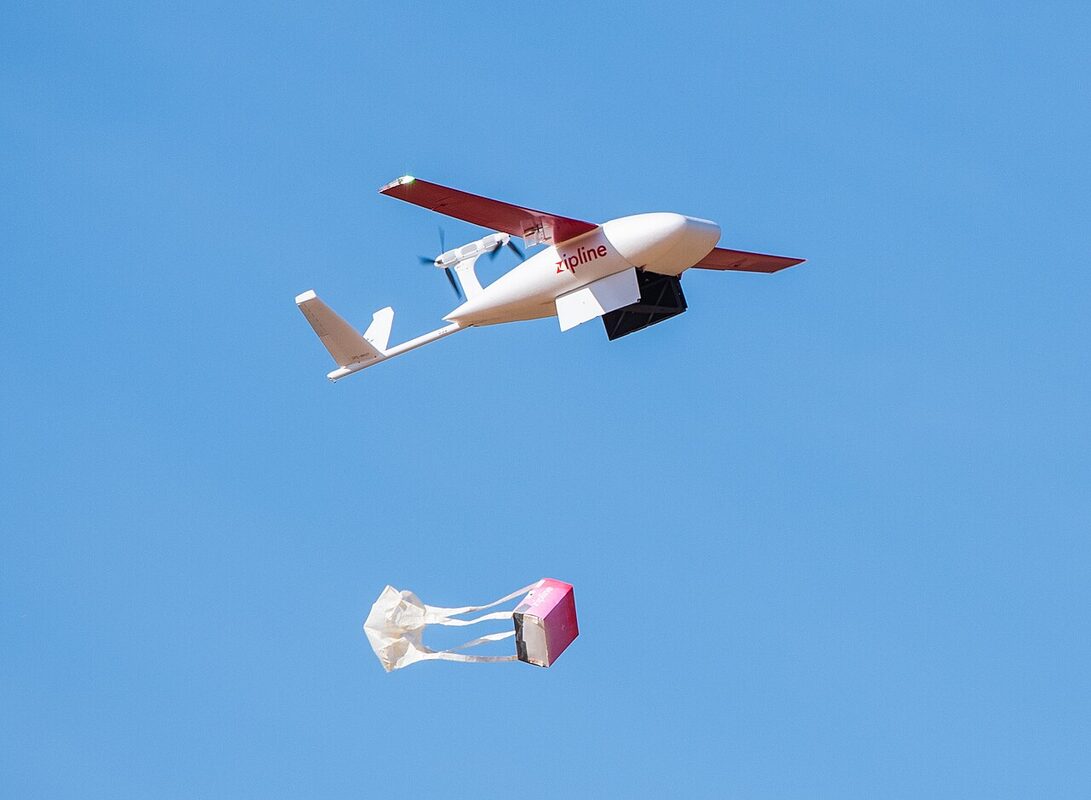
Zipline does not deliver a single package in Arizona today. Even so, the Federal Aviation Administration has published a draft environmental assessment that would let the company fly up to 130,000 drone deliveries a day over metro Phoenix and Tucson. That ceiling is far larger than anything the agency has reviewed in the state before. The draft also has some problems: its comment deadline doesn't match the one on the FAA's own web page, and parts of it still carry text from an earlier review of Zipline's Texas operations.
The document, dated November 2026, covers a proposal to amend Zipline's Part 135 operations specifications. Part 135 is the air carrier certificate Zipline already holds, and the amendment would add two new Arizona operating areas. The proposal would let Zipline fly its Platform 2 aircraft in both. The ceiling for each metro is the same: up to 65 Chargers, 1,300 Dropboxes and 65,000 deliveries per day.
What the numbers actually say
The draft has a table that breaks the proposal down by metro:
- Phoenix: 1,540.17 square miles, up to 65 Chargers, 1,300 Dropboxes, 65,000 deliveries and 195,000 transits per day.
- Tucson: 553.72 square miles, with the same 65 / 1,300 / 65,000 / 195,000 figures.
Together that comes to 130 Chargers, 2,600 Dropboxes, 130,000 deliveries and 390,000 transits a day. Transits outnumber deliveries three to one because the analysis counts each delivery as three flight legs. DroneXL laid out that math, and later roundups such as QUE.com repeated it.
Both metros get the same delivery cap, but Tucson covers about a third as much area. That makes the density very different. DroneXL calculates about 117 deliveries per square mile per day in Tucson and about 42 in Phoenix. The densest area in Zipline's earlier Texas draft was El Paso, at 47.7 deliveries per square mile per day. Houston was at 6.5. The Tucson figure is roughly two and a half times the El Paso figure.
The draft defines nighttime as 10 p.m. to 7 a.m. According to DroneXL's reading, about 5 percent of flights would happen in that window. At the full ceiling, that works out to about 6,500 overnight deliveries a day across both metros. This matters for noise: the effect of a drone passing overhead at 3 a.m. is judged very differently from the same flight at 3 p.m.
The aircraft
The proposal covers Platform 2, Zipline's home-delivery system. In this design, a larger aircraft hovers high above the delivery point and lowers a smaller droid to the ground. The draft describes an aircraft of about 63 pounds including its 8-pound maximum payload, and DroneXL reports that it cruises at 330 feet and about 70 mph. In the draft, Chargers are the docking and charging points for the aircraft, and Dropboxes are the kiosks where packages are picked up or dropped off.
Which deadline is right?
Anyone planning to comment should look at this part closely. The draft EA says the 30-day public review starts Friday, November 6, 2026, and ends Monday, December 7, 2026, with comments due by 5:00 p.m. Central time. That is 4 p.m. in Arizona, which doesn't observe daylight saving time. The document doesn't explain why an Arizona review uses a Central-time deadline. DroneXL also found that the FAA's web page for the project gives December 9 as the deadline.
As far as DroneXL's reporting shows, the FAA has not reconciled the two dates. The safest course is to file before the earlier one, 4 p.m. Arizona time on December 7. The document names FAA official Derek Hufty as the point of contact.
Leftovers from Texas
The Central-time deadline is one of several signs that the draft was adapted from an earlier one. The Arizona document refers readers to "Appendix G, Texas Metro Areas Airports." DroneXL also found a wildlife passage that gives the blue jay's scientific name for the common grackle, and a reference to "autoloaders," which DroneXL describes as the FAA's word for Wing's pickup hardware, not Zipline's.
None of these errors changes the operational ceiling. They do make it harder to trust the rest of the analysis. An environmental assessment has one job: show that the agency looked closely at the specific place it is approving. A document that still lists Texas airports in its Arizona appendix doesn't give much confidence on that point. Commenters will probably say so.
The wildlife section has its own inconsistency. It cites 65,000 flights per day "across metro areas." The operations table, however, assigns 65,000 deliveries to each metro, and every delivery counts as three transits. Depending on how it is read, the wildlife figure could be an undercount by a factor of two or six, or it could be shorthand for the per-metro figure. The draft doesn't say which.
A ceiling, not a forecast
The 130,000 figure is a regulatory upper bound, not a projection of demand. Companies seeking these reviews generally ask for the most they could plausibly need, because amending a certificate and redoing an environmental assessment later is slow and expensive. If the analysis covers the upper bound, the FAA can sign off once and Zipline can grow within that limit without going back.
Zipline isn't operating in Arizona yet. Zipline's Zach Hill told 12News, as reported by DroneXL, that the company hopes to begin serving Arizona in early 2027. He also said Zipline now makes a delivery somewhere in the world every 15 seconds. That rate is about 5,760 a day worldwide, which is less than a tenth of what the company wants permission to do in Phoenix alone.
The only earlier Arizona drone-delivery review on the FAA's project list, per DroneXL, gives a sense of scale. In November 2024, the FAA approved Amazon's Prime Air hub at Tolleson, west of Phoenix, for 469 flights a day. DroneXL notes that Zipline's request is roughly 277 times larger.
Why It Matters
The National Environmental Policy Act review is where drone delivery's real limits get set. Zipline already holds Part 135 authority. The open question is how many flights, over which neighborhoods, and at what hours. An environmental assessment that clears 130,000 daily deliveries across two metros would be a template. If it holds up, other operators will point to it, and the FAA will have accepted metro-wide, high-density delivery as an environmental baseline in a state where its previous approval topped out at a few hundred flights a day.
That makes the document's quality important. The clearest test for public comments is Tucson's density, at more than twice the busiest Texas area. Others are the overnight flights and the wildlife analysis that seems to undercount the flights it is assessing. The copied Texas text and the conflicting deadlines don't decide the outcome on their own. But people in Phoenix and Tucson will have reason to wonder how carefully their area was analyzed. The FAA can deal with that most simply by correcting the document and settling on one deadline.
For now, Arizona residents, local governments and airport operators can comment on a proposal that would put up to 390,000 drone transits a day over their region. Until the FAA says otherwise, they should assume they have until 4 p.m. Arizona time on December 7.