
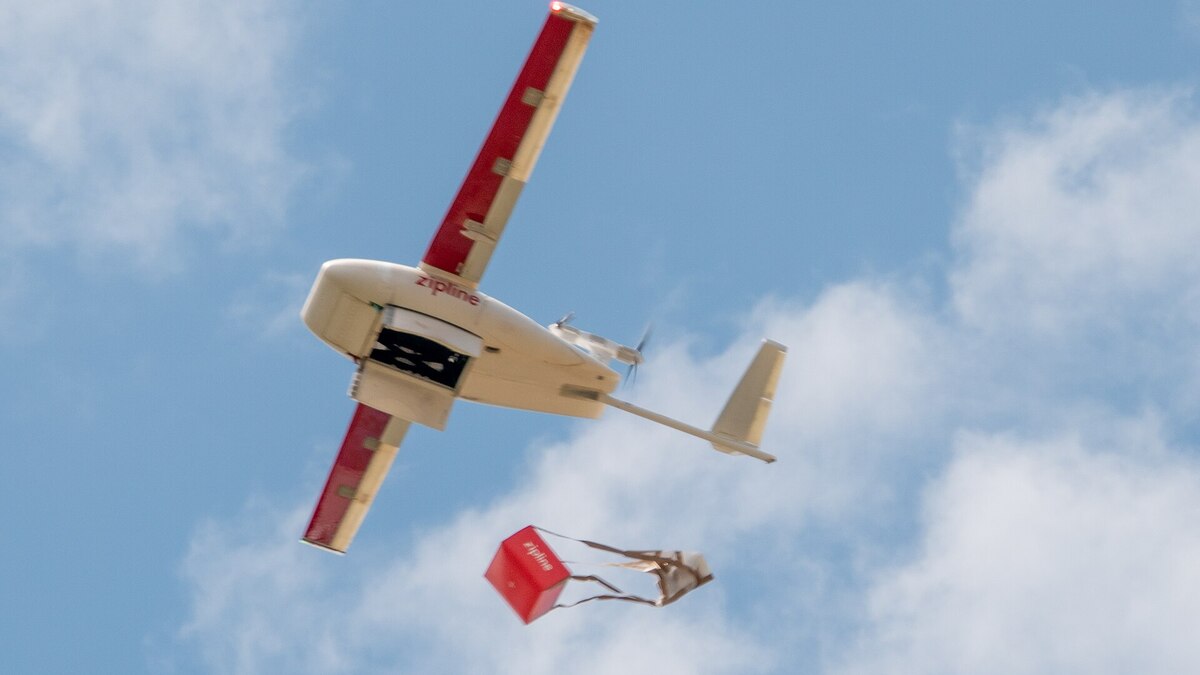
Zipline has hired an Uber executive to lead an expansion of its African drone network that targets at least 20 new hubs. That expansion depends on governments paying their bills, and in Ghana, where the company built one of its earliest national networks, the government has been behind on payments.
Anthony le Roux, who has spent 13 years at Uber and now leads the ride-hailing company's Group Transportation business, will join Zipline as Head of Operations for Africa in January 2027, The Condia reported. He opened Uber's Cape Town operation in 2013. At Zipline he is expected to stand up at least 20 new "nests," the company's name for its launch-and-recovery distribution hubs, within two years, according to DroneXL. He is also recruiting three senior executives, for deployment, service delivery and logistics, to build out the leadership team under him.
What Zipline Has Actually Signed
The 20-hub target is much larger than what Zipline has formally agreed. Le Roux told TechCabal, as relayed by DroneXL, that Cote d'Ivoire is the only market formally agreed. It has approved a 10-hub network: nine new nests plus the existing site at Daloa. DroneXL reports the first phase of that build, covering Daloa plus three new sites, runs 27 months, which is longer than the two-year window for the full 20-hub goal. The other ten or more hubs have no announced host countries yet; le Roux named none while talks are open.
Zipline's stated ambitions for the expanded network are large. The company says the full program will reach more than 130 million people and 20,000 health facilities and delivery sites and create more than 800 skilled jobs, per The Condia. Caitlin Burton, CEO of Zipline Africa and Emerging Markets, said in a statement that le Roux has "a proven track record of scaling transformative technologies in Africa and beyond," DroneXL reported.
Each hub is effectively a contract with a government. Zipline's African networks deliver blood, vaccines and medicines for national and state health systems, and governments pay for the flying, according to DroneXL. That arrangement gives Zipline steady demand and political backing. It also leaves the company dependent on a government's budget, its payment record and the politics around both.
The Ghana Problem
Ghana shows what happens when that dependence goes wrong. On November 25, 2025, during Parliament's debate on the 2026 Budget, Dr. Ayew Afriye of the health committee said the government owed Zipline GH¢175 million while the budget allocated GH¢20 million. The company had begun decommissioning three of its Ghana operational centres, citing a lack of government funds, MyJoyOnline reported.
Eight months later the issue was still open. On July 30, 2026, Health Minister Kwabena Mintah Akandoh told Parliament the government is taking steps to mobilise funds to pay what it owes Zipline Ghana Limited, the Ghana News Agency reported. The agency put the debt at about GH¢175 million and said it had forced the shutdown of three distribution centres. Akandoh said some payments had recently been made but that the Ministry still owed money as of March 2026. The service agreement was signed in 2018 for four centres and expanded to eight in 2020. Akandoh also said Zipline was underperforming, with only 10 per cent of its services covering hard-to-reach areas and 4 per cent classified as emergency deliveries, so the payment dispute is not one-sided.
In other words, the GH¢175 million figure has stood since at least November 2025 and has already cost the country hubs. Zipline now runs three centres in Ghana, at Omenako/Suhum, Mpenya/Mampong and Vobsi/Walewale, according to the Ghana News Agency. And Ghana is not a marginal market for Zipline. MyJoyOnline described the service, inaugurated in April 2019, as having been touted globally as a flagship partnership.
Why an Uber Operator
Le Roux's background explains the hire. He opened Uber's Cape Town operation in 2013, then ran Eastern Europe from Warsaw and the Middle East and Africa region from Dubai, according to The Condia. He told TechCabal that aviation and fixed infrastructure are new to him, but argued that hiring local teams and dealing with regulators carry over from ride-hailing, DroneXL reported. Zipline appears to want someone who has repeatedly opened new markets.
The hire also follows closer financial ties between the two companies. Uber took part in Zipline's $1.5 billion funding round, which closed on November 5 at a $21.5 billion valuation, The Condia reported. Uber has also said it wants one million Zipline deliveries a day by the end of 2029, with drone delivery coming to Uber Eats. That target is tied to Uber's consumer delivery business rather than Zipline's government health contracts in Africa. Still, Zipline now counts Uber among its investors and customers, and it has hired one of Uber's operations leaders to run its African network. The Condia notes that Zipline said none of the new round's money is earmarked for Africa.
Why It Matters
The question for the African expansion is less whether Zipline can build hubs and more whether governments will keep paying for them. The Condia says the expansion runs mainly on a $150 million pay-for-performance award from the US State Department, announced in November 2025, which covers upfront costs, with African governments expected to cofinance through multi-year service contracts. Collecting payment from governments is a commercial and political risk that a good operator cannot fully control, and le Roux himself told TechCabal that without strong government backing, the product is "just not going to be a feasible product to go and launch."
Ghana shows the cost when payments fall behind. Hubs that had been delivering medical supplies were shut. The government is left with a debt to clear and a service that now covers less of the country. Any government considering a Zipline contract, and any investor valuing Zipline's government business, can see that example.
There are three things to watch over the next two years:
- Signed contracts beyond Cote d'Ivoire. Ten of the promised 20-plus nests have a host government. The rest do not yet.
- Contract structure. It is not yet clear whether new agreements will include stronger payment protections than Ghana's 2018 deal, which is due to expire in September 2027 with arrears still outstanding.
- Ghana itself. If Ghana pays the debt and the three closed centres reopen, Zipline can argue that its model survives a payment crisis. If the debt drags on, other governments have less reason to keep paying on time.
Le Roux starts in January. His first priorities are likely to be the 27-month first phase in Cote d'Ivoire and filling three senior leadership roles. His bigger job will be persuading more governments to sign long-term delivery contracts and then pay them on schedule.
Sources
- Zipline hires Uber's Anthony le Roux to run its Africa operations (The Condia, Nov 18 2026)
- Zipline Hires Uber Veteran For 20 African Hubs While Ghana Owes It (DroneXL, Nov 18 2026)
- Health Minister assures Parliament of plans to settle Zipline debts (Ghana News Agency, July 30 2026)
- Zipline grounds drones at 3 key hubs as state debt hits GH¢175m (MyJoyOnline, Nov 25 2025)
