
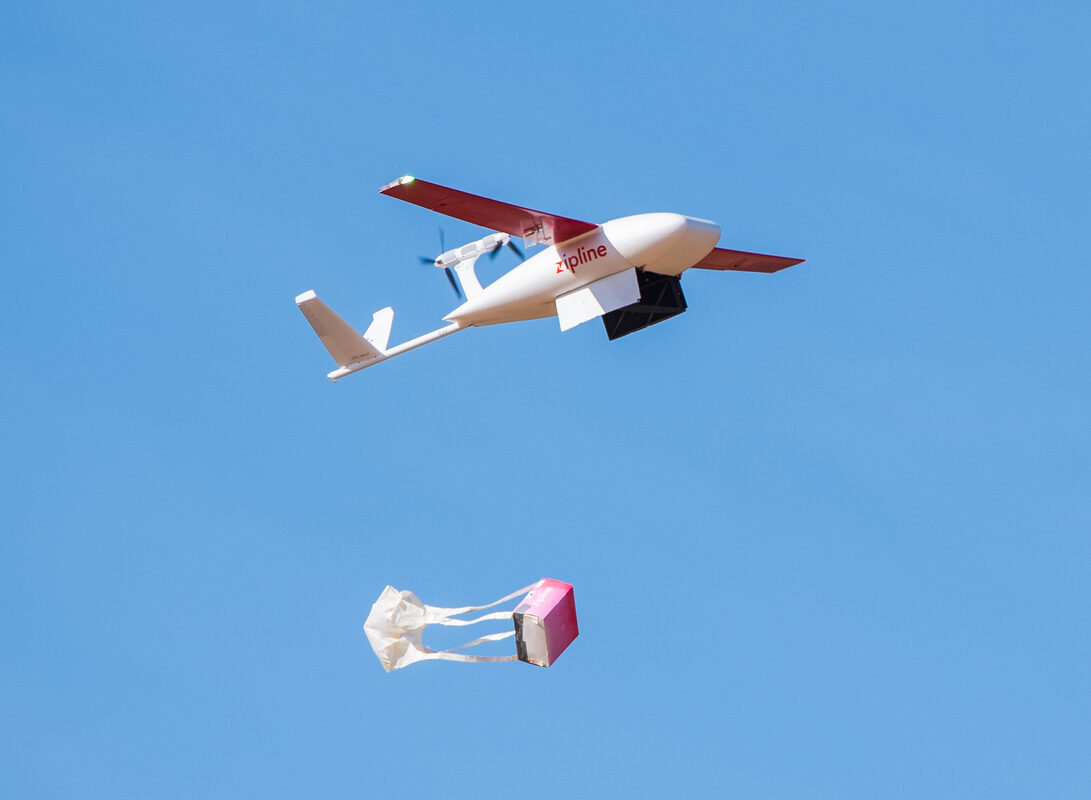
Wing, the Alphabet drone-delivery company, now has a partner and a deadline for Japan. On Oct. 27 Japan time, KDDI, its drone subsidiary KDDI SmartDrone and Wing Aviation LLC announced a strategic partnership. The goal is to start drone delivery in some areas of Japan during 2027. Wing's own post, dated Oct. 26 in US time, describes the target as launching "in select areas in Japan by end of 2027" and then expanding across the country "in coming years."
The KDDI SmartDrone release names three chief executives as heads of the parties: Matsuda (松田 浩路) of KDDI, Hirono Masafumi (博野 雅文) of KDDI SmartDrone and Adam Woodworth of Wing. It names one retailer, Lawson, whose products will be among the groceries and daily goods carried. It gives no launch city, no fleet size, no price to customers and no delivery-time target for Japan. What follows covers what was announced, what wasn't, and why the structure of the deal matters.
Who brings what?
The division of labour follows each company's strengths. Wing supplies the aircraft, the operations software and the ground stations it already runs in the United States. KDDI, one of Japan's big mobile carriers, supplies its LTE network, handling of the regulatory process and its ties with local governments.
The network matters most. KDDI's release cites its mobile network for use in the sky as a basis for beyond-visual-line-of-sight (BVLOS) flight. It also points to drone ports across the country and to its record of flying remote disaster surveys. DroneXL reports that KDDI SmartDrone runs a drone school at more than 20 sites and flew flood-survey missions in Ishikawa in September. So the Japanese side is not starting from scratch. It already has the pilots, the airspace experience and working links with local governments that a foreign operator would otherwise have to build.
Wing brings scale. According to the KDDI release, Wing has made more than 1 million residential deliveries and now makes thousands a day across five US markets, typically within 30 minutes. That 30-minute figure describes Wing's US operations, and neither company has applied it to Japan.
Why is Lawson the only retailer named?
Ownership is the likely explanation. As DroneXL points out, KDDI and Mitsubishi signed a capital partnership over Lawson on Feb. 6, 2024. A tender offer at 10,360 yen per share closed in May 2024, and the two companies now each own 50 percent of the convenience-store chain. For KDDI, adding Lawson to the drone deal means routing deliveries through a business it co-owns.
Both the release and an independent report from Japanese drone outlet DRONE.jp describe Lawson products as being among the goods carried, not the only goods. The release also says the service will later expand with local governments and regional partners. Even so, Lawson is the only commercial name on the page. DroneXL's author concludes that the first version of the service will probably carry only Lawson goods. That is the outlet's analysis, not something the companies have said, but nothing in the announcement contradicts it.
What problem is this supposed to solve?
The release frames the service around three social problems, and DRONE.jp repeats all three:
- Food access. About 9.04 million people in Japan have difficulty getting to food shops. This is the country's long-running "shopping refugee" problem, concentrated in ageing and depopulating areas.
- Time poverty. Dual-income households have little time for errands.
- The "2024 logistics problem." DroneXL ties this to a 960-hour cap on driver overtime that took effect in April 2024, which tightened capacity across Japan's delivery networks.
Wing's post leans on the logistics problem as well. Put together, the pitch is that drones can take over some of the short, low-weight trips that a shrinking pool of drivers can no longer cover economically.
Can Wing legally fly this in Japan today?
The legal path exists, but it is demanding. DroneXL notes that Japan has allowed autonomous flights over inhabited areas since Dec. 5, 2022, under what the regulator calls Level 4. Flying at Level 4 requires three things: Class 1 certification of the aircraft, a Class 1 pilot licence and permission for the specific flight. Any Wing aircraft flown over Japanese neighbourhoods would need to clear that certification process.
Wing's post is careful here. It says the partners bring their expertise "as Japan develops a safe, scalable regulatory framework for drone delivery." In other words, Wing describes the framework as still being built, not finished. That wording, along with a launch date more than a year away, suggests certification and approval work makes up much of the time before launch. Neither company has said where Wing's aircraft stand in Japan's certification process.
How big a step is this for Wing?
Internationally, it is a significant one. DroneXL reports that Wing's locations page lists five US metro areas with active service, 14 more coming, and none outside the United States. If the Japan service launches, it would be Wing's first new country since Ireland, where it began operating in Lusk in 2022, according to the outlet.
Both companies' wording points to a deliberate, phased entry: "some areas" in 2027 in KDDI's version and "select areas" in Wing's, followed by broader expansion. Neither describes a fast nationwide rollout.
What is still missing?
The announcement leaves out most of the operational details that would decide whether this becomes a real service or stays a pilot programme:
- No launch city or region has been named.
- No delivery fee or customer pricing has been disclosed.
- No Japan-specific delivery-time target has been given. The 30-minute figure applies to Wing in the US.
- No retailers other than Lawson have been named, and no local governments have been identified.
- No aircraft certification timeline has been published.
Why It Matters
Japan has been an obvious market for drone delivery for years. Its population is ageing, rural areas are emptying out, the driver labour market is tightening under the 2024 overtime rules, and a Level 4 legal framework for flights over inhabited areas has been in place since late 2022. Wing brings a residential delivery business with more than 1 million deliveries behind it. This deal pairs it with a carrier that owns the network, the regulatory relationships and half of a national convenience-store chain.
That vertical setup is the most important part of the announcement. In Japan, KDDI can provide the network connectivity, the regulatory handling, the government ties and, through Lawson, the merchandise. On that reading, it cuts down the number of outside parties that have to agree before the first drone takes off. The trade-off is that early service may be closely tied to Lawson, and whether the service grows beyond KDDI's own stores will be the test.
The end-of-2027 date is the number to watch. Before then, the useful signals will be a named launch area, progress on Class 1 certification for Wing's aircraft, and any retail or local-government partner whose name isn't Lawson.
