
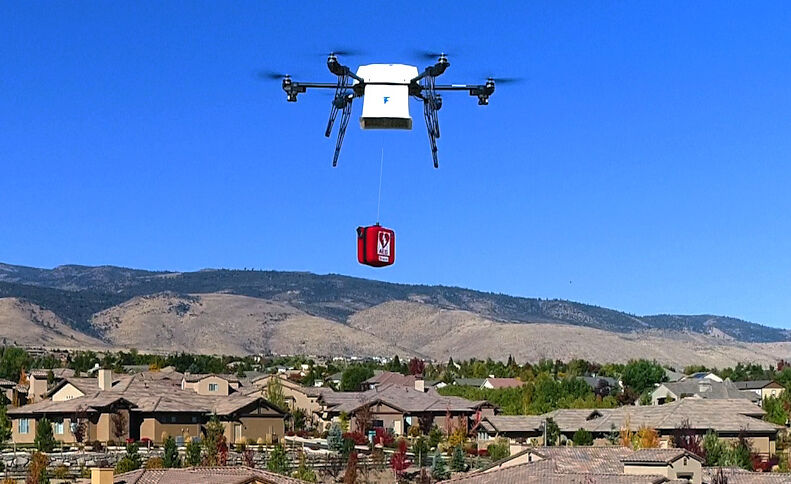
Wentzville, Missouri, a city in western St. Charles County in the St. Louis area, is writing its drone-delivery rules before any application has arrived. On the night of Oct. 21, the city's Board of Aldermen passed first reading of Bill 4914, a zoning measure that would make drone-delivery bases a conditional use. Operators would need a city permit, proof of FAA approval, insurance, and noise testing at the proposed launch site and at nearby homes.
The bill comes out of a specific request. According to city Planning and Zoning minutes reported by DroneXL, Wing, the Alphabet-owned delivery operator, pitched an 18-drone "nest" at the Wentzville Walmart on June 8. Separately, Kirkwood's city council let a Walmart drone-station permit die without a motion on Oct. 15. That leaves Wentzville as the next place in the St. Louis area where a city decides how drone delivery fits into local zoning.
What Wing proposed in June
The June 8 minutes describe a presentation by Catherine Lovett, Wing's manager of local policy. She proposed an 18-drone nest beside the store's curbside pickup area. In her description, aircraft would cruise at 150 to 200 feet and deliveries would take five to 15 minutes.
The commission did not approve a site. It voted 6-0 to have city staff write a zoning category for this kind of facility. Wentzville's code had no category for a cluster of charging pads and autonomous aircraft next to a big-box parking lot, so the city chose to create one before ruling on any specific application.
The minutes also contain a figure that doesn't match Wing's own. They record a payload of 2.3 pounds. Wing's Oct. 5 announcement says its aircraft carry "up to five pounds," which is about 2.3 kilograms. DroneXL's reading is that the minutes, a recording secretary's summary rather than a transcript, recorded the kilogram figure as pounds; the minutes do not say which unit was used. The difference matters for anyone trying to work out what these aircraft can carry over a subdivision. Kirkwood's draft permit used a third number and capped deliveries at 2.5 pounds.
What Bill 4914 actually does
Bill 4914 regulates land use. As reported by First Alert 4 and DroneXL, it would:
- Classify drone-delivery bases as a conditional use, so each proposed site needs its own permit and review instead of being allowed by right in a commercial zone.
- Require operators to show FAA approval for their operations.
- Require insurance.
- Require noise testing at the proposed launch site and at nearby residences, plus a noise study as part of the application.
DroneXL points to the bill's applicability language, which covers operations delivering "to properties within the City." A literal reading could reach operators whose nests sit outside Wentzville but whose drones drop packages inside city limits. How the city would enforce a permit against a base in another jurisdiction is still an open question.
The bill also leaves things out. As described in the reporting, it sets no payload weight limit and no cap on how many drones can operate from one site. Kirkwood's draft permit did include a weight cap. Wentzville appears to be leaving fleet size and payload to the conditional-use review and to federal regulators.
The limit on what a city can regulate
At a Sept. 23 board meeting, City Attorney Jim Hetlage said the FAA has already authorized drones for commercial delivery, so the city's rules reach only the base where drones take off and land. That boundary shapes local drone-delivery disputes: the city's reach is the site, not the flights.
A city does control land use. It decides where a nest can go, how far it sits from homes, what screening or setbacks it needs, and whether its noise is acceptable to neighbors. Because of that, Bill 4914 focuses on what happens at the site. Noise testing near the launch pad and at nearby homes is one of the few ways a municipality can address flight effects without claiming authority over airspace. Takeoffs and landings concentrate the noise at the nest, and the nest is on land the city zones.
The FAA approval requirement works the same way. The city isn't adding its own airworthiness or operational standards. It is requiring evidence that the federal regulator has already signed off before it issues a local permit.
How the bill moved
The bill did not pass on its first try. DroneXL reports that the board postponed it on a 6-0 vote four weeks before the Oct. 21 first reading. Mayor Nickolas Guccione confirmed to First Alert 4 that the measure passed first reading on Wednesday night. The station reported a second consideration in about two weeks, and the board's next regular meeting is Nov. 4.
Passing the bill would not approve Wing's nest. It would create the process Wing, or any other operator, would have to go through. The 18-drone Walmart proposal would then need its own conditional-use application, noise study, and review.
The Kirkwood precedent and the wider rollout
Wentzville's bill was already moving before Kirkwood's decision, but the nearby outcome shows what is at stake. First Alert 4 reports that Kirkwood rejected Walmart's drone station the week before Wentzville's vote. DroneXL reports the council let the permit die without a motion on Oct. 15. According to the station, Walmart is also looking at St. Charles, Maplewood and Manchester. That means several St. Louis-area municipalities, each with its own code, council and residents, may face the same question within months.
The local fights are part of a much larger rollout. In its Oct. 5 release, Wing said it is adding the Denver and Seattle metros for 2027. That brings the Wing-Walmart network to nearly 20 major U.S. metros, with plans to reach more than 270 Walmart locations. Wing says more than three million customers already have access to the service.
Covering 270-plus stores means getting 270-plus sites through local land-use review. Federal approval handles the aircraft and the airspace. Each nest still needs local permission, and Kirkwood shows that local permission can be refused.
Why It Matters
Drone delivery is increasingly a zoning question decided by suburban aldermen and planning commissions. Kirkwood and Wentzville are trying two different approaches. Kirkwood handled a single permit and let it lapse. Wentzville is writing a general rule that sets a path to approval and puts conditions on it.
For operators, a conditional-use framework is predictable. The requirements are known in advance: FAA paperwork, insurance and noise data. The risk is that each nest becomes its own public hearing. For residents, the noise testing at nearby homes gives them a measurable way to object, which a general complaint about drones does not. For other cities, Bill 4914 could become a template. It leaves flights to the FAA and regulates the ground footprint.
The gaps in the bill matter as much as its requirements. With no payload ceiling and no limit on drones per site, an approved nest could in principle grow beyond the 18 aircraft Wing described in June, unless the conditional-use permit for that site says otherwise. The second reading around Nov. 4 will show whether aldermen are comfortable leaving those limits to case-by-case review. With Walmart looking at more St. Louis-area suburbs, other councils will be following how Wentzville decides.
Editor's note: DroneXL's coverage includes the outlet's own view that the bill should pass. That is opinion and is not reflected as fact in this article.
