
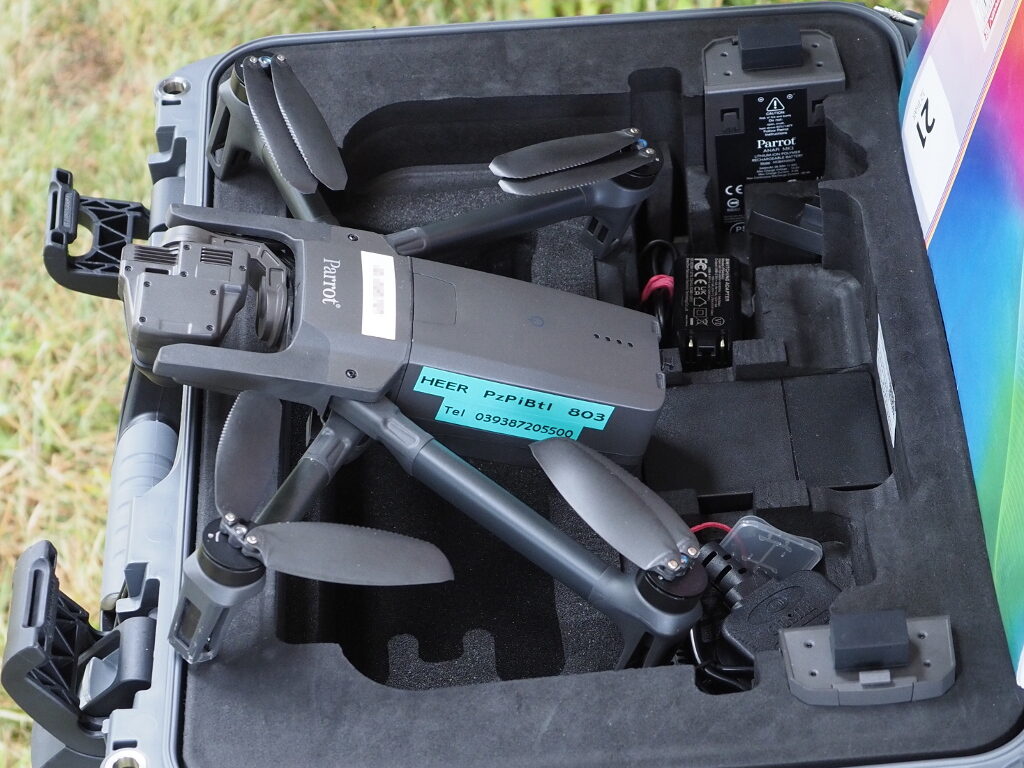
Drone-as-First-Responder programs have often been sold as subscriptions: an agency signs up for a service, and the hardware, software and support come in one recurring bill. On Oct. 22, Drone Nerds, a division of XTI Aerospace (Nasdaq: XTIA), launched a package that is sold differently. Evolver DFR combines a Parrot drone, an autonomous dock from DBOX and SkyfireAI's FlyAura software. The company sells it as a multi-year, multi-location program that an agency buys on a single purchase order, with no recurring subscription fees for the contracted solution.
The product debuts at the International Association of Chiefs of Police (IACP) conference in Orlando, Oct. 24-26, at booth 2761. The company has not published a price or a contract length, and the launch comes while its parent company is working through missed debt payments.
What is in the box
According to XTI's announcement, Evolver DFR has three main parts.
- The aircraft: Parrot ANAFI UKR GOV. The company describes it as Blue UAS approved, with a 35x zoom, a 640 thermal sensor, AES-256 radio encryption and FIPS 140-2 compliance. Blue UAS status is likely to matter to public-safety buyers, because the Blue UAS Cleared List figures in the FCC's drone-component rules discussed below.
- The dock: DBOX PRT. This is a climate-controlled autonomous docking station from Vilnius-based DBOX. It recharges the aircraft between flights and is meant to work in heat, cold and rain. Drone Nerds' product page rates it from -32°F to 122°F and lists its IP55 rating as pending, DroneXL reported. On its own, the dock is listed at $35,962 in Drone Nerds' online store, according to DroneXL.
- The software: SkyfireAI FlyAura. It offers browser-based flight control, live video, a common operating picture, TAK integration and a searchable flight record.
Drone Nerds adds services around the hardware. According to the XTI release and DroneXL, the package includes a needs assessment, coverage planning, site selection, installation, training, help with FAA and BVLOS paperwork, and an "Always Flying" program for expedited replacement of damaged aircraft. UASweekly's write-up, which is based on the company's press release, describes the same pitch: an integrated system meant to help police, fire and emergency-management agencies deploy autonomous drones for emergency response.
The release includes quotes from Jeremy Schneiderman, who is interim CEO of XTI and CEO of Drone Nerds, and from Chris Roberts, Parrot's senior vice president and chief revenue officer.
The no-subscription pitch
The main selling point is how the program is bought. The release contrasts Evolver with traditional DFR offerings built around ongoing subscriptions, and says a single purchase order covering a multi-year program at multiple locations gives departments predictable budgets and simpler procurement. A buyer can see the commitment up front instead of facing renewals each year, though that depends on terms the company has not published.
The weakness is that no number has been published. Neither the announcement nor the Evolver website gives a price or the length of the "multi-year" term, DroneXL noted. The one public price, $35,962 for the dock alone, covers only one component; the aircraft, software, installation and services come on top. "No recurring subscription fees for the contracted solution" also leaves open what happens when the contract ends, when software needs updating, or when an agency wants more sites.
A recent contract shows what the competition looks like. This month, Lakeland, Florida bought DFR flights as part of a 10-year, $21.98 million contract with Axon, according to DroneXL. That deal and Evolver DFR are not directly comparable, since the Lakeland contract also covers body cameras, TASERs and in-car video. But it shows the size of the long-term commitments that agencies are now signing, and that procurement officers will be comparing offers against.
The FCC question
The dock is where regulation could cause trouble. In a July Public Notice, DA 26-758, the FCC said it treats docking stations as drone components, according to DroneXL. Items on the Blue UAS Cleared List are exempt until Jan. 1, 2028. The Evolver release calls the DBOX PRT NDAA-compliant, but it does not say which FCC exemption, if any, covers the dock.
For buyers, this is something to resolve before signing. The Parrot aircraft's Blue UAS status is clearly stated. The dock's regulatory standing is not spelled out in the launch materials. An agency signing a multi-year purchase order will want to know whether every piece of the system can be supported for the whole term, and not only until the 2028 exemption date.
The vendor's balance sheet
The second issue is the seller's finances. XTI bought Drone Nerds in November 2025. According to DroneXL, which cites XTI's own filings, XTI's drone holding company missed $1.5 million in note payments due Sept. 30. The notes are owed to the sellers of Drone Nerds and Anzu Robotics. Waivers signed Oct. 16 prevent collection until Dec. 31, 2026 at the latest. The same Oct. 16 filing, DroneXL reported, says the waivers do not cover a cross-default under the JPMorgan credit line Drone Nerds borrows against.
XTI's quarterly report, filed Oct. 20, flags substantial doubt about the company's ability to continue as a going concern, DroneXL reported. It also lists state and federal inquiries involving Drone Nerds and Anzu. The company still expects $125 million to $130 million in revenue for 2026.
None of this means the product is flawed or that Drone Nerds can't deliver. The hardware and software come from third parties, Parrot, DBOX and SkyfireAI, and the revenue forecast is substantial. But under the Evolver model, the agency commits to one vendor for a multi-year term. Installation, training, paperwork support and the "Always Flying" replacement program are all promises that run for years. The payment schedule has not been published; DroneXL's advice is to ask how payments line up against delivery over the life of the program. If most of the money is paid at the start, a buyer is depending on the vendor being around later.
Why It Matters
DFR is an active area for public-safety technology, and Evolver DFR takes an integrator approach, putting together third-party parts rather than selling one vendor's platform. It pairs a Blue UAS-approved aircraft from Parrot, a Paris-based company, with a dock from Lithuania-based DBOX and software from Huntsville, Alabama-based SkyfireAI, and sells them on a single purchase order instead of a subscription. For departments that want to avoid recurring fees, the offer is appealing.
The launch also shows what procurement officers should look at beyond the specifications. These include the dock's status under the FCC's component rules, which carry a Jan. 1, 2028 end date for the Blue UAS exemption. They also include the vendor's finances, which in this case involve missed payments, waivers that run no later than Dec. 31, 2026, a cross-default under the credit line that the waivers do not cover, and a going-concern warning. Agencies at IACP in Orlando this week can ask Drone Nerds directly for the price, the contract term and the FCC basis for the dock. Those answers matter as much as the camera's zoom range.
