
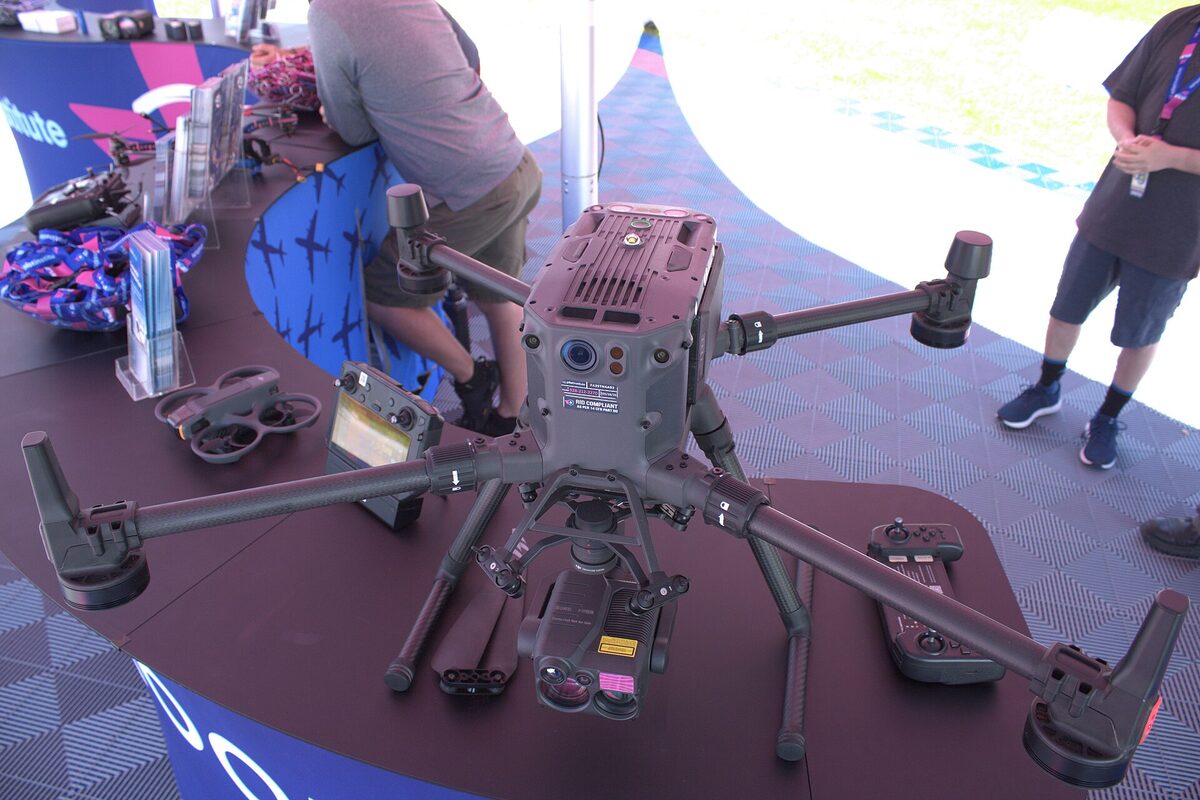
On Oct. 14, DJI launched Dock 4, a drone-in-a-box station, along with the Matrice 5TD, the aircraft built to live inside it. The headline feature in DJI's announcement is an automatic battery swap that takes 25 seconds. The spec sheet holds a detail that matters more to people who work with thermal sensors. The 5TD's infrared camera has a native resolution of 1280x1024. DroneXL notes that the Matrice 4T, DJI's folding thermal drone, and Skydio's X10 both carry 640x512 detectors.
Eleven days later, that detail reached the US drone industry. On Oct. 25, Flyby Robotics CEO Jason Lu posted on X that DJI is mass-rolling 1280 thermal on Mavic-sized drones while US 640x480 imagers have lead times of six months or more. DroneXL checked the post and found DJI's spec sheet backs Lu on the sensor but does not show a Mavic-sized drone carrying it. The questions below sort out which parts hold up.
What exactly is the 5TD's thermal sensor?
DJI's Dock 4 specifications page lists the thermal camera as follows:
- Native resolution: 1280x1024
- Pixel pitch: 8 µm
- Frame rate: 30 Hz
- Aperture: f/0.85
- UHR infrared mode: 2560x2048 at 30 fps
The UHR figure is where buyers could get confused. DJI's launch announcement says infrared output reaches "up to 2560x2048 in UHR mode." Dealer heliguy calls it super resolution on top of the 1280x1024 sensor. The 2560x2048 number is processed output. The detector itself is 1280x1024. Some replies to Lu's post argued the sensor was a 640 upscaled in software; Lu answered that 1280 is the native resolution, and DJI's spec sheet supports him.
The 8 µm pixel pitch matters too. DroneXL reports that shrinking the pixel from the 12 µm used in DJI's earlier Zenmuse H30T puts the same 1.3 million pixels on a sensor with less than half the area, and a smaller sensor needs a smaller lens for the same field of view. DroneXL also notes that Leonardo DRS, a US company, sells a 1280-class core called Tenum 1280, but at a 10 µm pitch. A US-built 1280 core exists. The difference is in how small the pixels are and which aircraft carry the sensor.
Is the 5TD a "Mavic-sized" drone?
No. According to DroneXL, the Matrice 5TD weighs 2,600 g and is a dock drone that cannot be flown from a remote controller at all. It is not a folding drone you carry in a backpack. DroneXL also reports that DJI's Matrice 4T, the folding thermal drone in DJI's line at 1,219 g, still uses a 640x512 thermal sensor.
Lu's comparison is therefore off by a product category. DroneXL found that DJI's spec sheet shows a 1280 core on a docked aircraft that flies from a fixed station, not on a small, hand-launched drone.
And the six-month lead time?
The six-month-plus figure for US 640x480 imagers is Lu's own claim, and DroneXL presents it that way. DroneXL notes that Lu's company buys thermal cores and also sells against DJI. None of the sources here independently confirm the lead time, and no imager supplier is named as the source. Readers should treat it as one manufacturer's report of its own supply chain, not a measured industry figure.
The comparison point DroneXL offers is Skydio's X10, which uses a 640x512 thermal sensor. That puts the X10 at the same thermal resolution as DJI's Matrice 4T and a full step below the 5TD.
What else does Dock 4 do?
The thermal camera is one part of a larger package. DJI's launch materials and spec sheet list:
- Battery swap: under 25 seconds, with turnaround from landing to takeoff under 45 seconds (measured in a controlled test environment, per DJI)
- Flight time: up to 59 minutes
- Speed: up to 21 m/s
- Latency: drone-to-cloud latency of up to 160 ms, which DJI says is about 32% lower than the previous generation
- Payload and sensing: 11x telephoto camera, 3 km laser rangefinder, mmWave radar, LiDAR, and AI detection of 17 object types
- Dock: 66 kg without the aircraft or batteries in the battery compartment, rated IP56
Heliguy adds operational figures. It lists a 10 km operating radius and says the aircraft can reach a target 3 km away in under three minutes. Heliguy also reports an independent flight termination system and an AP1 parachute, which it says help the aircraft meet EU C5/C6 and UK UK5/UK6 compliance with the parachute installed.
The battery swap changes how a dock gets used. DJI says the automatic swap cuts the turnaround between flights from a 30-minute recharge to just seconds. A 25-second swap within a turnaround under 45 seconds means the drone can go back out almost immediately after landing, which DJI pitches at security patrols, remote infrastructure inspections, and first-response launches.
Can US customers buy it?
No. DroneXL reports that the December 2025 Covered List action already blocks the Matrice 5TD from the United States. The only price in these sources is from China, where DroneXL, citing DoNews, reports 167,999 yuan for the Dock 4 kit with the Matrice 5TD and O4 Ground Station, hardware only. None of the sources give a US price, and DJI has not published production figures, so Lu's "mass-rolling" claim cannot be checked against numbers either.
As a result, US operators will not be choosing between a 5TD and a domestic drone. For US drone makers, the 5TD is a spec-sheet benchmark rather than a product they can buy.
Why It Matters
DroneXL's verdict is that Lu has the right alarm and the wrong diagnosis. DJI has shipped a native 1280x1024 thermal sensor at 8 µm pitch on an automated, dock-based aircraft. Per DroneXL, Skydio's X10 and the Matrice 4T that US departments buy today both carry 640x512. A US company, Leonardo DRS, does make a 1280-class core, but at a coarser 10 µm pitch and marketed for weapon sights, goggles, combat vehicles, missile seekers and space, with no drone on its list. DroneXL concludes that America can build a 1280 thermal core and that the gap is in the drones.
The corrections matter as well. The 5TD is a 2.6 kg aircraft that stays with its dock, not a handheld drone. The six-month imager wait is one company's claim. The Covered List action means US buyers cannot purchase the 5TD at all. As DroneXL puts it, keeping the 5TD out does not put a 1280 camera on any American drone. Without published lead-time data, production figures, or a US price, the argument rests on spec sheets and one social media post.
