
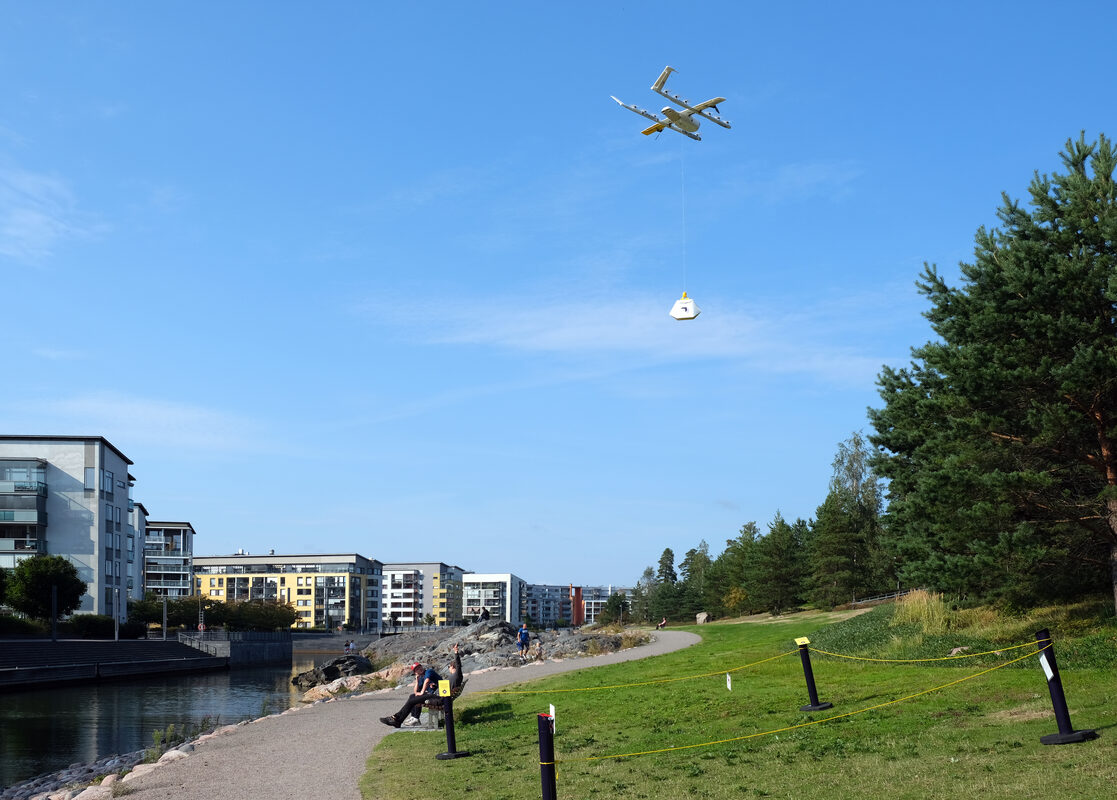
When Walmart and Alphabet's Wing launched drone delivery out of a single Frisco, Texas store in September 2023, the framing was predictable: a novelty pilot, an experiment in last-mile logistics. Two and a half years later, the numbers have changed that framing decisively. Walmart crossed 1 million cumulative drone deliveries in the first quarter of 2026 — and over 40 percent of that entire milestone total landed in just the most recent quarter before the announcement. Demand is not diffusing; it is concentrating.
That trajectory is the context for this week's announcement that Wing and Walmart are adding seven metro areas to their joint network: Memphis, New Orleans, Philadelphia, Phoenix, San Diego, the San Francisco Bay Area, and Salt Lake City. Operations in the new markets are targeted to begin by 2027. Combined with a pipeline of previously announced but not yet live cities — Orlando, Tampa, Charlotte, St. Louis, Cincinnati, Los Angeles, and Miami — the partnership is aiming for nearly 20 US markets and more than 270 store locations capable of serving upward of 40 million Americans.
From 66 Stores to a National Footprint
Current operations run out of 66 Walmart locations spread across Texas, Georgia, North Carolina, and Arkansas — the sunbelt footprint of a carefully contained pilot. The seven new metros represent a deliberate geographic break from that pattern. Philadelphia and San Francisco sit at opposite ends of the density-and-regulation spectrum from suburban Dallas; New Orleans and Salt Lake City bring meaningful logistical variety. The selection signals that Wing has enough operational confidence — and FAA relationship capital — to stop treating coastal population centers as too complex to enter.
That regulatory relationship got materially more useful in March 2026, when Wing received FAA approval to conduct flights after sunset. Extended operating hours are not a minor detail in last-mile drone delivery; they unlock the evening demand window that accounts for a disproportionate share of quick-commerce orders. Wing has not disclosed what operational constraints accompany the after-sunset authorization, but the approval removes a hard ceiling that had limited competitive parity with ground-based same-day services.
The Wing hardware profile has not changed with the expansion announcement. The aircraft carries payloads up to five pounds, flies at speeds up to 60 mph, and deploys a tether system to lower packages to the delivery point rather than landing — the same approach that avoids the need for a clear landing zone and keeps interaction with the package brief. Eligible items span groceries, household essentials, and consumer electronics. Delivery can complete in as little as 30 minutes from order. For Walmart+ members, drone delivery currently carries no additional charge; non-members pay $20 per delivery, a price point that positions the service above standard shipping but below most courier options for time-sensitive orders.
The Consolidation Question
Wing's Chief Business Officer framed the milestone in terms that deliberately resist the pilot-program narrative:
"Our work with Walmart has shown that drone delivery isn't just a novelty, it's a service many customers count on multiple times per week." — Heather Rivera, Chief Business Officer, Wing
Rivera's phrasing — multiple times per week — is the operationally significant claim. A service used that frequently is utility infrastructure, not a convenience experiment. It also implies a customer cohort that has substituted drone delivery for some portion of habitual ground-based quick-commerce, which is a different and stickier demand signal than occasional trial usage. The 40-percent quarterly concentration in deliveries is consistent with that read: a smaller-but-loyal user base running high repeat rates rather than a broad population sampling the service once.
Wing is not the only operator chasing that cohort. Amazon Prime Air continues to expand its own delivery footprint. Zipline's platform-based delivery model has been active in several US cities. DroneUp, which Walmart itself has also partnered with for separate delivery programs, continues to operate in parallel. The market is not yet winner-take-all, but it is consolidating around operators with credible FAA track records, retail distribution relationships, and the capital to absorb the infrastructure buildout costs ahead of meaningful unit economics. Alphabet's backing gives Wing patience on that last dimension that smaller independents cannot match.
Walmart's parallel relationship with DroneUp — and now Wing's separate announcement of a Papa John's pizza delivery collaboration in North Carolina — suggests the drone delivery ecosystem may settle into a multi-carrier model similar to conventional last-mile logistics, where retailers maintain relationships with several air operators rather than committing exclusively. That dynamic would benefit operators with strong FAA standing and scalable hardware over those competing primarily on price.
The 2027 Number and What It Requires
Reaching 270-plus locations serving 40 million Americans by 2027 is an aggressive target relative to where the partnership sits today. Scaling from 66 stores to 270 in roughly 18 months requires not just siting and infrastructure at new locations but FAA authorization for operations in each new airspace environment — a regulatory process that does not compress simply because the operator's safety record is strong. The after-sunset approval in March 2026 demonstrated that Wing can move the regulatory needle, but urban-core airspace in Philadelphia or San Francisco is categorically more complex than the suburban Texas corridors where the service was refined.
Greg Cathey, Walmart's SVP of eCommerce Fulfillment Transformation, framed the expansion around customer expectations: "Customers expect their orders on their terms, delivered with speed and ease." The language is deliberately understated relative to the scale of the operational commitment implied by the 2027 target. Whether the 270-location figure is a ceiling or a floor will depend substantially on how quickly Wing can replicate its FAA authorization playbook in denser, more contested airspace — and whether the quarterly delivery growth rate that produced 40 percent of a million deliveries in a single quarter continues to hold as the service moves into markets with no existing Wing brand awareness.
The infrastructure bet is already placed. The question now is execution speed against a ticking competitive clock.
Sources
- Wing — Wing and Walmart name seven new markets for drone delivery service
- Yahoo Finance — Walmart, Wing to add 7 markets (June 9, 2026)
- Robotics & Automation News — Wing and Walmart expand drone delivery network to seven new US metro areas (June 9, 2026)
- The Drone Girl — Walmart Wing drone delivery expansion 2026 (June 10, 2026)
- Flying Magazine — Walmart Wing drone delivery 7-city expansion (June 11, 2026)
- Washington Times — Walmart aims to expand drone delivery service by 2027 (June 11, 2026)
