
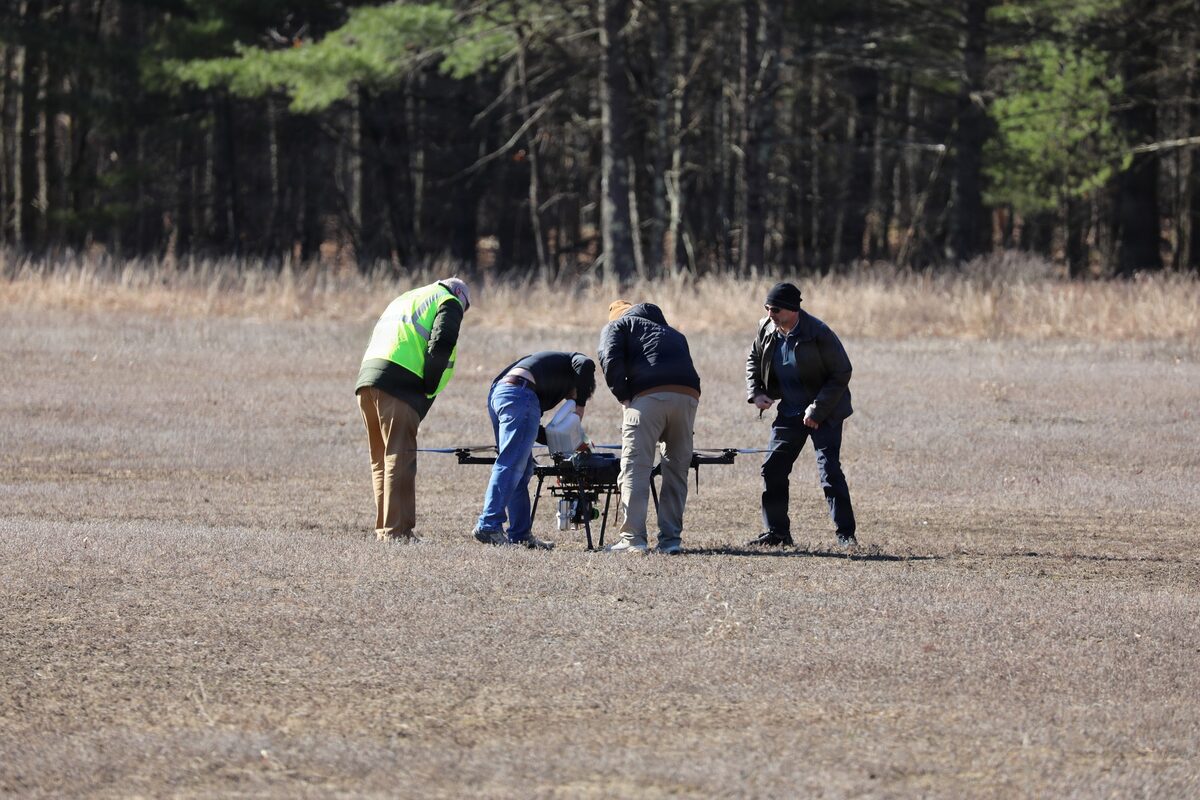
Two items crossed the wire inside 48 hours, and they only make sense read together.
On July 23, 2026, DroneLife reported that Powerus — a West Palm Beach, Florida company with manufacturing in Charlotte, North Carolina — is pushing its US-built heavy-lift airframes into agriculture through a wholly owned subsidiary, Kaizen Aerospace. The hardware is not subtle: the xFold series of eight-rotor UAVs spanning 100 to 1,000 pounds of payload capacity, topped by an ultra-heavy-lift platform called the Dragon H1000. Alongside it came a distribution agreement with New Zealand's Aerospread Technologies, worth an estimated $60 million — described as roughly $60 million in potential product revenue over the first five years, not booked revenue — and a partnership with Sprig Aerospace, a Kentucky-based veteran-owned startup that received an FAA special airworthiness certificate in the experimental category plus an accompanying certificate of waiver or authorization for research-and-development flying.
Meanwhile, on its own Part 137 landing page, the FAA has posted language that should make every agricultural exemption holder in the country sit up: "The FAA has become aware of exemption holders conducting commercial agricultural operations in a manner noncompliant with the conditions and limitations of their exemption. Therefore, the FAA is implementing operational validations to ensure that each exemption holder fully understands their obligations to conduct operations in accordance with their exemption, the required Part 137 certificate, their ATO-issued COA, and all pertinent sections of 14 CFR."
One of those things is a supply story. The other is a compliance story. They are the same story.
The hardware pitch is substitutionary, and says so out loud
Powerus co-founder and president Brett Velicovich did not bury the lede on why an American company thinks it can sell 1,000-pound-class multirotors into row-crop country: "These are aircraft that're manufactured in the United States. Typically, folks have had to reach out to China to be able to get anything that is in the realm of saving them money."
That is the entire commercial thesis in two sentences. The company's own site leans on the same axis — "U.S.-Based Manufacturing" and "Domestic manufacturing expansion" are headline attributes, and it describes "heavy-lift VTOL platforms and tactical unmanned systems designed for defense missions, emergency response, agriculture, and infrastructure operations," offered through its PowerAir division, with production "scaled through U.S.-based manufacturing and strategic partners."
A caveat worth stating plainly, because vendor pages invite the opposite reading: the Powerus site surfaces media coverage — a Wall Street Journal headline about a drone company "Targeting Pentagon Sales," a Reuters headline about "Investors back drone company targeting Pentagon contracts" — but does not confirm any specific awarded agreement. Treat the defense side as positioning, not backlog. The same discipline applies to the Aerospread deal: a five-year distribution agreement with a $60 million estimate attached is a sales channel and a forecast, not $60 million in the bank.
The Sprig side is where the ambition gets concrete. Cofounder Alex Scott's framing: "Once we put this out there, this will be the largest vertical-takeoff-and-landing crop duster drone in the industry." That claim is testable, eventually, in the only venue that counts — a certificated operation spraying a real field under a real exemption. Right now Sprig is flying under an experimental airworthiness certificate and a COA, which per Velicovich is meant to let the company "continue to refine the system, do more data collection, do a lot of sophomore flight tests" — exactly the correct instrument for R&D at that mass class, and exactly not a license to run commercial application work.
What Part 137 actually demands, and why a 1,000-pound airframe changes the paperwork
The regulatory picture matters here more than the rotor count, because payload class determines which regulatory door you walk through.
14 CFR Part 137 governs the use of aircraft — including drones — to dispense or spray substances. The FAA's definition of an agricultural aircraft operation is broader than most operators assume. It covers dispensing any "economic poison" as defined in Section 137.3, and dispensing any other substance intended for plant nourishment, soil treatment, propagation of plant life or pest control. The FAA also treats chemicals used as disinfectants for viruses as falling within the economic-poison category. If you are spraying something that touches a plant or a pest, assume you are in Part 137 until a lawyer tells you otherwise.
The split is at 55 pounds, and it is 55 pounds including the weight of the substance being dispensed:
- Under 55 lbs total: the aircraft may operate under Part 107, but needs an exemption from Section 107.36 (which otherwise prohibits using a drone to carry hazardous materials) plus exemptions from several Part 137 rules, and the petitioner applies for an FA-number through FAADroneZone.
- 55 lbs or more: the aircraft operates under Part 91 and Part 137, requires exemption from several regulations across Parts 61, 91 and 137, and requires an N-number obtained through Civil Aviation Registry Electronic Services (CARES) or by mail.
A Dragon H1000 hauling 1,000 pounds of payload is not near that line; it is in a different universe from it. Every one of those heavy platforms lands in the Part 91/Part 137 lane, with the full exemption stack and registered N-number behind it. Petitions must be filed 120 days before you need the exemption to take effect under 14 CFR § 11.63(d), submitted by commenting on shell docket FAA-2007-0001-0001. There is one piece of good news for operators: the FAA has streamlined Part 137 UAS certification itself — once exemptions are approved, submit FAA Form 8710-3 with your exemption number to [email protected], no longer routed through local Flight Standards District Offices.
The audit has teeth, and the teeth are procedural
The enforcement mechanism the FAA describes is not a ramp check with a clipboard. It is operational validations plus requests for information, and the RFI is where the leverage sits. The agency says it has begun sending RFIs seeking basic operational information, and that without it, the FAA "will not move forward with a decision letter and will close your petition request for failure to respond to the RFI." The FAA's Part 11 exemptions branch takes responses and questions at [email protected].
Read that against the 120-day filing requirement and the cost of ignoring an RFI becomes obvious. A closed petition is not a fine you can pay and move on from; it is a season. For an operator whose entire business model is a spray window measured in weeks, an administrative closure timed badly is functionally a shutdown.
This is the part the hardware announcements consistently underweight. The constraint on US ag-drone scale-up in 2026 is not thrust. It is the number of operators who can hold a clean exemption through an operational validation.
Europe is a control group, and it is behind
A July 22, 2026 Commercial UAV News webinar — featuring Julie Garland, founder and CEO of Avtrain and president of the Joint European Drone Associations, and Valerii Iakovenko, co-founder of Drone UA and Futurology and a former UN FAO drone expert, moderated by content manager Matt Collins — laid out how differently the same technology fares under a different rulebook.
In the EU, the Pesticide Directive prohibits aerial dispersal by default, with exemptions granted state by state rather than at Commission level. The operational frameworks are maturing — PDRA-S01 covers drones under 3 meters, SORA 2.5 covers larger aircraft, and an upcoming STS-03 standard scenario would let operators declare compliance for drones up to 8 meters and 750 kilograms without filing a full SORA — but a default prohibition with patchwork carve-outs is a structurally slower starting position than a default-permitted regime gated by exemption.
The natural experiment inside Europe is Ukraine, where early lenient regulation let the country briefly out-produce all other European nations combined in agricultural drone adoption. Iakovenko characterized the US trajectory differently again: FAA exemptions accelerated significantly through 2024 and 2025, a period he described as a "breakpoint" in market development — which is precisely the kind of volume growth that produces a compliance-audit wave a year later.
Two data points from the same session are worth pinning to the wall. First, the economics: Iakovenko estimated that roughly 75% of farm operations during the vegetation period could theoretically shift to drones at comparable cost, with yield gains of 2-4% on wheat and 6-10% on higher-value crops such as sunflower and corn. Second, the market correction: farmers, in his words, "are not ready to buy in a large scale the scanning possibilities of drones." Mapping and imagery — the pitch that dominated agricultural UAS marketing for a decade — did not convert. Spraying and dispersal did. The industry's actual adoption driver turned out to be the tank, not the camera.
Why It Matters
Every serious ag-drone product roadmap now points at the same place: heavier airframes, bigger tanks, and the Part 137 exemption stack that comes with them. Powerus and Sprig are betting that a domestically manufactured 1,000-pound-class platform can substitute for imported hardware in a market where, as Velicovich puts it, "typically, folks have had to reach out to China." That bet may well pay — but not on airframe availability alone.
The FAA notice reframes the bottleneck. Demand looks real: the European panel's own estimate is that three-quarters of in-season field operations could theoretically move to drones at comparable cost, and the adoption pattern says growers want spraying specifically. Supply is arriving, with US manufacturing and distribution channels forming in real time. What is being stress-tested right now is the third leg — the compliance scaffolding that lets a certificated operator legally put an economic poison on a field from a 55-pound-plus aircraft under Part 91 and Part 137.
The practical read for operators: assume your exemption's conditions and limitations will be examined, not assumed. Answer RFIs immediately — a non-response closes your petition outright. File 120 days ahead of when you need the exemption to take effect. Use the streamlined 8710-3 path to [email protected] rather than chasing a district office. And if you are being sold a heavy-lift platform on payload specs alone, ask the vendor which exemptions its intended mission profile requires, and whether any customer is currently flying that profile commercially — because the experimental certificate and COA that make R&D flying legal do not make revenue spraying legal.
The equipment race and the audit are not in tension. They are the same market maturing: hardware getting big enough to matter, and a regulator deciding it is time to check who is actually flying within the lines.
Sources
- Dispensing Chemicals and Agricultural Products (Part 137) with UAS — Federal Aviation Administration
- Powerus Expands U.S.-Made Heavy-Lift Drones Into Agriculture — DroneLife, July 23, 2026
- Webinar Discusses State of Drone Use in European Agriculture — Commercial UAV News, July 22, 2026
- Powerus — U.S.-Led Autonomous Systems for Defense & Critical Infrastructure (company site)
