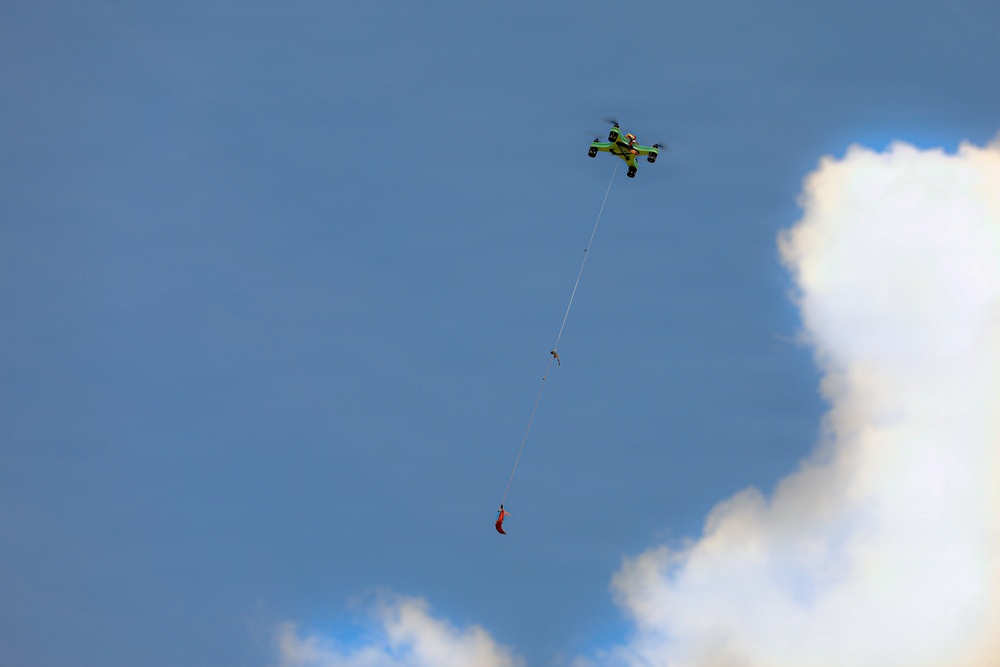
For three days this week, the biggest sound over a cornfield outside Boone, Iowa, wasn't a tractor engine. It was the layered whine of multiple agricultural spray drones lifting off in sequence, dumping water over standing and harvested corn, and setting back down for their next load — again and again, on a loop, for a crowd watching from a fenced-off viewing tent.
That was the scene at the Farm Progress Show's "Drone Zone," which ran September 1-3, 2026, open to the public from 11 a.m. to 3 p.m. each day. It's the second year the show has run a dedicated drone demonstration area — the format debuted in 2025 at the show's Decatur, Illinois stop — and this year's edition, on the show's home turf outside Boone, Iowa, drew multiple spray-drone exhibitors, including Agri Spray Drones and Raptor, each launching flights repeatedly throughout the day on a schedule organized by Agri Spray Drones' Alex Ryan.
The viewing setup was a 40-by-60-foot tent on the north side of the flight area, fenced off, with FAA rules requiring spectators to stay at least 100 feet back from the drones themselves. Inside, two screens streamed each drone's live first-person-view camera feed, giving visitors a pilot's-eye view of low-altitude passes over standing and harvested corn without standing in the flight path.
Why It Matters
The Drone Zone's return, now drawing multiple spray-drone exhibitors into the same fenced demonstration area over the show's three days, is a reasonably clean proxy for where agricultural spray drones sit in their adoption curve. A single-vendor demo tent is a sales pitch. A shared patch of airspace where competing rigs fly the same field in front of the same audience is something closer to a bake-off — the kind of format that shows up once buyers are comparing real options rather than being introduced to a new category for the first time.
It also matters because spray drones sit downstream of a real regulatory and licensing bottleneck, and Iowa has been unusually active in trying to clear it. Iowa State University Extension's Digital Ag Innovation Lab has positioned itself as a go-to regional resource for producers trying to figure out what it actually takes to fly a spray drone commercially in the state — and the requirements are not trivial. According to Extension's own guidance, a commercial operator needs an FAA Part 107 Remote Pilot Certificate at minimum, plus Part 137 aerial-application certification for the spraying itself, on top of licensing through the Iowa Department of Agriculture and Land Stewardship. Layer on pesticide label compliance and the insurance stack most operators carry — chemical liability, general liability, and hull coverage for the aircraft — and the path from "I want to spray with a drone" to "I am legally spraying with a drone" involves several separate approvals from separate agencies before a single acre gets treated.
That's the gap an event like the Drone Zone is implicitly selling against. A farmer who watches spray drones make clean, low-altitude passes over corn is seeing the appeal side of the ledger. The paperwork side — the FAA certificates, the state license, the insurance — is the part that determines whether that farmer is flying next spring or still waiting on approvals.
What producers actually saw
The Drone Zone flights weren't spraying actual pesticide — the demonstrations used water, consistent with how most public agricultural-drone demos are run, since dispensing real chemical over an open crowd area raises its own permitting and safety questions. But the flight profile itself — takeoff, load, low-altitude pass over the crop canopy, return, reload — was the real operational sequence spray-drone operators run in the field, just compressed into a public-facing loop.
Running it over both standing and harvested corn let visitors see the aircraft's behavior in two different canopy conditions, which matters for anyone evaluating a spray drone for a mixed-crop or multi-pass operation rather than a single application window.
Q&A: The licensing question producers keep asking
Q: Can I just buy a spray drone and start using it on my own land?
A: Not commercially, and in most cases not without certification even on your own operation. Iowa State University Extension's guidance lays out FAA Part 107 as the baseline remote-pilot credential, with Part 137 aerial-application certification required on top of that for anyone applying products via drone. That's a federal requirement layered on top of state licensing through IDALS.
Q: What does Iowa add on top of the FAA requirements?
A: State-level licensing through the Iowa Department of Agriculture and Land Stewardship, plus the standard obligation to follow pesticide label directions — the same label-compliance rules that govern any other method of application.
Q: What about insurance?
A: Extension's guide flags three categories operators typically need to carry: chemical liability, general liability, and hull/physical-damage coverage on the aircraft itself. That's a heavier insurance stack than a lot of new entrants expect walking in.
Q: Where should someone start if they're serious about it?
A: Extension recommends starting with small acreage or trial fields rather than converting a full operation to drone application immediately, and comparing results against conventional methods as you go — a hedge against both the learning curve on the equipment and the time it takes to work through certification.
A growing fixture on the show floor
The Drone Zone isn't operating in isolation. Iowa Farmer Today's coverage of the Farm Progress Show frames the drone area's expansion as part of a broader build-out of the show's ag-tech programming, alongside autonomous tractors and automated sprayers — the kind of lineup that signals organizers see autonomous and semi-autonomous application technology as a category worth dedicated floor space, not a novelty booth.
For an industry event that draws producers making real purchasing decisions, that's the more durable signal than any single flight demo: the show is now built around watching automated equipment work a field in real time, and spray drones earned their own regulated slice of that.
Sources
- Drones take flight at 2026 Farm Progress Show — Farm Progress
- Getting Started with Spray Drones in Iowa: A Practical Guide — Iowa State University Extension, Integrated Crop Management
- Farm Progress Show expands 'drone zone' — Iowa Farmer Today