
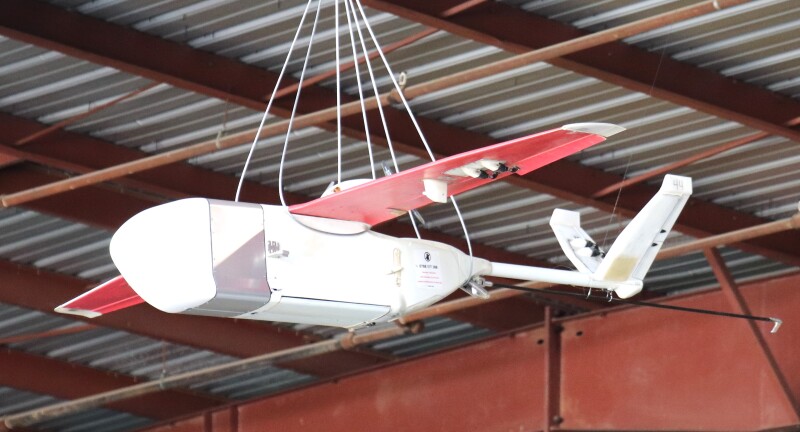
Zipline began taking drone delivery orders in the Austin area on Friday, Oct. 9. The service runs from a hub at 3000 E. Palm Valley Blvd., which sits in Round Rock's extraterritorial jurisdiction (ETJ), not inside city limits. The city's own explainer page is blunt about what that means for regulation: drone delivery hubs "are not specifically addressed under the City's current zoning ordinances."
A month earlier, the Federal Aviation Administration published a draft environmental assessment covering Zipline's planned operations in five Texas metropolitan areas, Austin among them. On land use, it assumes the local rules Round Rock says it doesn't have yet. "All Chargers and Dropboxes would be sited in accordance with all local land use ordinances and zoning requirements," the draft says, and then adds a caveat: "Local jurisdictions in Texas metro areas may vary in the scope of their review and approval of commercial operations."
Taken together, the two documents show where the oversight falls short. The federal review leaves ground-side siting to local governments. At least one of those governments says its code is silent on the question.
What launched, and where
According to Community Impact, Zipline held a launch event Oct. 8 at Stony Point High School. Orders opened the next day for customers within three miles of the intersection of E. Palm Valley Blvd. and Kenney Fort Blvd., Zach Hill told the outlet. Community Impact called it the first commercial drone delivery service in the Austin area. It also reported that the company started commercial service in January with operations in Houston and Dallas, and that Zipline's service area is expected to expand to other parts of Round Rock and the wider Austin metro.
DroneXL reports that the aircraft fly at up to 75 mph at roughly 300 feet and carry about 5 pounds per order. Zipline's safety record figures differ by document, according to DroneXL: more than 135 million commercial miles in what Zipline told a local TV station, and more than 140 million in the company's Austin launch announcement. DroneXL notes that both numbers come from the company.
What Round Rock says it can and can't do
The city's "Drone Delivery in Round Rock" page, read here through a Wayback Machine snapshot because the live site was not reachable from our server, sets out the limits of local authority:
- Flight paths: The city cannot regulate them. Federal and state law preempt local control of the airspace.
- Hub location: Inside city limits, the city can regulate where hubs go, with the stated aim of keeping them away from residential property. The current hub is in the ETJ, outside city limits.
- Zoning code: Hubs are not specifically addressed in current ordinances.
- Next step: The city is working with Zipline to allow a proposed in-city hub at the rear of the Renaissance Square shopping center along northbound I-35. It says the site will give it a chance to evaluate impacts and help develop regulations for future facilities within city limits.
- Complaints: Residents with operational issues such as noise are directed to Zipline at 855-947-5163, not to the city. Suspected FAA violations go to the FAA.
- Privacy: The page cites Texas Government Code chapter 423, with civil penalties of up to $5,000 per incident for unlawful image capture and up to $10,000 for distribution.
Round Rock is treating the first in-city hub as the test case for writing rules. That is a reasonable order of operations for a city meeting a new land use. It also means the rules will be written after the service is already running.
What the FAA's draft actually authorizes
The FAA's draft environmental assessment opened for a 30-day public review beginning Friday, Sept. 11, 2026. DroneXL reports the comment period closes Oct. 11, two days after the Round Rock hub began taking orders.
The scale in the draft goes well beyond a single three-mile service zone. Table 2.2-1 sets out maximums for the Austin study area:
- 2,498 square miles
- 30 chargers
- 600 dropboxes
- 30,000 deliveries per day
- 90,000 transits per day
Across all five metros the draft's maximums total 220 chargers, 4,400 dropboxes, 220,000 deliveries a day and 660,000 transits. Operations would run 24 hours a day, with about 95 percent of flights between 7 a.m. and 10 p.m.
The draft says chargers and dropboxes would go in established commercial areas "consistent with local zoning and land use requirements." Its land use section says: "Land use and zoning are typically governed by local and state laws." That is accurate. The FAA does not zone land. But the analysis assumes local review will exist and do real work. The draft's own caveat about Texas jurisdictions varying "in the scope of their review" admits that this assumption is not uniform.
Q&A: The gap, in plain terms
Is Zipline doing anything wrong? Nothing in the sources suggests so. The hub sits in the ETJ, and the city says its code does not specifically address hubs. Missing rules are not a violation.
Then what's the issue? The issue is the scale of the plan compared with the oversight in place. The FAA's draft contemplates up to 30 chargers and 600 dropboxes across the Austin area, and it relies on local zoning to keep those sites appropriate. Round Rock, the first city where Austin-area service is running, says it is only now developing hub rules, and it is using a future in-city site to do so.
Can the city do anything about flights over homes? According to its own page, no. Flight paths are preempted. The city's lever is hub location, and only inside city limits.
Has any Texas city already written rules? Yes. DroneXL points to Rowlett, where the council voted 6-0 on May 20, 2025, to add drone hubs (by special use permit) and kiosks (by right) as new uses in its nonresidential zoning districts. That approach puts hubs under a discretionary review and allows the smaller pickup points without one.
Why It Matters
The FAA's draft treats ground infrastructure as a local matter. In principle, that split makes sense: the FAA handles aircraft and airspace, and cities handle land. In practice it depends on cities having rules in place before the infrastructure shows up. Round Rock's page shows a city that does not have those rules yet, is open about it, and plans to write them around a hub that has not been built.
The numbers make this more pressing. A single three-mile zone is a small footprint. A metro-wide network of up to hundreds of dropboxes and tens of thousands of daily deliveries, running around the clock, would be sited one parcel at a time under whatever each city, county or ETJ has on its books when the application arrives. The FAA's draft acknowledges that those books vary. Rowlett has shown that a Texas city can write hub and kiosk rules before the operator arrives. Whether other jurisdictions in the Austin metro follow Rowlett or Round Rock will decide how much local review the FAA's assumption actually gets.
For residents, the practical point is that complaints about noise or nuisance go to the operator, privacy claims go through state law, and the only local land-use control the city describes applies to where hubs sit inside city limits.
Sources
- Draft Environmental Assessment, Zipline Proposed Drone Package Delivery Operations in Texas Metropolitan Areas (FAA, Sept 2026)
- Drone Delivery in Round Rock (City of Round Rock, via Wayback Machine snapshot)
- Round Rock Says It Has No Zoning Rule for Zipline's Drone Hub (DroneXL, Oct 11 2026)
- Zipline launches drone delivery zone in Round Rock (Community Impact, Oct 8 2026)
