
The vast majority of global internet and voice traffic crosses the ocean floor on transoceanic fiber-optic cables — seabed infrastructure that is increasingly recognized as both critical and vulnerable. Suspected Houthi attacks on undersea cables in the Red Sea put seabed infrastructure on the active warfare target list; Hamas built uncrewed undersea vehicles aimed at Israeli offshore natural gas platforms — no successful strikes as of early 2024, but the intent was established. Attribution is the hardest part: seabed attacks can be as low-tech as divers in shallow water or a ship dragging an anchor, enabling the kind of hybrid-warfare ambiguity that frustrated commanders favor.
Four Classes, One Hard Constraint
The Navy organizes its UUV acquisition programs into four size-based categories — small, medium, large, and extra-large — and the distinctions are not bureaucratic. The governing constraint is the submarine torpedo tube. Small and medium UUVs can be deployed from manned ships and submarines without surfacing; extra-large class vehicles, with diameters exceeding 84 inches, cannot fit through a torpedo tube and must operate from pier side or surface ships. That single geometric fact drives entire acquisition programs and force-employment concepts.
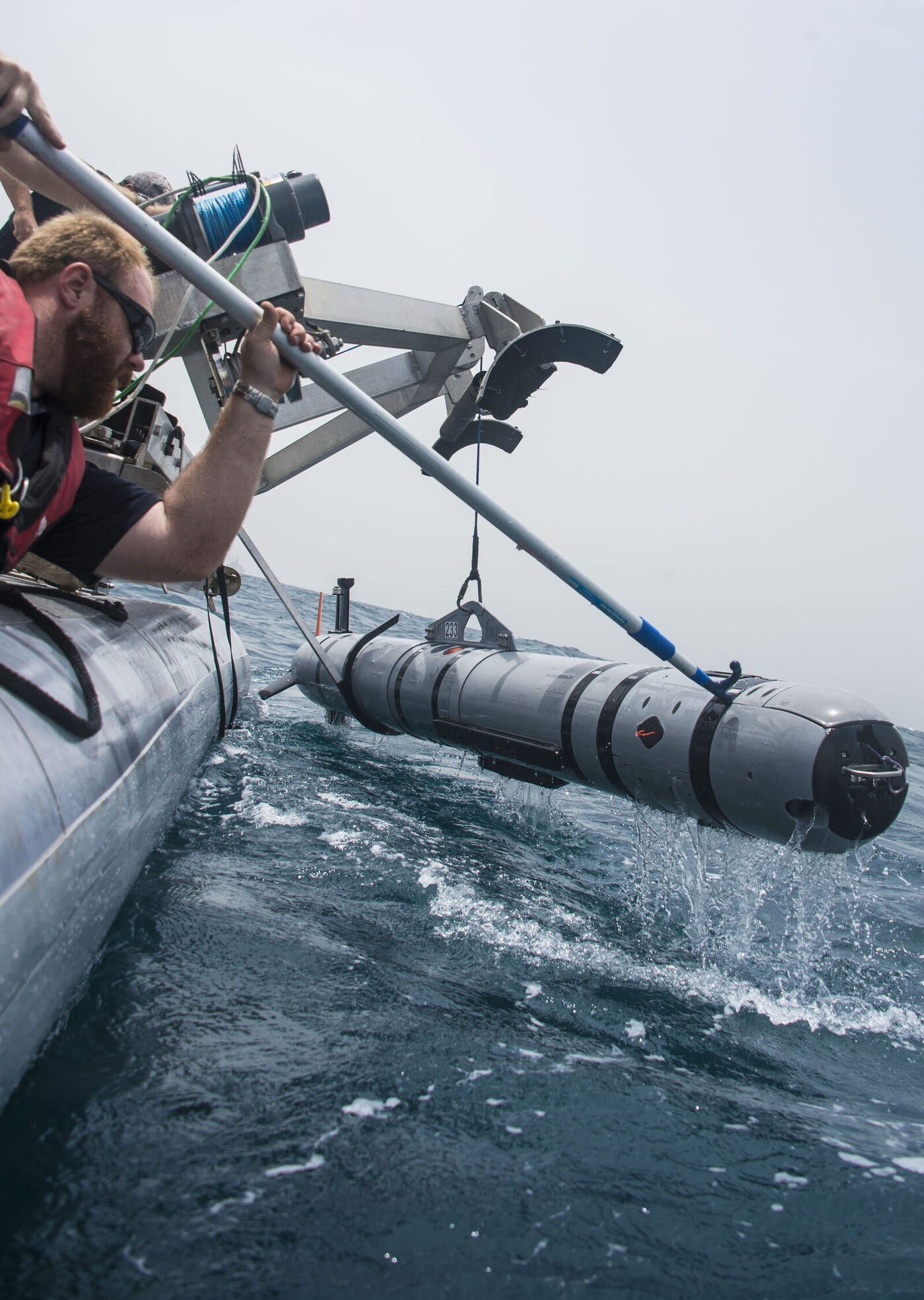
The small-class benchmark is the REMUS family, which originated at Woods Hole Oceanographic Institution and whose manufacturer, Hydroid, was acquired by Huntington Ingalls Industries from Kongsberg in March 2020. The REMUS 300 — selected as the Navy's next-generation small-class UUV under the Lionfish program in March 2022 — runs 2.3 meters long, reaches depths of 305 meters, and sustains up to 30 hours at up to 5 knots with a 110-kilometer standard range. Its primary sensor is a Marine Sonics MK II Arc Scout sonar at 900Hz/1,800kHz dual-frequency with 5-centimeter resolution, fine enough for mine countermeasures. HII secured a torpedo-tube launch and recovery (TTLR) contract announced April 2026, enabling Virginia-class submarines to deploy and recover REMUS UUVs through existing tubes without ever surfacing.
The Extra-Large Problem: Orca's Troubled Arc
The Boeing Orca represents the Navy's most ambitious UUV bet and its most instructive cautionary tale. The concept traces to around 2012–2013 under CNO Admiral Gary Roughead; a predecessor vehicle, the Echo Voyager, accumulated 10,000 hours at sea before transitioning into acquisition. Boeing was selected for the XLUUV contract in early 2019. At 51 feet (15.5 meters) baseline — roughly 85 feet (26 meters) with the payload module attached — Orca carries up to 8 tons of dry payload in a 34-foot modular bay that can hold four Large Diameter UUVs, nine 21-inch-diameter medium UUVs, or 48 small UUVs simultaneously. Range: 6,500 nautical miles on a hybrid diesel-electric system. Boeing VP Ann Stevens described the payload architecture plainly:
"The sky's the limit in terms of payloads that can be brought into the vehicle."
The program arc since 2019 is less tidy. The first prototype was delivered to the Navy in December 2023. As of June 2025, approximately $885 million had been spent over eight years of development; the Navy expected all five prototypes by end of 2025, representing multiple multi-year schedule slips. The GAO's assessment was blunt:
"It is now unclear whether the Navy will transition the XLUUV to a program of record because there are no clear requirements that the XLUUV can meet within current budget constraints."The three technical challenges the GAO flagged — autonomy issues, battery endurance limitations, and navigation problems — are not Orca-specific pathologies. They are structural features of the domain.
Against that backdrop, Anduril's Ghost Shark program offers a pointed contrast. The co-development agreement with the Royal Australian Navy and the Defence Science and Technology Group was signed May 2022; all three prototypes were delivered on budget and ahead of schedule. In September 2025, the RAN awarded Anduril Australia an A$1.7 billion (~USD $1.1 billion) contract for a five-year Ghost Shark fleet, designed for stealthy long-range ISR and strike missions complementing surface combatants and nuclear submarines. The first production Ghost Shark was delivered to the Royal Australian Navy in November 2025 — ahead of the January 2026 planned delivery milestone — for sea acceptance testing. In March 2026, the Defense Innovation Unit and Navy selected Anduril for the Combat Autonomous Maritime Platform (CAMP) program — also called Dive-XL — after the company completed what the program characterized as "the longest XL-AUV demonstration conducted to date" in operationally relevant conditions.
GPS-Denied, Bandwidth-Starved, Not Yet Swarming
Water absorbs radio signals almost completely. GPS does not penetrate. Submarines and UUVs "are quite literally navigating blindly most of the time," as one survey of UUV navigation research states. Traditional inertial navigation systems drift at 1–2 nautical miles per 24 hours and require realignment after approximately 150 hours. Practical solutions combine Strapdown Inertial Navigation Systems with Doppler Velocity Logs, terrain-aided navigation using seabed feature maps, and sonar-based SLAM. Almost all underwater vehicles also use proprietary communication interfaces, blocking interoperability between different manufacturers' fleets — a gap that becomes critical the moment any operator tries to manage mixed-vehicle operations. Multi-vehicle swarming has not been demonstrated to the level of confidence sufficient for real-world implementation.
China's Weaponized Fleet
China has tested at least five to six distinct XLUUV designs since 2022, placing it ahead internationally in both pace and variety. The UUV-300, first revealed at the DSA 2024 defense exhibition in Kuala Lumpur, measures 11.5 meters long and 1.6 meters in diameter and is offered for export. A candid photograph in May 2025 provided the first evidence of a secretive armed Chinese XLUUV on a transport truck, dimensions consistent with the UUV-300. The September 2025 Beijing parade introduced the AJX002 — 18 to 20 meters long, using pumpjet propulsion for reduced acoustic signature — with military officials characterizing it as optimized for mine-laying, including covert deployment in the Taiwan Strait. The AJX002 was displayed at China's September 2025 military parade alongside strategic systems, signaling China's framing of underwater drones as a peer-level strategic capability. Chinese XLUUVs can be armed with torpedoes, mines, or missiles — a significant departure from Western programs, which have resisted weaponizing underwater drones. Whether that restraint holds as China fields an armed XLUUV fleet and the seabed becomes a recognized battlespace is a policy question the hardware is rapidly outpacing.
Sources
- Boeing — Orca XLUUV program page
- Breaking Defense — After $885 million, GAO warns it's unclear if Navy's major UUV program will become program of record
- Breaking Defense — First Ghost Shark extra-large AUV delivered to Australian Navy
- Naval News — DIU and U.S. Navy select Anduril for XL-AUV program
- Naval Technology — REMUS 300 unmanned underwater vehicle
- Naval News — Candid image gives first evidence of China's secretive armed underwater drone
- Army Recognition — China to reinforce naval pressure over Taiwan Strait with new AJX002 extra-large underwater drone
- Marine Technology News — Inside Boeing XLUUV
- CRS via EveryCRSReport — Navy Large Unmanned Surface and Undersea Vehicles (R45757, September 2019)
- K-State Libraries — Underwater Autonomous Navigation and Other UUV Advances
- Naval News — Cable attack: new undersea threat is starting to reshape naval wars
- Army Recognition — U.S. Navy awards contract for torpedo-tube UUV launch system to boost submarine ISR and mine warfare
