
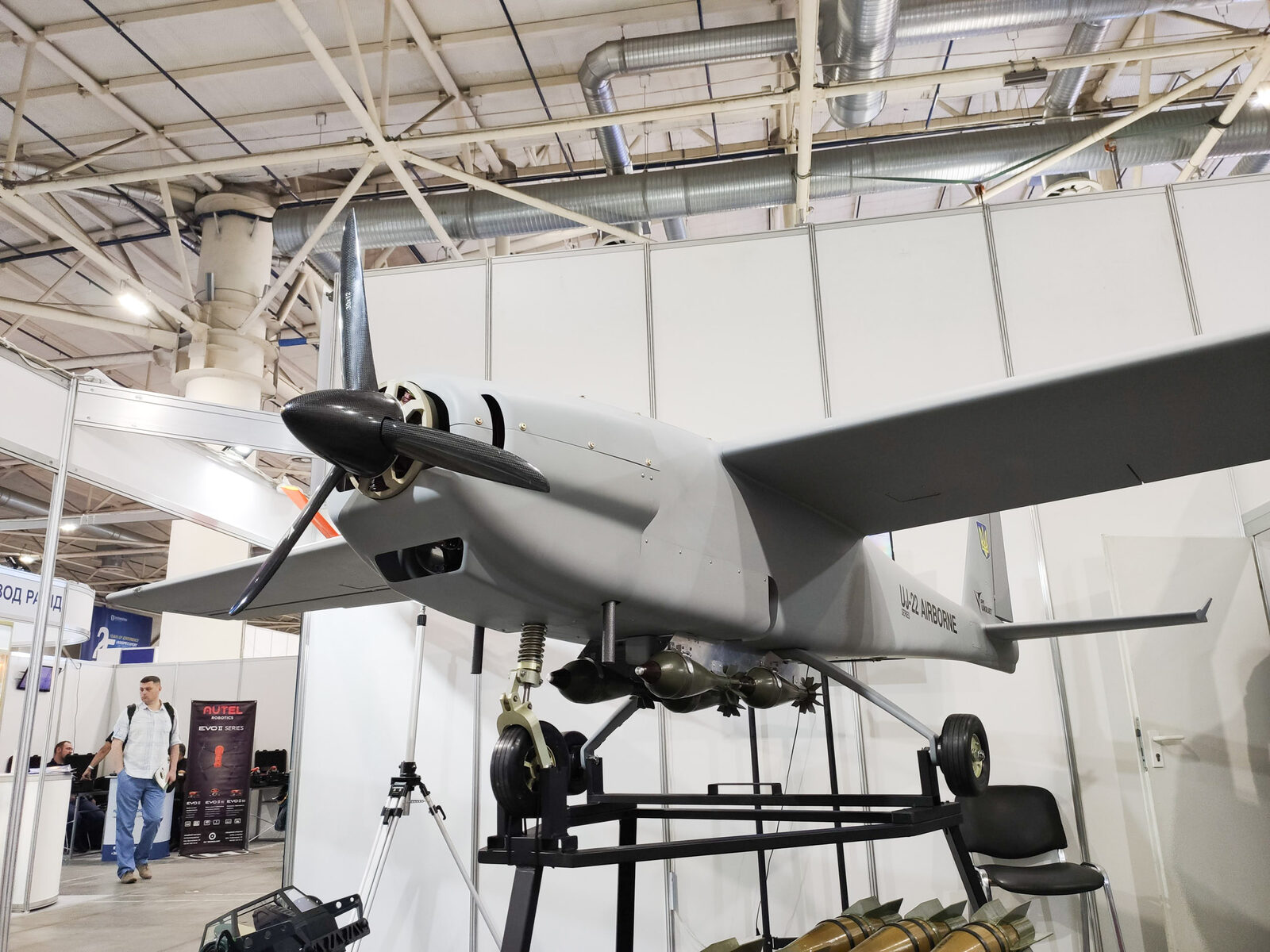
Ukraine's Unmanned Systems Forces struck the Hlibivka underground gas storage facility on Crimea's Tarkhankut Peninsula overnight June 18–19, 2026, in what Ukrainian military officials describe as the deepest infrastructure blow yet under a broader campaign to strangle Russian logistics across the occupied south. The 414th Brigade conducted the operation; drone types were not disclosed. Russia has not publicly acknowledged any damage.
The Hlibivka facility is Crimea's only underground gas storage installation. According to Ukrainian military sources, it regulates seasonal and daily gas consumption for the peninsula and maintains pressure across Crimea's gas distribution network — making it the kind of critical node that, if genuinely degraded, cannot easily be substituted. All damage assessments are Ukrainian military claims; no independent battle damage assessment has been confirmed.
A Multi-Target Strike Package
The gas storage hit was part of a coordinated multi-target operation rather than a single-axis sortie. According to USF commander Robert "Madyar" Brovdi, who announced the strike via Facebook with combat video, the same overnight package also claimed:
- The "Repeynik" anti-drone radar station in Kamianske, Crimea
- A P-18 "Terek" radar station in Novovasylivka, Zaporizhzhia region
- A diesel locomotive in Rozdolne, Crimea
- Two ZU-23 armored transporters in Luhansk region
- Fuel tankers across multiple regions
- The command-observation post of Russia's 656th Motorized Rifle Regiment in Donetsk Oblast
All of these are Ukrainian military claims citing Brovdi; no third-party verification of the individual target kills has been reported. The simultaneous targeting of air-defense radar nodes alongside fuel and transport infrastructure reflects a deliberate attempt to suppress both Russian early warning and the resupply chains that sustain forward-deployed forces.
A second overnight strike — June 19–20 — reportedly hit the Tavriiska Thermal Power Plant in Simferopol, according to Russian Telegram channels and the Crimean Wind monitoring group. The Kyiv Independent explicitly noted it could not immediately verify this report as of its June 20 publication, and Ukraine's military had not confirmed the strike. That claim should be treated as unverified and disputed.
Logistics Lockdown: Scale and Stated Results
The Hlibivka strike is the latest in Ukraine's formally designated "Logistics Lockdown" campaign, launched May 27, 2026, with Hr 5 billion (approximately $113 million USD) allocated specifically for mid-range drone procurement. The campaign's stated objective is to suppress Russian offensive logistics by degrading fuel, transport, and air-defense infrastructure across occupied territories — targeting the connective tissue of the Russian military machine rather than front-line units directly.
The operational tempo has escalated sharply. USF data cited by CNN indicates mid-range strike missions have risen 28-fold over the past year. Ukrainian military data, also reported by CNN, counts more than 300 new truck hulks appearing alongside the Novoazovsk–Mariupol–Melitopol–Crimea highway corridor in the first half of June 2026 alone, according to Kyiv Post, citing open-source satellite imagery — a figure that, if accurate, would represent sustained attrition of rear-area transport at a scale that would stress any logistics system.
Brovdi stated on June 20 that drone strikes in the first two weeks of June cut Russian vehicle traffic on the Chonhar bridge route — a principal land corridor between the Russian mainland and Crimea — by approximately 71%.
That figure is a Ukrainian commander's claim, reported by CNN and Kyiv Post citing Brovdi. No independent satellite traffic analysis or third-party monitoring has been cited to corroborate it. The Chonhar crossing is a strategically significant chokepoint; any sustained suppression of traffic through it would materially complicate Russian resupply of forces both in Crimea and across the southern front.
Why It Matters
Crimea has functioned as Russia's primary southern logistics hub since 2014 — a rear-area sanctuary that, in earlier phases of the war, was largely insulated from Ukrainian strike capacity. The extension of mid-range drone reach into the Tarkhankut Peninsula, the westernmost tip of Crimea, signals a meaningful expansion of Ukraine's effective operational depth. Striking the peninsula's sole underground gas storage facility targets infrastructure that cannot be rapidly replaced or relocated; degrading it — if the claim holds — would impose cumulative pressure on the peninsula's civilian and military energy systems through the coming winter.
The simultaneous radar kills, if confirmed, matter for a different reason: suppressing air-defense sensor networks degrades Russia's ability to detect and intercept follow-on strikes, potentially enabling higher sortie survival rates and opening corridors for deeper penetration. The P-18 "Terek" is a Cold War-era metric-wave early-warning radar that, while aged, provides detection at ranges modern fire-control radars do not cover — its loss, if real, is not trivially replaced.
What the campaign cannot yet demonstrate is whether the claimed traffic suppression translates into degraded Russian combat effectiveness at the front. A 71% drop in vehicle crossings at one bridge, over two weeks, is a striking number — but Russian logistics are not a single-point system, and degraded throughput at Chonhar can be partially offset by alternate routes, stockpiling, and adjusted resupply timing. The more durable question is whether Logistics Lockdown can sustain this operational tempo long enough to outpace Russian adaptation, and whether the mid-range drone inventory — purchased with that Hr 5 billion tranche — is being consumed faster than it is replenished.
For the moment, Ukraine's USF has demonstrated that it can reach targets across the full breadth of Crimea, that it can coordinate multi-domain strike packages targeting radar, fuel, rail, and command infrastructure in a single overnight operation, and that it is willing to present those results publicly with combat video. Whether the physical damage matches the claim is, as always, a separate question.
Sources
- Ukrinform — Unmanned aerial systems strike underground gas storage facility on Tarkhankut Peninsula and other targets, June 19, 2026
- Euromaidanpress — Madyar's drones hit gas storage site deep in Crimea; same operation took out radars, tankers, and Russian command post, June 19, 2026
- Kyiv Independent — Ukrainian drones hit gas storage facility in occupied Crimea; footage shows power plant reportedly struck, June 20, 2026
- CNN — Ukraine mid-range drones target Russian logistics, June 20, 2026
- Janes — Ukraine conflict: Kyiv keeps up attacks on Russian oil facilities despite air defences, April 10, 2026
