
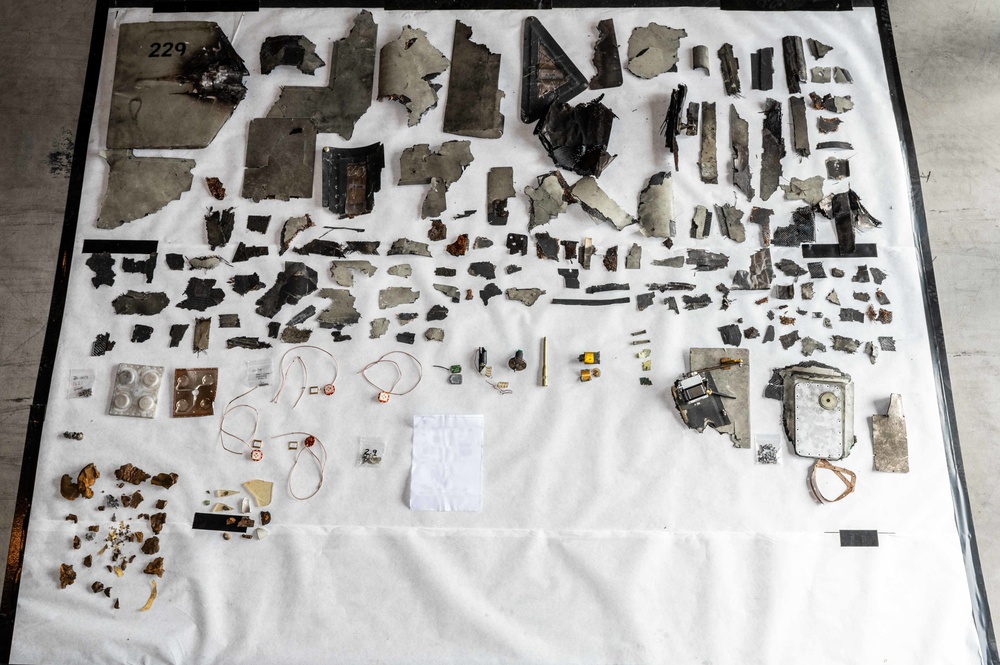
Overnight on July 28-29, Russia launched a combined-arms drone package against Ukraine that signals a deliberate shift in tactics: pairing genuine jet-powered strike drones with decoys engineered to look identical to them on radar. The goal, according to Ukrainian officials and open-source reporting, is to overwhelm and exhaust Ukraine's rapidly expanding fleet of interceptor drones before the real weapons arrive.
The Ukrainian Air Force reported 80 uncrewed aerial vehicles in the package, launched from six dispersed sites spanning Russian territory and occupied Ukrainian land: Oryol, Kursk, Bryansk, Primorsko-Akhtarsk, occupied Donetsk, and Hvardiiske in Crimea. Spreading launches across that many sites forced Ukrainian air-defense units to track multiple ingress corridors simultaneously rather than concentrating on a single axis of attack.
Ukrainian defenses neutralized 65 of the 80 drones — roughly 81% — as of 08:00 local time, according to the Air Force's tally, reported by both New Voice of Ukraine and Tech Times. That figure is actually a few points below the roughly 90% intercept rate Ukraine had sustained over the prior two months, per Tech Times' review of Ukrainian Air Force data on recent heavy-attack nights — a gap that lines up with the added strain of decoys in the mix and the presence of faster, jet-powered airframes among the real threats.
Five Drone Types, One Package
Per the Ukrainian Air Force, the 80-UAV raid combined five distinct airframes:
- Shahed/Geran variants, including jet-powered models — the Geran-3, Geran-4 and Geran-5 — capable of roughly 500 to 600 kph, far faster than the original propeller-driven Shahed-136/Geran-2, which cruises at roughly 185 kph.
- Gerbera loitering munitions, a lighter, cheaper decoy airframe Russia has fielded in growing numbers.
- Banderol loitering munitions, a jet-powered variant reported to reach 400-600 kph.
- Italmas strike drones.
- Parodiya decoys — warhead-free airframes built specifically to mimic the radar signature of a real Shahed.
The inclusion of Parodiya is the tactical center of gravity here. Because the decoy is designed so that ground-based radar cannot reliably distinguish it from a live Shahed, Ukrainian operators are forced to treat every contact as a potential real threat and commit an interceptor to it. Each interceptor spent on a Parodiya is one that isn't available when a genuine warhead-carrying drone — especially a jet-powered one closing at up to 600 kph — comes through minutes later.
Why Speed Changes the Math
The jet-powered Shahed/Geran variants in this package aren't a new discovery, but their presence alongside decoys sharpens a problem Ukraine's defense industry has been racing to solve. Reporting on Ukrainian Air Force figures puts Ukraine's current propeller-driven interceptor drones at roughly 120-150 kph cruise speed with sprint speeds around 200-250 kph — well short of the 300-600 kph range now reported for jet-powered Geran-3/4/5 and Banderol variants. According to a Janes defence-intelligence report, at least two Ukrainian companies are already testing jet-powered interceptor UAVs of their own, with one reporting a successful shootdown of a jet-powered Geran in testing; those interceptors are being built to exceed 350 kph specifically because the current generation of propeller-driven interceptors cannot run down jet-powered targets.
That's the logic behind pairing decoys with faster real weapons in the same raid: it doesn't just add numbers to saturate radar, it specifically targets the timing and asset-allocation constraints of Ukraine's interceptor-drone network, which has become one of the more cost-effective layers of Ukraine's counter-Shahed defense over the past year.
A Ballistic Missile Barrage Two Nights Later
The Parodiya-laden drone package wasn't the only pressure Russia applied that week. Two nights later, overnight on July 30, Russia launched a separate large-scale ballistic missile attack across multiple Ukrainian regions. The Kyiv Independent reported at least 8 people killed and more than 50 injured nationwide from that assault, with explosions heard in Kyiv. A missile — which Polish Prime Minister Donald Tusk said was likely a Russian Kh-101 — crashed in a field near Tarnawa-Kolonia in Poland's Lublin region during the attack, prompting Poland's air force to scramble fighter jets to protect its airspace.
The two nights aren't the same event, but together they illustrate a pattern: Ukraine's air-defense network doesn't get a night off. On one night it has to absorb a missile threat that interceptor drones cannot engage at all; on another, its drone-on-drone layer is being deliberately drained by decoys and outrun by jet-powered airframes. Sustained across a week, that combination compounds the defensive burden Ukraine's air-defense planners have to manage.
Why It Matters
Ukraine's interceptor-drone program has been one of the more effective and economical answers to the Shahed threat: cheap, fast-to-produce airframes that can down cheap, mass-produced attack drones without expending scarce and expensive surface-to-air missiles. Russia's pairing of jet-powered Shaheds with radar-indistinguishable Parodiya decoys is a direct attempt to blunt that advantage — not by making individual drones harder to shoot down, but by forcing Ukraine to spend interceptors on threats that were never going to detonate, then following up with real weapons moving too fast for most of the interceptor fleet currently in service to catch.
Ukraine still intercepted about 81% of the 80-drone package, which shows the defense network hasn't been broken by the tactic. But that rate came in a few points below Ukraine's roughly 90% trend from the prior two months, even as the underlying drone counts stayed in a similar range — a sign that Ukraine's defenders are working harder, and likely burning more interceptors per genuine kill, to hold a slightly weaker line. That's precisely the pressure driving Ukrainian industry, per Janes, toward jet-powered interceptor UAVs of its own — an arms race now playing out at drone-versus-drone speed rather than missile-versus-missile speed. Whichever side fields the faster, cheaper airframe at scale first will shape how sustainable nightly barrages — and nightly defenses — remain for the rest of the war.
Sources
- Russia Pairs Jet Drones With Radar Decoys to Outrun Ukraine's Interceptors — Tech Times
- Russia launches 80 drones in overnight attack against Ukraine — New Voice of Ukraine
- At least 8 killed, more than 50 injured across Ukraine as Russia launches massive ballistic missile, drone attack — Kyiv Independent
- Ukrainian companies developing jet-powered interceptor UAVs — Janes
