
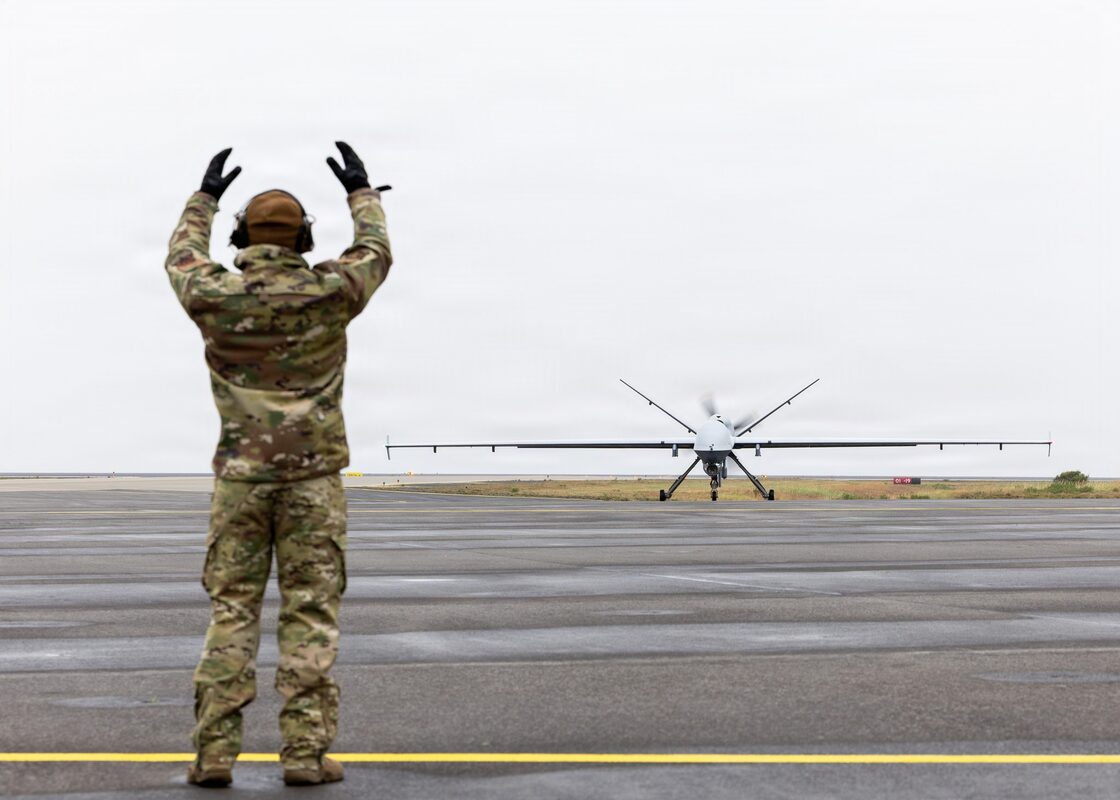
Over a single 72-hour stretch spanning September 6 to 8, 2026, Ukraine's long-range drone campaign reached three targets that illustrate how the war's deep-strike phase has matured: an aircraft repair complex that keeps Russia's A-50U AWACS aircraft flightworthy, a major oil refinery already on Kyiv's target list for months, and — in the other direction — Russian retaliatory strikes that killed civilians in Kyiv, Bryansk, Belgorod, and Crimea. Layered on top of the physical exchange, Ukraine's military intelligence agency disclosed that Russia has begun testing a new satellite constellation to support drone reconnaissance and strike operations, a development that speaks to where this contest is headed even as the current round of strikes plays out.
A Direct Hit on Russia's AWACS Lifeline
The most consequential strike of the window, in terms of Russia's military capability, hit overnight on September 6-7 at the Taganrog military airfield in Rostov region, roughly 40 kilometers (25 miles) from the Ukrainian border. Ukrainian drones struck two co-located facilities there: the 325th Aircraft Repair Plant and the Beriev Taganrog Aviation Scientific and Technical Complex — which repairs and modernizes the A-50U Beriev airborne early-warning and control (AWACS) aircraft, along with Il-76 transports and Il-38 maritime patrol planes, according to United24 Media, which cited NASA FIRMS satellite data recording a thermal anomaly at 2:44 a.m. local time in the airfield's aircraft parking area.
The A-50U fleet is one of Russia's scarcer high-value military assets, per United24 Media's reporting. United24 Media reported that Russia has shifted to daily A-50U sorties to bolster air defense against Ukrainian cruise-missile strikes, a conclusion drawn from OSINT analysis of more than 1,600 aviation reports collected between June and August 2026. That operational tempo makes the health of the Taganrog repair line relevant to how much airborne early-warning coverage Russia can sustain — and it means a strike that pulls the complex offline, even temporarily, could affect a fleet with limited slack to absorb disruption to its maintenance pipeline.
A Refinery Fire and a Contested Casualty Count
Ukrainian drones also ignited a blaze at Rosneft's Saratov oil refinery, a facility that the Kyiv Independent notes has been repeatedly targeted by Ukraine's drone program over the course of the war. The Moscow Times, citing Saratov region's governor, reported that the strike caused residential damage and left 10 people injured, including three children — a detail suggesting the attack, or Russian air-defense debris from intercepting it, affected an area beyond the refinery's perimeter. The Moscow Times described some reporting on the Saratov strike as unverified at the time of publication, while confirming the governor's account of injuries and property damage independently.
Russia's Retaliatory Strikes
Russia answered with a wave of missile and drone strikes across Ukraine and struck Kyiv overnight, killing at least three people and injuring 16, according to the Kyiv Independent. The outlet noted the attack came just as a brief truce — one that had coincided with a visit by a U.S. envoy — collapsed into renewed missile fire.
Ukraine's own drone strikes drew a broader retaliatory pattern across Russian-held and Russian territory. The Moscow Times reported at least four people killed and 18 injured overnight in a spread of locations: one dead at a gas station in Starodub, Bryansk region; one dead and four injured in Belgorod region, where the governor said the area had absorbed 112 attacks in the preceding 24 hours; and two dead, one injured near Simferopol in occupied Crimea. Russia's Defense Ministry claimed it intercepted 384 Ukrainian drones across Russian territory and Crimea overnight — a figure that, if accurate, underscores the scale Ukraine's drone production and sortie rate have reached, even accounting for the Russian military's history of rounding such numbers to project a comprehensive air-defense picture.
Satellites Enter the Strike-Drone Picture
The physical exchange over Kyiv, Saratov, and Taganrog was accompanied by a disclosure with longer-term implications. Janes, a primary defense-intelligence outlet, reported that Ukraine's Defence Intelligence directorate (DIU/HUR) told reporters Russia had operationalized its new Rassvet satellite constellation for satellite communications over Ukraine by late July 2026, sustaining the connection for "several hours." A DIU official told Janes the capability "could be potentially used for real-time data transmissions and for operating reconnaissance and strike UAVs" — meaning a functioning Rassvet network could let Russian forces control drones or relay targeting data beyond line-of-sight without relying on ground-based communications infrastructure that Ukraine can more readily jam or strike.
Russia has deployed 38 Rassvet satellites as of August 2026, built by Bureau 1440 and launched in batches starting with an initial 16-satellite launch on March 23, 2026. Seven more launches are planned by year's end, per Janes' report. Even so, DIU assessed that Moscow faces component constraints that will limit the pace of future deployments — suggesting the constellation, while operational in a limited test capacity, is not yet a mature or fully resilient system.
Why It Matters
Each element of this 72-hour window points to the same underlying dynamic: both sides are racing to protect and extend an increasingly automated air war while inflicting attrition on the systems that support it. Ukraine's strike on Taganrog targets a facility central to keeping Russia's A-50U AWACS fleet airworthy, and a fleet already flying daily sorties to compensate for cruise-missile threats has little slack to absorb disruption to that maintenance pipeline. The Saratov refinery strike continues a monthslong campaign against Russian fuel-processing capacity, an economic and logistical pressure point distinct from battlefield effects. On the other side of the ledger, Russia's claimed interception of 384 drones in a single night, if accurate, illustrates how much of its air-defense effort is now consumed by Ukrainian long-range drones rather than conventional aircraft or missiles — a shift in the threat picture that has forced changes like the daily A-50U flights in the first place. And the Rassvet satellite disclosure signals that Russia is actively working to close a command-and-control gap that has repeatedly hampered its drone operations, even if component shortages currently cap how fast that capability can scale. Together, the events of September 6-8 read less as isolated incidents than as snapshots of an escalating, technologically layered contest over who can strike further, faster, and with better targeting data.
Sources
- Kyiv Independent — "Russia pounds Kyiv in overnight attack, killing 3, injuring 16 / Ukrainian drones ignite blaze at Russia's Saratov Oil Refinery"
- The Moscow Times — "4 Killed in Ukrainian Drone Attacks on Russian Regions and Crimea"
- United24 Media — "Ukraine Hits Taganrog Aviation Hub Keeping Moscow's Scarce A-50U AWACS Fleet Alive"
- Janes — "Ukraine's defence intelligence says Russian forces used Rassvet satellites for 'several hours'"