
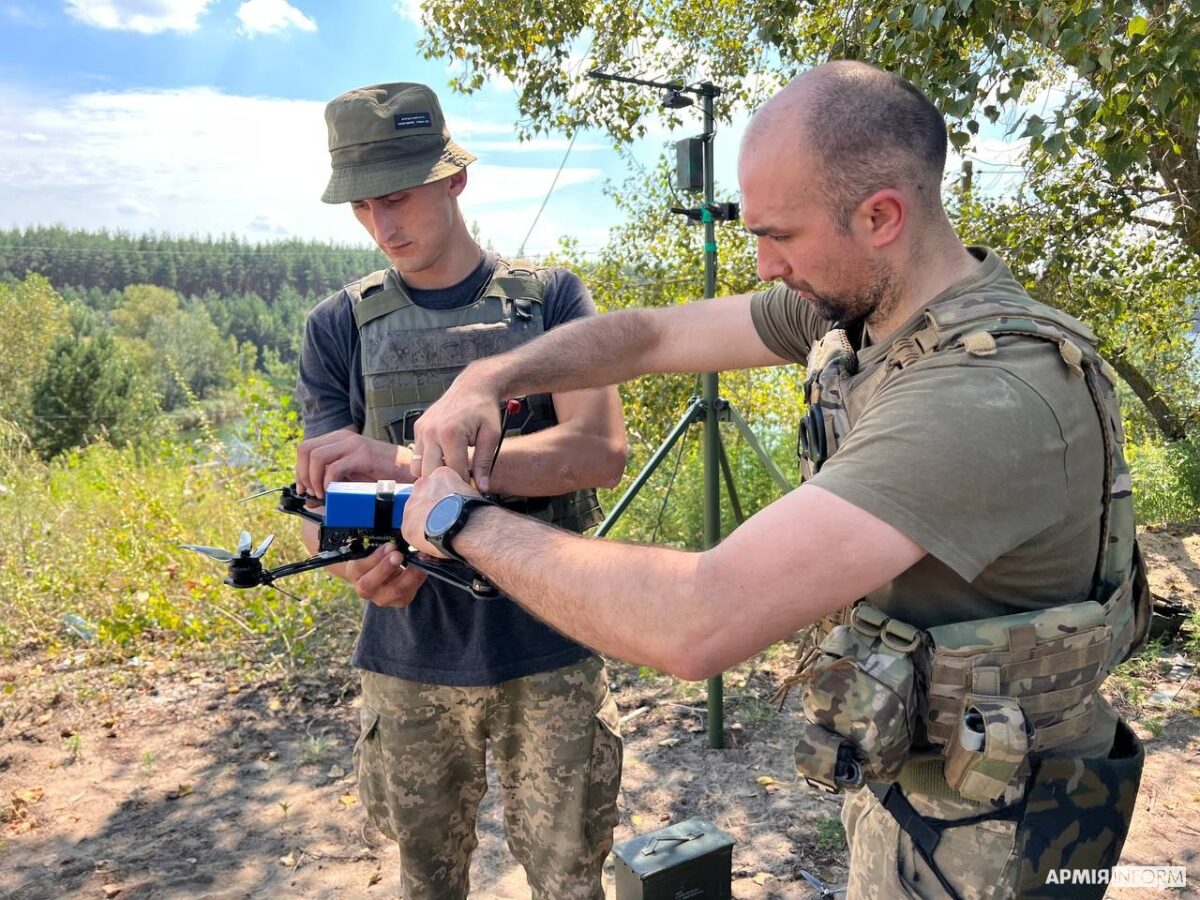
Before February 2022, Ukraine had seven drone manufacturers. By 2025 it had roughly 500, with about 100 holding active government contracts. Ground-vehicle robotics companies went from zero to 280 over the same period; electronic-warfare firms from two to 300. The Brave1 defense-tech ecosystem now lists 1,500 companies and 3,500 products. That expansion didn't happen in peacetime conditions—it happened under daily missile strikes, in a country simultaneously rebuilding procurement institutions from scratch, and it has produced an industry that operates on timelines NATO acquisition offices are only beginning to process.
From Volunteer Workshops to Industrial Contracts
The first wave of Ukrainian drone production was improvised. Volunteers assembled FPVs in apartments; brigades sourced quadcopters through charitable foundations; quality was inconsistent and supply unpredictable. Annual output jumped from a few thousand small drones in 2022 to 600,000 in 2023, then to 2.2 million in 2024—96 percent domestically produced. By February 2025, President Zelensky stated Ukraine was capable of manufacturing 4 million drones per year. In May 2025 alone, Ukrainian forces deployed 400 distinct drone types at prices ranging from a few hundred dollars to $250,000.
That acceleration required institutional spine. Brave1, launched in 2023 by six Ukrainian ministries on a Defense Innovation Unit model, became the connective tissue. By February 2025 it had issued more than 470 grants totaling 1.3 billion UAH (roughly $8 million) and drawn 155 manufacturers into structured procurement. Ukraine allocated 25 percent of its war budget to UAVs as early as August 2023; the government UAV budget ran $970 million in 2023, $1.43 billion in 2024, and $1.14 billion in 2025.
Manufacturers still ran at only 37 percent capacity through 2024 because contract flow was erratic. In March 2025 the government began offering guaranteed multi-year contracts—three, five, or ten years—for makers with greater than 50 percent domestic content. The twin marketplaces Brave1 and DotChain closed the last-mile gap: DotChain lists approximately 150 models from 30 manufacturers, promises five-to-ten-day delivery to frontline brigades, and has enrolled 130 brigades. Units earn credits for strike-confirmed kills. A DJI order clears in roughly three days; comparable European suppliers take four to five months.
"We do in 3 days what NATO does in 3 months or 3 years." — unnamed Ukrainian industry participant, DIU-Brave1 Warsaw Conference
The Production Ladder: FPV to Turbofan Strike
The base layer of Ukrainian production is the FPV—cheap, expendable, high-volume. Monthly capacity reached 200,000 units in 2025, a tenfold increase over 2024. Accuracy ceilings have also risen: FPV hit rates stand at 30–50 percent in general use, compared with roughly 30 percent overall strike success in 2022 versus 70 percent by 2024. FPV drones contribute to 60–70 percent of Russian equipment losses.
Above the FPV tier sits a growing fiber-optic segment. Fiber-guided drones are immune to the electronic warfare and RF-intercept countermeasures Russia deploys most heavily. Early Ukrainian systems reached roughly 10 kilometers; by January 2025 the 414th Brigade announced a 41.4-kilometer fiber FPV, with a 1,100-unit batch and production approaching 1,000 per month.
At the top of the ladder are long-range strike systems. The AN-196 Liutyi uses AI route navigation. The FP-5 Flamingo represents a larger-class strike system that Ukrainian forces have deployed against Russian targets.
The Chinese-Component Dependency and the Localization Race
Ukraine's industrial expansion rests on a fragile supply base. China supplied most of the components that made cheap FPV production possible—flight controllers, carbon frames, brushless motors, radio modules, navigation cameras, lithium-ion batteries. In 2023, Ukraine purchased 60 percent of DJI's global Mavic output. Then Beijing tightened the tap: June 2023 restrictions targeted drones over 15.5 pounds; September 2024 comprehensive controls covered nearly every critical component. The contrast with Russia was sharp: Russia received $14.5 million in direct Chinese drone shipments in 2023 versus $200,000 for Ukraine. China's 2025 rare-earth-magnet export restrictions cut global shipments by 75 percent.
The downstream effects were severe. Component prices tripled. Ukraine was losing roughly 10,000 drones per month to battlefield attrition. Only 5 percent of Ukrainian defense-industry council members reported zero Chinese components in their supply chains. Motor dependency was characterized as "almost absolute," rooted in China's dominance of neodymium magnet supply. Thermal cameras were 90 to 95 percent Chinese-sourced.
The localization effort is measurable but incomplete. Motor-G, founded in 2023, reached mass production in December 2024 and is approaching 100,000 motors per month, against a total Ukrainian demand exceeding 730,000 units monthly. Vyriy reached 65–70 percent localization and delivered its first 1,000 fully localized thermal drones in March 2025. Five Ukrainian electronic-component manufacturers were operational by December 2024. Ukraine is planning a chip fab at 110–180 nanometers capable of 50,000 chips per month. Ukrainian carbon fiber frames now undercut Chinese pricing. An April 2025 Component Library platform launched with 180-plus users and 130-plus listed products. The 2024 funding mix—40 percent Ukraine, 30 percent US, 30 percent Europe—reflects how internationalized the supply problem has become.
The export and IP picture is more sobering. General Cherry has partnered with Croatia's Orqa for NATO-market production and signed an agreement with US firm Wilcox Industries for a New Hampshire manufacturing line. But Ukrainian companies filed just four drone-related patents between 2022 and 2023; Russia filed 333.
Sources
- Georgetown Security Studies Review — A First Point of View: Examining Ukraine's Drone Industry
- CSIS — Why China's UAV Supply Chain Restrictions Weaken Ukraine's Negotiating Power
- Kyiv Independent — Little by Little Away from China: Ukraine's New Mass Production of Drone Parts
- CSET Georgetown — The Future of Drones in Ukraine: A Report from the DIU-Brave1 Warsaw Conference
- Defense Express — Ukrainians Made an FPV with Fiber Optic Cord Stretching for 41 km (Jan 2025)
- Militarnyi — Flamingo, Liutyi, Workshops: VNIIR Progress
- DroneXL — Ukraine Military Drone Marketplace Brave1 (April 2026)
