
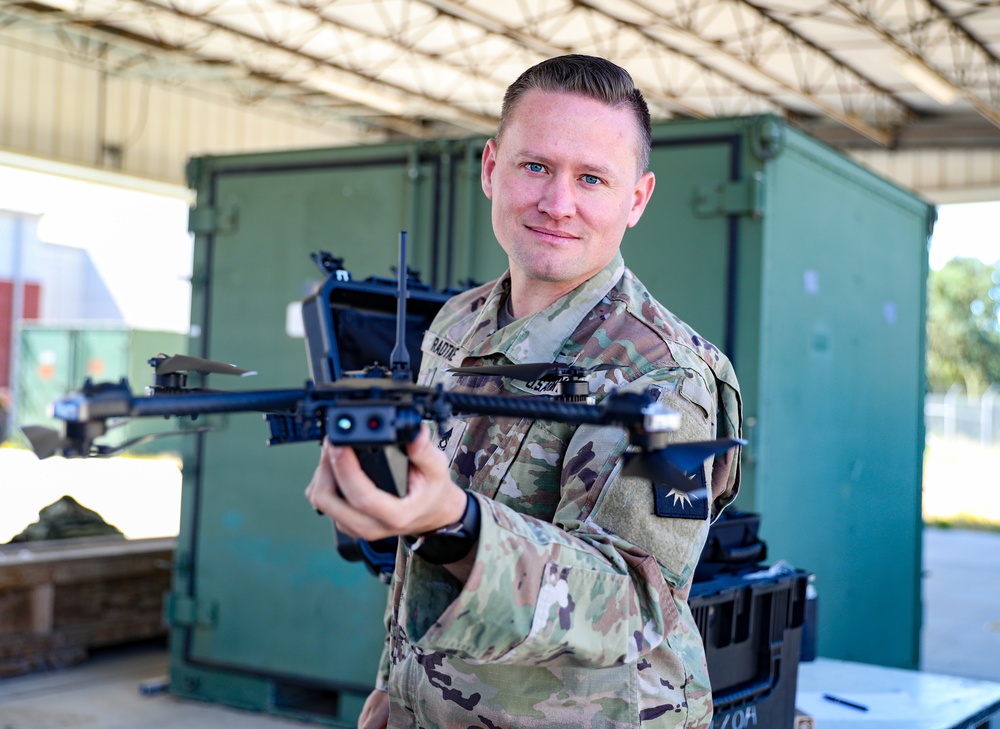
On July 13, 2026, Ukraine's Ministry of Defence published a list of names that read like a bestiary: Halka, Hydra, Kruk, Sokil, Beshket, Bababoom, Zorro, Optoslon, Bilyi Vovk. They are not concept sketches or trade-show mockups. Each one has cleared codification — the formal administrative act that admits a weapon into service with Ukraine's Defence Forces — and the ministry counted 413 of them since January 1.
That is more than two new unmanned aerial systems approved for military use every single day, weekends and air-raid alerts included. It is over 30% more than the same period in 2025, and more than 73% above the first half of 2024. The figure was independently reported the same day by Ukrainska Pravda and by ArmyInform, the Defence Ministry's own information agency, which framed the story around accelerating codification tempo rather than any single airframe.
The interesting number is not the drones. It is the gate they went through.
What codification actually is
In Ukrainian military-administrative usage, кодифікація is the mechanism by which a piece of equipment stops being a thing someone built and becomes a thing the state can buy, issue, account for, and send to a brigade. It assigns the item a catalogue identity within the armed forces' supply system. Before codification, a drone coming out of a workshop is a donation at best — unbudgetable and untracked. After codification, it is a line item.
In most defense establishments this gate is where innovation goes to wait. Type classification, qualification testing, and cataloguing are measured in fiscal years. Ukraine has spent the war compressing that gate into something closer to a conveyor — and the 413 figure is best read not as a count of gadgets but as a measurement of throughput. The ministry is reporting on its own bureaucracy's clock speed.
The comparison across years makes the point sharper than any single-year total could. A 73% increase over 2024 and a 30% increase over 2025 describes an institution that is still finding slack in a process it has already optimized twice.
Nearly all of it is Ukrainian
The MoD's announcement says майже всі — almost all — of the 413 systems are Ukrainian-made, and ArmyInform's phrasing is similar: "the vast majority are developments of Ukrainian manufacturers." Neither puts a precise percentage on the drone subset specifically, and readers should be wary of one being supplied for them.
The wider denominator is where a hard number does exist. According to zbroya.gov.ua, the Defence Ministry's weapons portal, Ukraine codified roughly 1,000 weapons samples of all kinds between January 1 and mid-June 2026 — up more than 50% from 659 in the same period of 2025. Of those 1,000, the portal reports 892 were domestically manufactured: an 89.2% domestic share, up from 69.6% across 2025. Euromaidan Press reports the same two figures.
That near-90% share is worth stating precisely, because it is easy to misread. It describes all newly codified Ukrainian materiel — ammunition, communications gear, electronic warfare, cruise missiles — not the drone tranche alone. The domestic share of the 413 UAS is characterized by the sources only qualitatively.
What does fall out of the figures is the trajectory. The domestic share jumped roughly twenty percentage points in a year. That is not a gradual localization curve. Something changed in what Ukraine can build versus what it must be given — and the direction of travel is away from dependence on external supply at precisely the moment external supply has become the least predictable variable in the war.
The drone share of that 1,000 cannot be cleanly computed from the published figures. The 413 count runs through July 13, while the 1,000-sample tally stops in mid-June, where the portal's own breakdown lists "300+ new UAVs." The two numbers do not share a denominator, and dividing one by the other produces a ratio no source states.
What the mix says about the fighting
The categories reported are broader than a strike-versus-reconnaissance taxonomy suggests: aerostat, fixed-wing, and multirotor reconnaissance systems; loitering munitions and FPV drones; bomber UAS and interceptor drones; relay drones and target UAVs; fibre-optic systems; and both front-strike and deep-strike drones.
Two categories dominate the approvals. Per Ukrainska Pravda, multirotor strike drones and fibre-optic UAS represent the largest share, with significant growth specifically in front-strike attack drones — the short-range end of the kill chain that operates within a few kilometers of the line of contact. Among the individually named approvals are the Queen Hornet, a 17-inch multi-purpose drone, and the Kolibri 13-O, an FPV drone with a 20-kilometer fibre-optic control link.
Fibre-optic control is the tell. A cable-guided drone cannot be jammed, because there is no radio link to jam. It cannot be direction-found back to its operator by RF triangulation, because it is not transmitting. In exchange it accepts a spool's worth of range, a snag risk in trees and rubble, and a physical tether that constrains maneuver. That an entire nation's approval pipeline is bending toward this tradeoff is a statement about how thoroughly the electromagnetic spectrum over the front has been contested. When both sides have saturated the airwaves with jamming, the winning move is to stop using the airwaves.
The heavy weighting toward multirotor strike drones and front-strike systems tells a parallel story about attrition economics. These are short-range, high-volume, expendable systems — the category where unit cost matters more than exquisite capability, and where a domestic supply chain that can iterate weekly beats an imported system that iterates annually. Codifying 413 of them is less about fielding 413 distinct capabilities than about keeping a legal supply of substitutes flowing as each design is countered in turn.
The numbers that need a name attached
Two figures circulate alongside this announcement, and they do not carry equal weight.
The Octopus interceptor order is corroborated. ArmyInform reports directly that "the Defence Ministry of Ukraine is purchasing 8 thousand Octopus interceptor drones for the Defence Forces' needs," and Euromaidan Press describes the same 8,000-unit procurement of what it calls a Shahed-killer with automatic terminal guidance. Two sources, one of them the ministry's own agency.
The kill count is not. Euromaidan Press alone reports that Ukrainian interceptors destroyed a record 33,000 Russian UAVs in March 2026. That figure does not appear in the ArmyInform piece, the zbroya.gov.ua release, or the Ukrainska Pravda report, and UASFeed has not been able to corroborate it independently. Readers should weigh it as Euromaidan Press's reporting rather than as a confirmed ministry figure.
The 413 number itself carries no such caveat. It appears in the ministry's own announcement and in three separate outlets, including the ministry's information agency, all on July 13.
One procedural note: the MoD's announcement page returns HTTP 403 to automated retrieval, a bot-blocking measure rather than a takedown. We cite it as the announcement of record on the strength of the corroborating coverage.
Why It Matters
Codification counts are the least glamorous statistic in defense reporting and one of the most diagnostic. Every military on earth has a drone-innovation problem; almost none of them have a drone-innovation-ingestion problem solved. The bottleneck in Western programs is rarely a shortage of clever airframes — it is that the clever airframe cannot be bought, because it has no catalogue number, because the process that assigns catalogue numbers was designed for tanks.
Ukraine's 413 is a demonstration that the gate is a policy choice, not a law of physics. A state under existential pressure rebuilt its admission-to-service pipeline into something that can absorb two new systems a day, and then accelerated it 30% year over year on top of that. The near-90% domestic share across all codified materiel means the pipeline is not just fast but self-feeding: the approvals are pulling from a workshop ecosystem that exists because the approvals exist. Codification is the industrial policy. The drones are the output.
For allied procurement officials, the uncomfortable read is that the relevant benchmark is no longer whose drone is better. It is whose bureaucracy can field a countermeasure to a countermeasure inside the enemy's adaptation cycle. On that metric the fibre-optic surge is instructive — an entire category shifted from novelty to approval-pipeline dominance in the time most acquisition systems spend writing a requirements document.
And the quiet headline is the composition of the pipeline itself. Of roughly 1,000 weapons samples codified through mid-June, the ministry's own breakdown counts 300-plus UAVs alongside 188 ammunition types, 128 communication systems, 60-plus electronic warfare systems, and 50 cruise missiles. A defense-industrial base whose single largest category of newly admitted materiel is unmanned aircraft is not a conventional force that has added drones. It is a different kind of force, and the paperwork is the proof.
Sources
- Українські «Соколи», «Гідри» і «Круки»: Міноборони кодифікувало 413 нових БпАК — Ministry of Defence of Ukraine, July 13, 2026
- Міноборони кодифікувало 1 000 зразків озброєння з початку 2026 року — zbroya.gov.ua (Ukrainian MoD weapons portal)
- Ukraine's Defence Ministry has codified over 400 unmanned aerial systems since start of year — Ukrainska Pravda, July 13, 2026
- Понад 400 нових БпАК: Міноборони наростило темпи кодифікації українських дронів — ArmyInform, July 13, 2026
- Ukraine approves more than two new drone systems a day this year. Almost all of them are now homemade — Euromaidan Press, July 13, 2026