
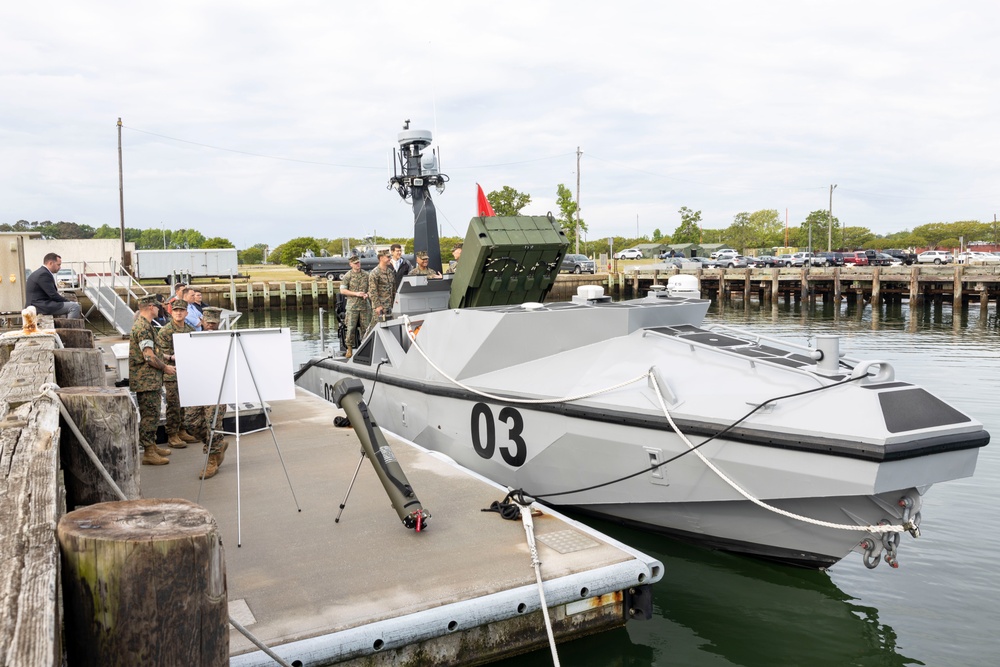
On July 13, 2026, a small, unremarkable-looking uncrewed surface vessel nosed up to a stretch of contested sand on Ukraine's Kinburn Spit, dropped its ramp, and let a tracked robot roll off into the surf. No sailor piloted the boat. No infantryman rode the robot ashore. No pilot sat behind the drone circling overhead. When the tracked machine reached the waterline, it opened fire on Russian positions with its own machine gun — the first shots ever fired in what Naval News and Forbes are calling the first fully unmanned combined-domain amphibious assault in history.
The operation was carried out by Ukraine's 123rd Separate Territorial Defense Brigade. In a statement, the brigade called it "the first combat mission of this kind known to us in the world" — a claim that, as of this writing, no other military has publicly disputed.
What Actually Happened
According to Naval News, the raid unfolded across three domains simultaneously, with no human physically present in any of them. An uncrewed surface vessel ferried a Rys unmanned ground vehicle — built by Ukrainian manufacturer Roboneers and armed with a 7.62mm PKT machine gun — across the water to the beach at Kinburn Spit. Once ashore, the Rys fired at least three rounds at Russian positions from the waterline. Overhead, a separate UAV provided real-time aerial observation, letting operators watching remote video feeds coordinate the boat-to-shore transfer and confirm the engagement.
Naval News identified the ground robot as a Rys, a tracked platform developed by Ukraine's Roboneers and armed with a 7.62mm PKT machine gun. Forbes contributor David Hambling pointed to the DevDroid TW 12.7 — a roughly $30,000, .50-caliber-armed tracked platform capable of about 4 mph — as an example of a typical Ukrainian combat UGV, though he did not identify the specific platform used in the raid. What both accounts agree on is the structure of the mission: a naval drone acting as a landing craft, a ground robot acting as the assault element, and an aerial drone acting as the eyes — an entirely roboticized reenactment of a classic amphibious raid, minus the humans.
Why Kinburn Spit
Kinburn Spit is a narrow, low-lying peninsula on the northern shore of the Black Sea's Dnipro-Buh estuary, opposite Ochakiv, and it has been a contested sliver of ground since Russian forces occupied it early in the full-scale invasion. Ukrainian forces had already planted a flag on part of the spit on June 25, 2026, according to Naval News, and the Ukrainian partisan monitoring group ATESH reported that Russia's 337th Regiment had pulled back from sections of the spit amid supply shortages. The unmanned raid appears to have followed on the heels of that partial Russian withdrawal, probing or reinforcing a foothold in territory Moscow's grip on had already loosened.
Part of a Bigger Pattern
The Kinburn Spit raid did not emerge in isolation. It's the latest data point in Ukraine's rapid buildup of an uncrewed Black Sea and littoral warfare ecosystem. Per C4ISRNET, Ukraine's Magura USV — built by Uforce, a London-based startup, for the GUR, Ukraine's military intelligence directorate — has sunk or damaged roughly a dozen Russian warships since 2022, and was significant enough as a concept that U.S. special operations forces trialed a version of it during the Balikatan 2026 exercise in the Indo-Pacific on June 24. The Security Service of Ukraine's Sea Baby platform, meanwhile, has grown into more of a mothership than a simple attack boat: it can carry roughly 4,400 pounds of payload, range up to 930 miles, and launch six to eight FPV drones from its deck. A Sea Baby variant reportedly became the first uncrewed underwater vehicle to strike a submarine while in port, per Ukraine's SBU, hitting a target at Novorossiysk on December 15, 2025.
Ground robotics have scaled just as fast. Forbes reports Ukraine produced roughly 10,000 UGVs in 2025 and is targeting 50,000 for 2026. Andriy Biletskyi, commander of Ukraine's 3rd Army Corps, has stated publicly that he wants unmanned ground vehicles to replace a third of front-line infantry positions by the end of the year — a goal that frames the Kinburn Spit raid less as a novelty and more as an early proof of concept for how Ukraine intends to fight going forward.
Why It Matters
Unmanned systems have individually reshaped modern warfare for years — FPV drones dominating the front line, naval drones neutralizing much of Russia's Black Sea surface fleet, ground robots hauling supplies and casualties under fire. What makes the Kinburn Spit operation notable is the integration: a single mission chaining a naval drone, a ground robot, and an aerial drone into one continuous, human-out-of-the-loop-of-fire sequence, from ship-to-shore transport through direct engagement.
That matters for a few reasons. First, it removes the single greatest constraint on amphibious raids — the risk to the assault force during the most exposed phase of the operation, the run from water to cover — without removing the ability to deliver direct fire. A robot that takes small-arms fire on an open beach costs a few tens of thousands of dollars and no lives; a squad that does the same risks both. Second, it signals that Ukraine's drone industrial base, which Forbes notes produced roughly 10,000 UGVs last year en route to a stated 50,000 target this year, has matured to the point where combining domains isn't an experimental stunt reserved for a single showcase unit — it's becoming operationally repeatable. Third, it validates the doctrinal ambition voiced by commanders like Biletskyi: using robots not just to support infantry, but to substitute for it in specific, dangerous roles, with amphibious assault being one of the most dangerous roles of all.
For other militaries watching the war — including the United States, which has already begun testing Ukrainian-designed naval drones like Magura in its own Indo-Pacific exercises — the Kinburn Spit raid is a preview of a tactic that is likely to proliferate well beyond the Black Sea.