
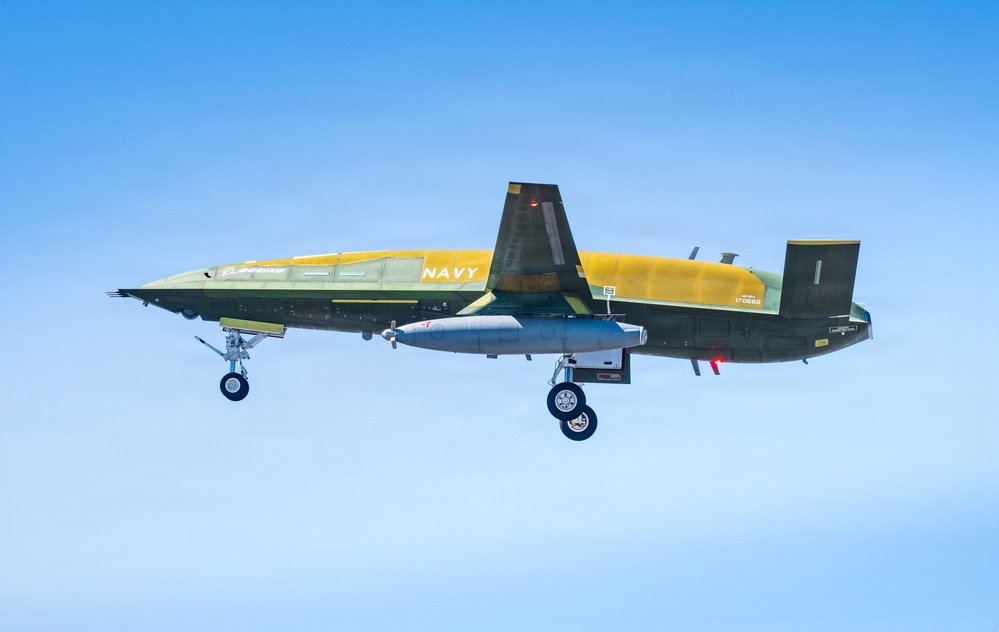
The U.S. Navy on July 14 released a Request for Information seeking industry input on what it calls the "Air Wing of the Future" Family of Systems — a suite of unmanned carrier-based aircraft designed to take on nearly every mission currently split between manned jets, helicopters and support planes. The notice, issued by the Navy's Portfolio Acquisition Executive for Aviation, gives industry until Aug. 13 to respond, and it lays out a strikingly broad set of requirements for a service that has spent the past decade cautiously wading into carrier-based unmanned aviation with a single aircraft: the MQ-25A Stingray refueling drone.
This time, the Navy isn't asking for one airplane. It's asking for a family of them.
What Exactly Is the Navy Asking For?
According to the RFI, the Navy wants concepts and capabilities across eight distinct mission sets: surface strike, land strike, anti-submarine warfare, air-to-air combat, electronic warfare, intelligence-surveillance-reconnaissance (ISR), aerial refueling and task force resupply. That list reads less like a single aircraft's mission profile and more like the entire job description of a modern carrier air wing — traditionally performed by a mix of F/A-18 Super Hornets, F-35C Lightning IIs and E-2D Hawkeyes.
The RFI sets a minimum range requirement of 1,000 nautical miles for strike missions — a figure that has drawn particular attention because it would let unmanned strike aircraft operate well outside the threat envelope of long-range anti-ship missiles that have driven carriers to keep their distance from contested coastlines. The notice also calls for vertical takeoff and landing (VTOL) capability, specifically so the systems can operate from destroyers and mobile sea bases rather than solely from a carrier's flight deck. And it requires compatibility with the Navy's existing Unmanned Carrier Aircraft (UCA) control systems — the command-and-control infrastructure already built to fly the MQ-25A — rather than a bespoke ground-control setup for each new airframe.
Why a "Family" Instead of One Aircraft?
The framing as a Family of Systems, rather than a single program of record, signals that the Navy expects different companies — or different variants from the same company — to fill different mission niches under one common set of standards. That mirrors the approach the Air Force has taken with its Collaborative Combat Aircraft (CCA) program, which is developing multiple drone types intended to fly alongside manned fighters. UASFeed sister coverage and outside reporting have both tied the Navy's new RFI directly to CCA and to the MQ-25A Stingray as the two building blocks the service is now trying to extend into a broader carrier-based unmanned fleet.
The approach also reflects a concept some analysts have dubbed "affordable mass": rather than betting the air wing's combat power on a small number of extremely expensive, exquisitely capable manned platforms, the Navy is exploring whether a larger number of less expensive, more numerous unmanned systems — potentially expendable or attritable in some roles — can generate comparable or greater combat effect. If one drone in a strike package designed around eight mission types is lost, the theory goes, the mission continues; losing a single manned fighter is a far costlier setback in both material and human terms.
How Does This Connect to the "Golden Fleet" Plan?
The RFI is tied to the Trump administration's "Golden Fleet" Navy expansion initiative, which has pushed for a larger and more capable fleet. Folding a family of unmanned carrier aircraft into that expansion would let the Navy grow the effective size and reach of its air wings without a one-to-one increase in manned aircraft procurement, pilot training pipelines and the associated long-term costs. It also dovetails with a carrier air wing's finite deck space: a Ford- or Nimitz-class carrier can only park and launch so many aircraft, and a family of smaller, potentially VTOL-capable unmanned systems that can also operate from destroyers and mobile sea bases would let the Navy distribute more airpower across more platforms instead of concentrating it entirely on the carrier deck.
What Happens Next?
An RFI is not a contract solicitation — it's an information-gathering step the Navy uses to understand what industry believes is technically achievable before it commits to formal requirements and a competitive acquisition. Companies have until Aug. 13 to submit their responses, after which the Navy will presumably use the feedback to shape a follow-on solicitation. Given the breadth of the RFI's eight mission areas, it's plausible the "Air Wing of the Future" ultimately becomes several separate acquisition efforts — a strike-focused CCA-style fighter, a refueling/resupply variant building on MQ-25A lessons, and other specialized types — bound together by the same range, VTOL and control-system standards laid out in this notice, rather than a single aircraft trying to do all eight jobs at once.
Why It Matters
The RFI marks a meaningful escalation from the Navy's current, narrow experience with carrier-based unmanned aviation. To date, the MQ-25A Stingray has been the sole unmanned aircraft cleared to operate from a carrier deck, and its job — aerial refueling — is a support role, not a combat one. Asking industry for concepts that put unmanned aircraft into air-to-air combat, strike and electronic warfare roles alongside crewed F-35Cs and Super Hornets would represent a structural shift in how the Navy generates combat power at sea. The 1,000-nautical-mile range requirement in particular addresses one of the carrier force's most pressing operational problems: the growing reach of adversary anti-ship missiles is pushing carriers further from shore, which in turn shrinks the effective combat radius of manned strike aircraft unless the air wing itself can reach further. A family of longer-ranged, VTOL-capable unmanned systems — deployable from destroyers and mobile sea bases as well as the carrier itself — would give the Navy options to project airpower without closing the distance the carrier needs to stay safe. Whether industry can deliver eight mission types across a shared control architecture on the Navy's timeline is the open question this RFI is designed to answer.