
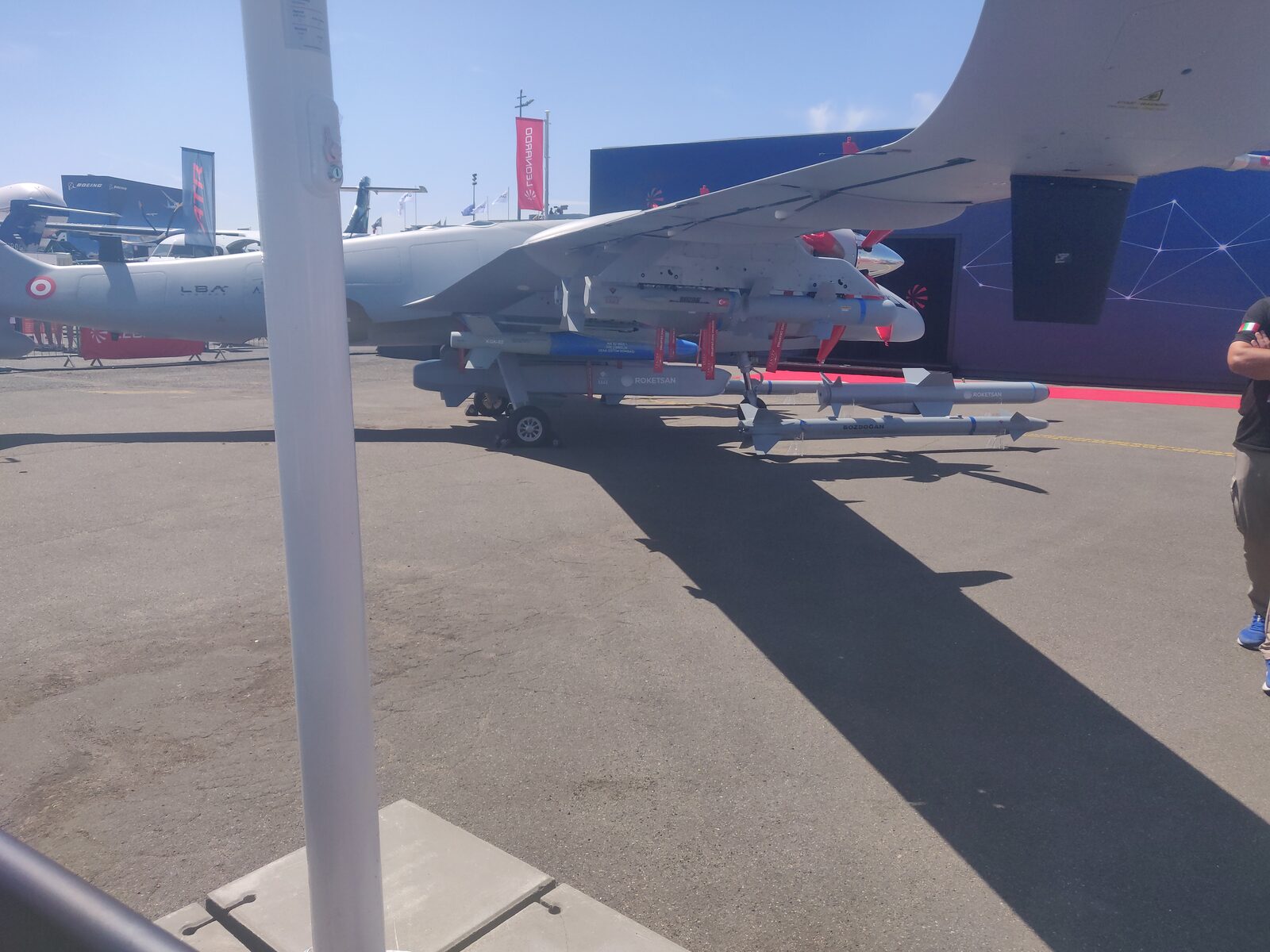
When Azerbaijan's forces used Bayraktar TB2s in the 2020 Nagorno-Karabakh conflict, Turkey's drone industry got its global audition. What's come since is considerably heavier. Two platforms—Baykar's Akinci and Turkish Aerospace Industries' Aksungur—represent a deliberate step up from the TB2 in weight class, weapons load, and strategic ambition. Both are now in export service. Neither is as famous as the TB2. Both deserve more attention than they get.
The Akinci: Deep-Strike UCAV
Comparing the Akinci to the TB2 by specifications understates the difference in roles. The TB2 weighs 1,200 kg at max takeoff; the Akinci is 5,500 kg—more than four times as much. The TB2 is 6.5 meters long; the Akinci is 12.2 meters with a 20-meter wingspan. The TB2's operational range is roughly 300 km; the Akinci's is roughly 5,000 km. The TB2's ceiling is around 8,239 meters; the Akinci's operational altitude is 30,000 feet, with a service ceiling of 40,000 feet. These are not incremental improvements—they describe an entirely different class of aircraft.
Unveiled at TEKNOFEST Istanbul in September 2019, the Akinci completed its maiden flight in December of that year, conducted its first live-fire test in April 2021, and entered Turkish Armed Forces service in August 2021. Engine options include 450 hp and 750 hp turboprops. Maximum endurance is up to 24 hours at 150 knots cruise, with a 250-knot top speed.
The sensor suite is what separates the Akinci most clearly from its predecessor: multi-mode AESA radar, synthetic aperture radar, SIGINT collection, air-to-air radar, EO/IR with laser designation, and the Aselsan ANTIDOT 2-U electronic warfare pod—which adds ESM detection, classification, and geolocation of radar emissions plus active jamming and deception. That EW capability was previously restricted to crewed aircraft. Dual AI-powered avionics run against a triple-redundant flight control system, with both line-of-sight and BLOS satellite comms.
The Akinci is among the first UCAVs certified to carry air-launched cruise missiles. Its certified weapons include the SOM-A stand-off cruise missile, TRG-230 Kaplan aeroballistic missiles, JDAM-equipped gravity bombs, MAM-T/C/L smart micro munitions, BOZOK miniature laser-guided rounds, and—most consequentially—Gokdogan and Bozdogan air-to-air missiles. Air-to-air capability on an uncrewed platform shifts the Akinci from a strike asset to something closer to an autonomous combat air vehicle. The PT-10 variant formalizes this as a modular multi-mission configuration.
As of early January 2026, Baykar had delivered 110 Akinci airframes, targeting 120 by year-end. More than 2,000 personnel have been trained as pilots and technicians since 2021; certification requires 30 sorties over five months—a pipeline that creates long-term dependency relationships with export customers. The Akinci has reached at least 10 export countries. Pakistan was the first foreign customer, receiving its initial batch in summer 2023. Azerbaijan completed pilot training by August 2022 and held a formal unveiling at a new UAV academy during President Aliyev's visit in February 2024. The confirmed roster includes Ethiopia, Libya, Kosovo, Kyrgyzstan, Saudi Arabia, and Morocco—which stepped up from 19 TB2s acquired in 2021 to adding the Akinci in 2024, with deliveries planned to begin in February 2025.
Baykar reported $1.8 billion in total exports in 2024, representing 90 percent of its revenue and approximately 25 percent of Turkey's entire defense export figure that year. The company claims roughly 60 percent market share in global UCAV exports and describes itself as three times larger than its closest U.S. competitor. Turkey as a whole claims approximately 65 percent of the global UAV export market—a redistribution of market share away from U.S. and Israeli suppliers over roughly a decade.
The Aksungur: State Builder, Maritime Focus
While Baykar is private, Turkish Aerospace Industries is majority state-owned—a distinction that shapes how the Aksungur moves through export pipelines. The platform is TAI's heavy MALE offering, evolved from the earlier Anka UAV and aimed primarily at maritime patrol, ISR, and persistent strike. Its airframe is larger in wingspan than the Akinci (24.2 meters versus 20 meters) but lighter overall, with a 3,300 kg MTOW on an 1,800 kg empty structure. Maximum payload exceeds 750 kg across six hardpoints. Maximum endurance is 50 hours on ferry profile; with full payload at 25,000 feet, that drops to 12 hours. Ceiling is 40,000 feet.
The Aksungur's most strategically significant feature is its propulsion. Both engines are TEI PD-170 twin-turbocharged diesel units, each producing 170 hp, developed by TUSAŞ Engine Industries. Turkey's Defense Industry Agency launched the PD-170 program in 2012 to build the country's first indigenous turbodiesel aviation engine. First ignition was January 2017; first delivery to TAI in November 2017; first flight on the Anka platform in December 2018. The engine now has more than 2,000 hours of runtime across three platforms: Anka, Aksungur, and Baykar's TB3. In a dedicated altitude test, an Aksungur reached 40,000 feet.
"Our Aksungur achieved another success with its 40,000 feet altitude attempt." — Mehmet Demiroğlu, TAI CEO
The indigenous engine argument resonates with export customers who have watched Western suppliers restrict parts to countries under arms embargoes. An Aksungur operator acquires a platform with fully domestic powerplants, removing a significant point of foreign leverage over its operations.
In March 2026, TAI revealed a configuration that extends the Aksungur's reach substantially: the platform configured to carry two SUPER SIMSEK multi-role UAVs as air-launched assets. The SUPER SIMSEK is a compact autonomous vehicle—4 meters long, 200 kg MTOW, 50 kg mission payload—powered by a turbojet engine capable of Mach 0.85, with a 35,000-foot ceiling and 900 km operational radius when air-launched. Its mission modes are modular: radar and IR signature enhancement for deception; electronic warfare jamming; or direct strike with a roughly 35 kg HE warhead. The March 10, 2026 test positions the Aksungur as a mother-ship for expendable distributed assets—a networked strike concept that was until recently the exclusive province of advanced crewed aviation.
The Aksungur's export footprint is smaller but growing. Angola signed a $93 million contract with TAI in October 2022, the first confirmed African customer, managed through state corporation Simportex; TAI General Manager Omer Yildiz stated in 2023 that "eight Aksungur UAVs have been manufactured so far, and another six are on the production line," with production scaling from one per quarter to one per month. Kyrgyzstan's Border Guard Service was the first contracted foreign customer; Chad's Air Force confirmed acquisition in April 2024. Turkey's Navy, the primary domestic operator, fields five aircraft.
The operational record in northern Iraq is instructive. Turkish Aksungurs have conducted ISR missions over Kurdish militant positions in a contested environment. Neither the Akinci nor the Aksungur is a stealth system. Both platforms face real vulnerability in contested airspace with modern point defense. The environments where Turkish drones have performed most visibly have been permissive or semi-permissive; the Pantsir engagement is a data point that customers in higher-threat environments will need to weigh.
Turkey's export ladder now spans three tiers: the TB2 as a volume entry point in 34 nations; the Akinci as a premium heavy-strike UCAV in 10 countries; and the Aksungur as a maritime-focused persistent platform with a narrower but growing customer base. Morocco's step from TB2 to Akinci in three years illustrates the upsell logic at work—customers already inside Turkey's training and logistics ecosystem face less friction acquiring a heavier platform than switching to a competitor's system from scratch. That dynamic, as much as any individual platform's specifications, is what sustains Turkey's position at the top of the global UAV export market.
Sources
- Airforce Technology — Bayraktar Akinci UCAV
- Naval Technology — Aksungur MALE UAV Turkey
- Baykar Technology — Global Leader in UCAV Exports, $1.8B in 2024
- Army Recognition — Baykar Ramps Up Akinci Production Toward 120 Units by 2026
- Army Recognition — Morocco Selects Bayraktar Akinci Drone
- Army Recognition — TAI Reveals Aksungur Equipped with Two Super Simsek UAVs
- defenceWeb — Angola Getting Aksungur UAVs from Turkey
- Military Factory — Aksungur MALE UAV
- UAS Weekly — Turkey's Aksungur Breaks Altitude Record at 40,000 Feet
- Eurasian Times — After Pakistan, Turkey Arms Azerbaijan with Akinci
