
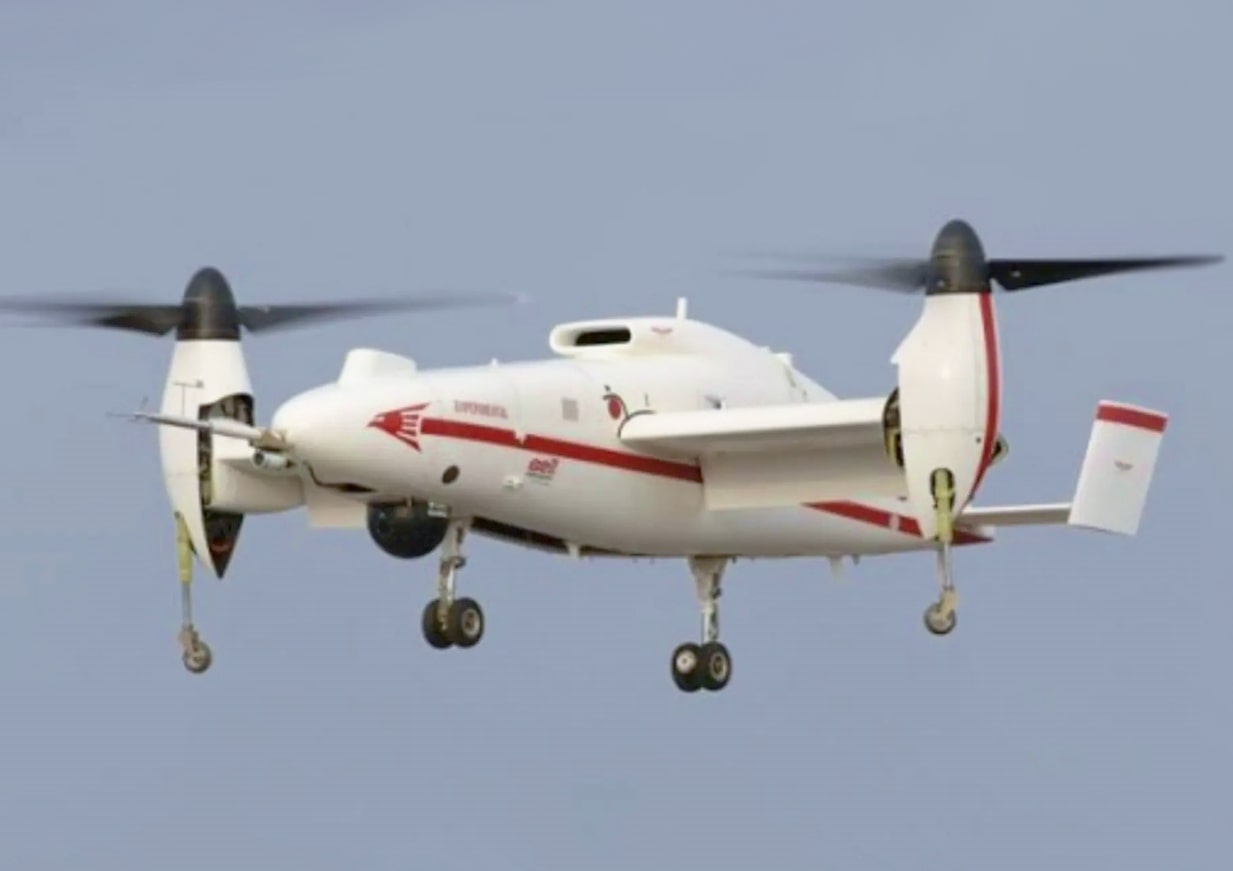
The fundamental problem with vertical takeoff and landing aircraft has nothing to do with software or batteries. It is physics. Hovering efficiently requires high rotor blade area and high tip speed to generate lift without forward velocity; efficient forward flight demands exactly the opposite — low blade area and low tip speed to avoid drag at cruise. These two requirements flatly contradict each other, and every convertiplane architecture in development today is a different engineering bet on where to place that compromise.
Four Families, One Contradiction
There are four main tilt-based VTOL design families. The tailsitter rotates the entire airframe from vertical to horizontal at transition. The tilt-rotor keeps the fuselage level and pivots only the propulsors 90 degrees, converting from helicopter mode to fixed-wing cruise. The tilt-wing tilts the entire wing — rotors included — together, eliminating the propeller slipstream problem that plagues tiltrotors during hover. And the ducted-fan design shrouds the rotor inside a duct, fixed or tilting, extracting aerodynamic and acoustic benefits from the shroud itself.
A fifth family, lift+cruise — sometimes called "quad-plus-pusher" — uses dedicated vertical rotors for hover that disengage in forward flight, relying on a fixed wing for cruise lift. It is the most common architecture in current commercial eVTOL products because it is mechanically simple. The tradeoff is dead weight: those lift rotors contribute nothing during cruise but must still be carried, powered, and cooled throughout the mission.
Tilt-Rotors and Tailsitters: The Mechanical Gamble
Tilt-rotors use the same propulsors for hover and cruise by pivoting them 90 degrees while the airframe stays level. The elegance hides a cost: the propeller slipstream strikes the wing during hover, reducing effective thrust. Tilt-wing designs sidestep this by tilting the full wing alongside the rotors, but at the price of a larger, heavier mechanism. Both approaches require what Aerospace Global News describes as "highly sophisticated flight control algorithms" and face stringent certification requirements, particularly for failure-mode analysis across the transition regime.
Bell's APT 70 is the commercial cargo reference case. The APT is a tailsitter: the entire biplane-winged, no-fuselage airframe tilts from vertical hover to horizontal cruise across four electric motors. Army Technology describes it as a "tail-sitter design that allows the aircraft to take-off and land horizontally and tilt towards forward during the flight," managed via touchscreen GPS-autonomous control. The APT 70 carries 70 pounds over 35 miles at up to 127 mph (30-minute one-way endurance at full payload); maximum endurance reaches 55 minutes flown empty; substituting 32 kg of additional battery for payload extends that range past 100 km. The platform completed its first autonomous flight in August 2019 and was later selected for NASA's Systems Integration and Operationalization (SIO) programme.
The military tailsitter case is more demanding. Northrop Grumman's TERN (Tactically Exploited Reconnaissance Node), funded jointly by DARPA and the Office of Naval Research, is a flying-wing delta with counter-rotating nose-mounted propellers that mirrors the Convair XFY-1 Pogo, which completed its first vertical takeoff in 1954. The Pogo could take off and land vertically but proved uncontrollable for human pilots during the hover-to-level-flight transition and never entered service. TERN strips out the pilot entirely. DARPA sized TERN as “the biggest thing that we can fit in the destroyer hangar,” targeting 600–900 nautical miles of operating radius — enough to reach 90–97 percent of the world's land mass from a destroyer without a carrier deck or prepared airstrip. The $150 million program (~73% government-funded) is producing two prototypes; Scaled Composites assembled the first in Mojave. Bell's V-247 Vigilant and Karem Aircraft's Swift represent competing tiltrotor approaches pursuing the same shipboard contract.
The tailsitter's revival is instructive: the configuration that defeated human pilots in the 1950s is viable now precisely because autopilot flight control handles the transition instability that no aviator could manage reliably.
What a Duct Actually Buys
Enclosing a rotor in a duct is not primarily a safety measure, though blade containment matters operationally. The aerodynamic returns are more significant. A ducted rotor achieves approximately 20 percent higher power loading (thrust per unit power) than an open rotor of the same diameter — delivering more thrust for equivalent power input. In a ducted coaxial-rotor system, the duct itself can contribute up to 53 percent of total system thrust when the rotor is positioned 0.31 duct-chord distances from the inlet — the shroud outperforms the rotor. A 2023 peer-reviewed study found ducted coaxial configurations achieve a maximum figure of merit of 0.61, roughly 12 percent better than open coaxial designs without ducting. The key variable is tip clearance: 0.015 rotor-radius or smaller restrains tip vortex development and minimizes thrust loss.
NASA quantified these relationships in wind-tunnel testing of a 10-inch ducted rotor UAV in the Army 7-by-10-Foot Wind Tunnel, evaluating isolated rotors, isolated ducts, and combined assemblies. As researchers Preston Martin and Chee Tung described the methodology: "the test conditions covered a range of angle of attack from 0 to 110 degrees to the freestream" at airspeeds up to 128 feet per second, spanning both hover-equivalent and high-speed conditions.
Efficiency gains compound in other directions. Conventional helicopter tail rotors consume 5–20 percent of total engine power solely to counteract main-rotor torque. Coaxial counter-rotating ducted fans eliminate that tax entirely. Ducted fans also attack noise at source: acoustic liners inside duct walls absorb blade-passage energy before it radiates, producing a lower noise profile — an advantage that matters considerably when the business model depends on operating near urban population centers.
The Lilium Jet pushes the ducted-fan premise to its logical limit. The seven-seat aircraft uses 36 individually controllable fans — 12 on the canard, 24 on the rear wing — managed through what Airport Technology calls a "Ducted Electric Vectored Thrust (DEVT) propulsion system" with active electronic differential thrust control. There are no traditional control surfaces: no tail, no rudder, no ailerons. Every pitch, roll, and yaw input comes from differential fan thrust across all 36 units. The airframe has 30 times fewer components than a commercial airliner. Performance targets reach 175 mph cruise at 10,000 feet over 155 miles — regional mobility numbers, not urban taxi.
Why It Matters
Tilt-rotor and ducted-fan development is not converging on a single application. For urban and regional commercial transport, distributed ducted fans offer noise compliance, blade-containment safety, and the mechanical simplicity of eliminating tilt mechanisms entirely — software-managed differential thrust replaces every articulated surface. For military and long-range autonomous operations, tilt-rotor and tailsitter architectures retain the structural efficiency argument: they carry no dead-weight rotors into cruise, an advantage that compounds significantly on missions past 100 kilometers. Lift+cruise dominates today's commercial eVTOL market because it is easier to certify, not because it wins on range efficiency.
TERN's shipboard mission — 90–97 percent global land-mass coverage from a destroyer without a runway — is the clearest statement of where that efficiency argument leads. That reach is not achievable at comparable payload fraction with a lift+cruise architecture. The electric tailsitter and tiltrotor are the configurations that make it tractable.
What is happening across both threads is that mid-century aeronautical concepts are getting their viable second implementation, this time in electric and autonomous form. The Convair XFY-1 Pogo failed because human pilots could not manage the hover-to-cruise transition. TERN succeeds in concept because an autopilot can. The physics of the contradiction have not changed. The control authority to navigate them reliably has.
Sources
- eVTOL News — Bell APT
- Army Technology — Bell APT 70 project
- Aerospace Global News — Pros and Cons of Different eVTOL Designs
- Breaking Defense — Tailsitter Drone TERN: Pilot Not Included
- NASA Technical Reports Server — Ducted Rotor VTOL UAV Wind Tunnel Study, Martin & Tung, 2004
- Airport Technology — Lilium 7-Seater eVTOL Jet
- PubMed Central — Ducted Coaxial-Rotor Aerodynamics, peer-reviewed, 2023