
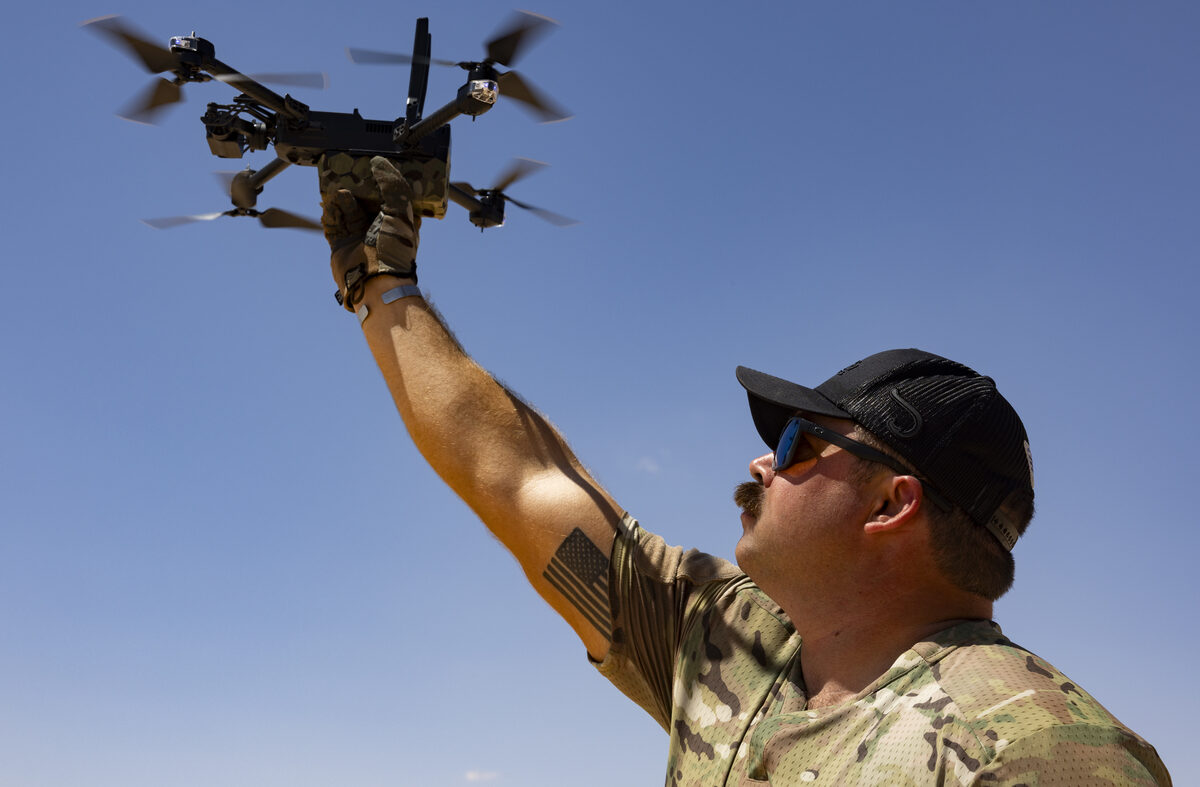
US Special Operations Command has bought uncrewed aircraft from Tekever, the Portuguese drone maker. The company announced the sale on October 26 in a release datelined Fayetteville, North Carolina. It left out almost everything a defense analyst would want to know. Tekever said that "the number, model and specific configuration of the UAS systems purchased are not being disclosed." It gave no contract value either.
What the company did confirm is the process behind the purchase. According to Tekever, the systems passed validation and acceptance testing, which included training and what it called an extensive flight programme at multiple locations. The procurement came only after that testing was complete.
"This procurement represents an important milestone in a relationship that has been built over time through rigorous testing, open dialogue and a clear focus on delivering effective capability," said Tekever CEO Ricardo Mendes.
What exactly was bought?
Officially, nobody outside the deal knows. Tekever's release describes a "highly deployable" intelligence, surveillance and reconnaissance (ISR) system with a modular design built from four parts: the air platform, mission payloads, communications, and AI-enabled mission software. That description fits much of the company's catalog and does not point to a single aircraft.
Trade coverage did not fill the gap. European Security & Defence and Defence Industry Europe both reported that Tekever withheld the number, model and configuration. Defence Industry Europe ran a photo of the AR3 Evolution with its story, but the caption presented it only as one of the unmanned systems Tekever offers, not as the aircraft SOCOM bought.
The best circumstantial evidence comes from DroneXL. It notes that the only Tekever drone named in the company's announcements of work with SOCOM is the AR3. Tekever said in March 2025 that it had completed an operational exercise with the command at Camp Roberts, California, with the AR3 at the center, operating in a contested electronic-warfare environment. DroneXL also argues that "highly deployable" fits the VTOL AR3 better than the larger AR5, which needs an airstrip. This makes the AR3 a plausible candidate, but it is still an inference. Tekever has not said which model SOCOM bought, and SOCOM has not said either.
What the AR3 brings, if that's the one
DroneXL summarized the published specifications for the current AR3 EVO from Tekever's product page:
- Takeoff weight up to 55 lb, or 66 lb in the VTOL configuration
- Endurance up to 22 hours as a fixed-wing aircraft, or 14 hours with VTOL
- Payload capacity of 13 lb
- Cruise speed of 46 knots
- Datalink range of up to 143 miles
- A landing footprint of roughly 16 by 16 feet
On those figures, the AR3 is a small, light aircraft that needs little space to land, and its endurance is long enough to keep watch over an area for much of a day. DroneXL lists swappable payloads that include electro-optical and infrared cameras, radar and signals intelligence sensors. European Security & Defence pointed out that modular, quick-to-deploy design can be particularly important for special operations forces, which need to deploy quickly and work with relatively small teams. Its report also highlighted Tekever's vertically integrated model, with engineering, manufacturing, software, AI and operational support all kept in-house.
Why the silence?
Holding back details is common in special operations procurement. Units that operate with small footprints and sensitive missions have good reason not to advertise which ISR assets they carry or how many they have. Tekever's release does not say whether the non-disclosure was its own choice or the customer's. In practice, though, the result is a press release that confirms a relationship while revealing very little about its scope.
That leaves the sale's size open. "USSOCOM purchased UAS" could mean a handful of systems for evaluation or a meaningful operational buy. Without a quantity or a dollar figure, outside observers cannot tell which.
The Fayetteville factor
The dateline is informative. Tekever opened its first US office in Fayetteville on May 18, the first day of SOF Week, according to DroneXL. Tekever's release says the company has an established presence in Fayetteville supporting its engagement with US defense and security customers. Fayetteville is next to Fort Bragg, home of US Army Special Operations Command. Five months after the office opened, the company has announced this purchase by US Special Operations Command, which Tekever describes as a further step in its long-term commitment to the US special operations community.
Fourth government customer since August
The SOCOM deal is part of a busy stretch for Tekever. DroneXL counts it as the fourth government customer the company has announced since August:
- August 11: The Portuguese Air Force ordered the AR5.
- September 16: The British Army's CORVUS contract was signed, worth up to £400 million (about $530 million).
- October 13: Tekever said the Bundeswehr had taken delivery of its first Tekever system, alongside news of a Munich headquarters.
- October 26: USSOCOM.
DroneXL also places the run against Tekever's fundraising. That includes a $74 million round in November 2024 and the first close of a $580 million Series D.
Why It Matters
For Tekever, the significance is less about the size of this particular order, which is unknown, and more about who the buyer is. US special operations is a demanding customer in the American market. According to Tekever, the systems had to get through validation, acceptance testing and multi-site flight trials before the purchase was announced. A European drone maker that clears that bar gains credibility well beyond one contract.
The deal also gives Tekever announced government customers in four countries within roughly eleven weeks: Portugal, the UK, Germany and the US. That is the kind of record investors and rival procurement offices pay attention to. The open questions are the ones Tekever chose not to answer: which aircraft, how many, and what the purchase leads to next. Until SOCOM or Tekever says more, the AR3 is a reasonable guess, and it is only a guess.
Sources
- TEKEVER delivers aerial intelligence for USSOCOM (Tekever press release, Oct 26, 2026)
- USSOCOM Purchases TEKEVER UAS for Aerial Intelligence Missions (European Security & Defence, Oct 26, 2026)
- U.S. Special Operations Command buys Tekever drones for intelligence and surveillance missions (Defence Industry Europe, Oct 26, 2026)
- Tekever Sells Drones to US Special Operations but Won't Say Which (DroneXL, Oct 26, 2026)
