
Qatar's state-owned defense company used its home trade show this month to show what it can build for itself. At Milipol Qatar 2026 in Doha, Barzan Holdings launched more than a dozen products designed and made in Qatar. The list covers five aerial drones, two unmanned surface vessels (USVs), electronic warfare and secure communications offerings, new small arms, and a joint venture with Ukrainian firm Carmine Sky for layered air defense against drones.
The launch matters more because of where Qatar has been standing. As Breaking Defense notes, Iranian missiles and drones have targeted the country, and it was the only Gulf state struck by an Israeli raid in September 2025. A Gulf state that has been on the receiving end of both drone and missile attacks is now marketing its own FPV drones and counter-UAS services.
Who Barzan Is
Barzan was founded in 2016 and is wholly owned by Qatar's Ministry of Defence, according to the Arabic-language daily Al Raya. The company says it has more than 800 employees, including over 140 engineers and 80 project managers, working through four main factories and a number of specialized service and technology companies. Milipol Qatar 2026 is Barzan's fourth time at the show, and it has been a partner of the event since 2018.
Ahmad al-Mulla, a commercial relationship manager at Barzan, described the product launch to the Gulf Times as spanning five categories: autonomous systems, electronic warfare, communications, firearms and unmanned aerial vehicles. He said Barzan builds and manages its technologies directly in Qatar and functions as a "master integrator" for custom specifications. In practice, that means the company is positioning itself as the national point where technology, local manufacturing and military requirements come together.
Ahmed Ali Al-Kuwari, who heads Barzan's technology sector, told Al Raya that the company is showing more than 12 new products designed and made by Qataris. He listed the Rasid autonomous boat, several drone types, secure communications and cybersecurity products, electronic warfare services for air defense, and new weapons from the Barzan Industrial unit.
The Aerial Lineup
Barzan's five new aircraft fall into two groups: three first-person-view (FPV) quadcopters sized at 7, 10 and 15 inches, and two intelligence, surveillance and reconnaissance (ISR) platforms. Breaking Defense published these figures, which it attributed to information provided by the company:
| System | Type | Payload | Range / datalink | Endurance / performance |
|---|---|---|---|---|
| FPV-15 inch | FPV quadcopter | 4 kg | 20 km | Up to 20 min |
| FPV-10 inch | FPV quadcopter | 2.5 kg | 15 km | 12 min at full payload |
| FPV-7 inch | FPV quadcopter | 1.5 kg | 15 km | Up to 15 min |
| H Silent | ISR quadcopter | EO/IR gimbal | 40 km datalink | Up to 40 min |
| ISR VTOL-400 | ISR VTOL | 4 kg | 40 km datalink | 10,000 ft ceiling, 110 km/h |
The three FPV airframes form a graduated family. Payload rises from 1.5 kg to 4 kg as the frame grows from 7 to 15 inches, and the largest model adds 5 km of range over the two smaller ones. The FPV-10 is the only model whose endurance figure is given at full payload. The other two are quoted with "up to" endurance, so the three numbers can't be compared directly.
Barzan's key selling point for the FPV line is modularity. Al-Mulla told the Gulf Times the aerial platforms' payloads are interchangeable and the system is "essentially plug-and-play." It can be configured for surveillance, intelligence gathering, kamikaze operations or interception. That last role matters: one airframe family that could fly either as a one-way attack munition or as an interceptor against other drones would fit the counter-UAS business Barzan is building through its Ukrainian partnership, though the sources do not say which airframes are used for which role.
The two ISR platforms cover different jobs. Breaking Defense says the H Silent multirotor carries an electro-optical/infrared gimbal, flies for up to 40 minutes, has a 40 km datalink, and is designed for surveillance, border security and critical infrastructure protection. The VTOL-400 matches that 40 km datalink but adds a 4 kg payload, a 10,000-foot maximum operating altitude and a 110 km/h speed. As a vertical take-off and landing aircraft, it can launch and recover without a runway.
Two Ways to Put a Drone on the Water
On the maritime side, Barzan took two very different approaches.
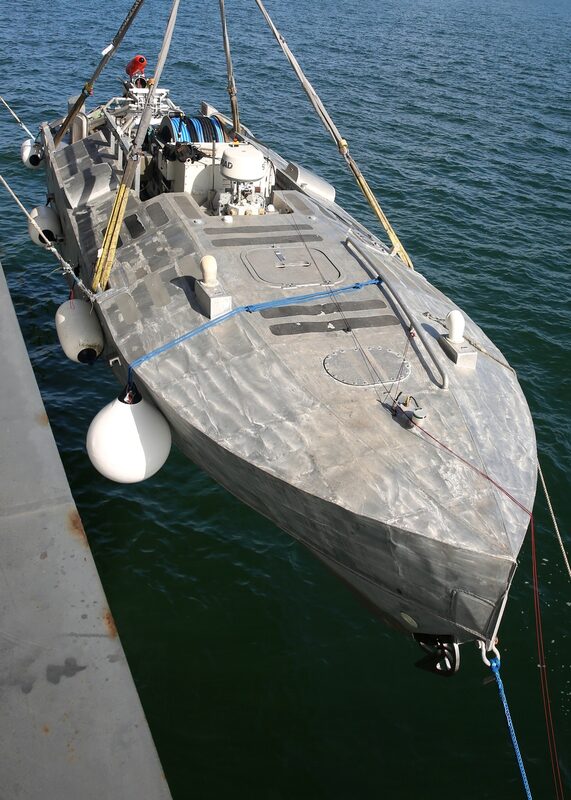
The Rasid USV is, per Breaking Defense, an unmanned jet ski-style watercraft capable of surveillance missions. Al-Kuwari named Rasid first in his list of new products.
The second offering, the Barzan Conversion Solution, is a coast guard vessel that can operate either manned or unmanned. Al-Mulla told the Gulf Times it is the first project of its kind developed domestically, in collaboration with the Qatari Coast Guard at the Ministry of Interior. Converting boats already in service is a different bet from building new drone boats: a service keeps hulls its crews already know and gains the option to operate them without people aboard.
The Ukrainian Connection
The most strategically interesting part of the announcement isn't a single product. It's a partnership. Barzan has formed a joint venture with Ukraine's Carmine Sky to develop what Breaking Defense calls a layered "Full-Cycle Air Defence" capability. The system is expected to counter threats from FPV drones up to jet-powered UAVs and to incorporate radar, radio-frequency sensors, electronic warfare systems and hard-kill platforms.
The Gulf Times reports that Barzan presented "Full-Cycle Integrated Air Defence Services" under electronic warfare, supported by the Carmine Sky venture to protect critical national infrastructure. Al Raya describes Carmine Sky as specializing in counter-drone air defense systems and infrastructure protection. Al-Kuwari's wording, "electronic warfare services for air defense," frames this partly as a service, not just hardware sold off a catalog.
The sources do not give the joint venture's ownership structure, its production location, or which specific sensors and interceptors make up the layers.
The Rest of the Stand
Beyond unmanned systems, the Gulf Times reports that Barzan introduced three light arms, the BIG556 4.5", BIG556 7" and Q1 Corner rifles, and two communications and cybersecurity products, Secure Comms VPN and Secure Comms CHAT. Al Raya adds that the stand also covered cybersecurity products and new weapons from Barzan Industrial. Together these fill in the five categories al-Mulla named.
Why It Matters
Qatar has been a target in the recent past. Iranian missiles and drones have been aimed at it, and Israel struck it in September 2025. Barzan's Milipol launch is a public sign that Doha's answer includes building more of its own equipment, especially in the drone and counter-drone areas where those threats came from.
The product mix is telling. Barzan isn't opening with a large, expensive flagship. It's opening with FPV airframes in three sizes, payloads that can be changed between strike and interception roles, two ISR aircraft, and a USV conversion package developed with its own coast guard. These are the kinds of systems that are likely to be needed in large numbers, and they are harder to rely on getting from abroad when everyone else wants them at the same time. That is an inference, not something the sources state.
The Carmine Sky venture follows the same logic. Breaking Defense says the joint venture will let Doha leverage Ukraine's expertise to deliver an integrated, layered air defense architecture. Pairing that with a state-owned Gulf integrator gives Qatar a route to layered counter-UAS capability without building it from scratch. If Barzan can turn the "master integrator" role into real production at its four factories, Qatar becomes a buyer that can also produce.
Plenty is still unknown. The published specifications are manufacturer figures, and none of the sources give production rates, prices, export plans or customer commitments beyond the Coast Guard conversion work. Whether this lineup becomes fielded capability will depend on what Barzan delivers in the coming months, not on what it showed in Doha.
