
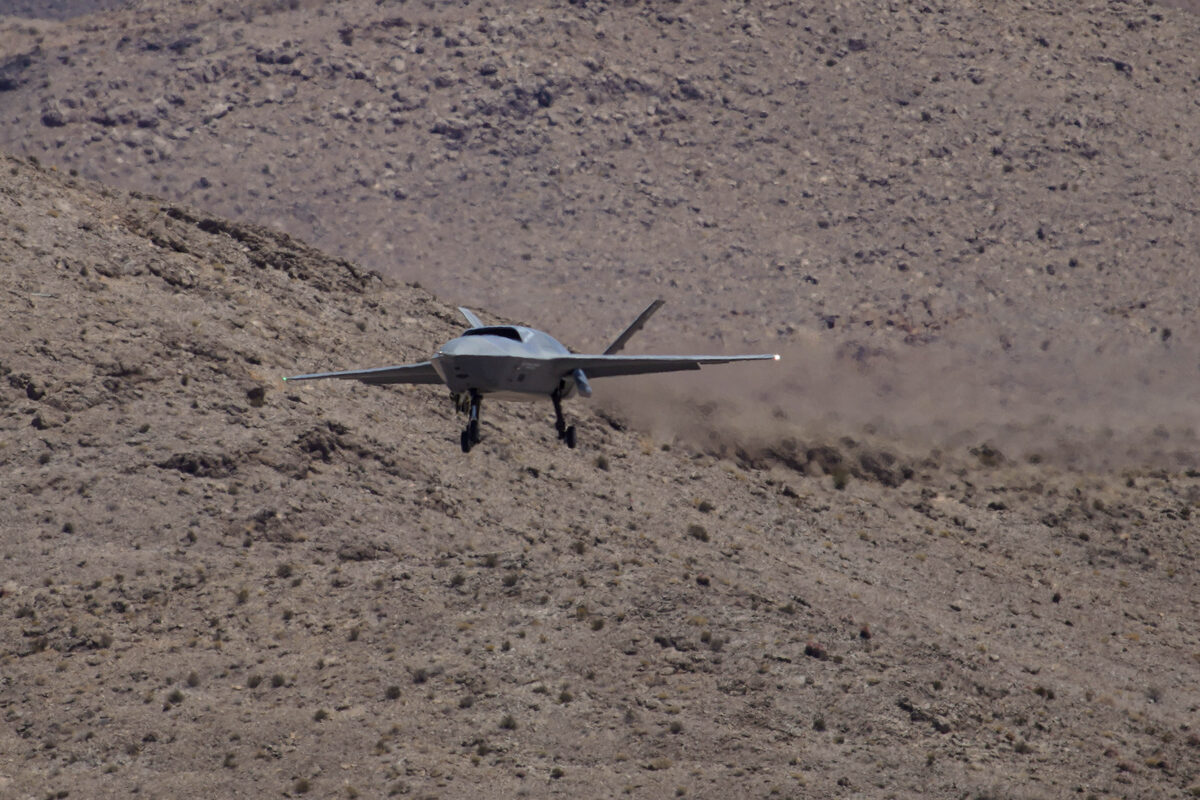
Since 1992, General Atomics Aeronautical Systems (GA-ASI) has built every one of its uncrewed aircraft itself, including the MQ-9A, the MQ-1C, the MQ-20 and the MQ-9B. That is changing with the FQ-42 Vengeance, the company's Collaborative Combat Aircraft (CCA). In a press release datelined Oct. 24 in San Diego, GA-ASI named Spirit Defense, a Boeing company, as the fuselage design-build partner for the FQ-42. Spirit Defense opened a 50,000-square-foot facility in south Wichita, Kansas, on Oct. 23 to do the work.
Taken alone, the announcement is a supplier deal. It matters more because of what the Air Force is now asking for. The service has said it wants at least 500 CCAs in its inventory by 2032, split between GA-ASI's FQ-42 and Anduril's FQ-44A, with an Increment 2 to come after that. An aircraft maker that has always built everything in house now has to plan for a much larger production run, and this deal is how it is starting to prepare.
What Was Announced
The Air Force awarded GA-ASI a contract to produce the FQ-42 in June. Under the new arrangement, Spirit Defense will be responsible for designing and building the aircraft's fuselage, not just making parts to drawings GA-ASI supplies. The press release quotes GA-ASI President David R. Alexander and Spirit Defense CEO Keith Schrader. It presents the partnership as a way to reduce "single points of failure" in the FQ-42 supply chain.
According to KWCH in Wichita, the new Spirit Defense site was converted from a tooling and factory support building. The partners told the station that all fuselages are already moving to the next phase of production. The announcement gave no production rate. Defence Industry Europe reported that it did not include production targets or a delivery timetable, so it does not say how many fuselages Wichita will build each year or when the first Spirit-built airframes will reach GA-ASI.
The Airframe Spirit Is Building
GA-ASI has released few details about how the FQ-42 is built. Mike Atwood, GA-ASI's vice president of advanced aircraft programs, said on The Merge podcast in 2024 that for CCAs the company was falling back on hybrid structures, meaning metal frames with composite skins. The War Zone notes that advanced composites and hybrid structures are Spirit's main business.
Atwood also described the program's goals at the Wichita event, according to KWCH. He said the Air Force has openly stated that the goal of the program is an unmanned aircraft that does what the F-35 does at one quarter the cost, and that the aircraft is meant to augment the F-35 rather than replace it. Cost is central to the whole CCA idea, and a cheaper airframe only helps if the factories behind it can turn out hundreds of them.
Why Spirit, and Why Now
GA-ASI has said it can handle volume production. At the Air & Space Forces Association conference in September, GA-ASI's Mike Shortsleeve said, "We're ready to do that production." Bringing in an outside fuselage partner suggests that being ready will depend on more than GA-ASI's own plants.
Spirit has a complicated history. The War Zone notes that it began as a Boeing division and became an independent company in 2005. Boeing then bought it back after financial losses and quality lapses, a deal that began in 2024 and was finalized last year. Spirit now does defense work as part of Boeing, and that work includes building a fuselage for an aircraft from another prime contractor.
For GA-ASI, the appeal is capacity it does not have to build itself. Spirit's Wichita facility, which KWCH reports was renovated from a tooling and factory support building, adds floor space. One risk is that GA-ASI's fuselage schedule now partly depends on a supplier that had suffered financial losses and quality control lapses before Boeing reacquired it, and The War Zone notes Boeing has since faced continued challenges getting the firm back on track.
Why It Matters
The CCA program is the Air Force's main test of whether it can buy combat aircraft in large numbers at low cost. A target of at least 500 aircraft by 2032, shared between two vendors, is a large step up for a company that has built all its aircraft itself. GA-ASI says the Spirit partnership adds capacity and reduces the risk of single points of failure, which suggests it intends to spread the work across more of the industrial base.
The deal also hints at how the competitive field may develop. A company owned by Boeing, a traditional prime contractor, is building a major structure for General Atomics, one of the newer CCA players. The War Zone has argued that industrial partnerships like this would likely be required to meet the Air Force's volume and schedule goals for the program.
Several questions are still open. GA-ASI has not said how many FQ-42s it expects to deliver each year, how many of them will have Spirit fuselages, or when Wichita's output will reach final assembly. Separately, Defence Industry Europe and the GA-ASI release report that GA-ASI is discussing its Gambit family of modular combat aircraft with international militaries. If those talks become orders, they could add to GA-ASI's production demands. The next round of program disclosures will need to answer the production-rate questions before anyone can judge whether the 2032 goal is realistic.
Sources
- GA-ASI Partnering With Spirit Defense For FQ-42 CCA Production (GA-ASI press release via ACN Newswire)
- General Atomics FQ-42 CCA Drone Production Ramp Up To Be Boosted By Boeing Subsidiary (The War Zone)
- Spirit Defense announces new facility and defense program (KWCH)
- General Atomics partners with Spirit Defense on FQ-42 uncrewed fighter production (Defence Industry Europe)
