
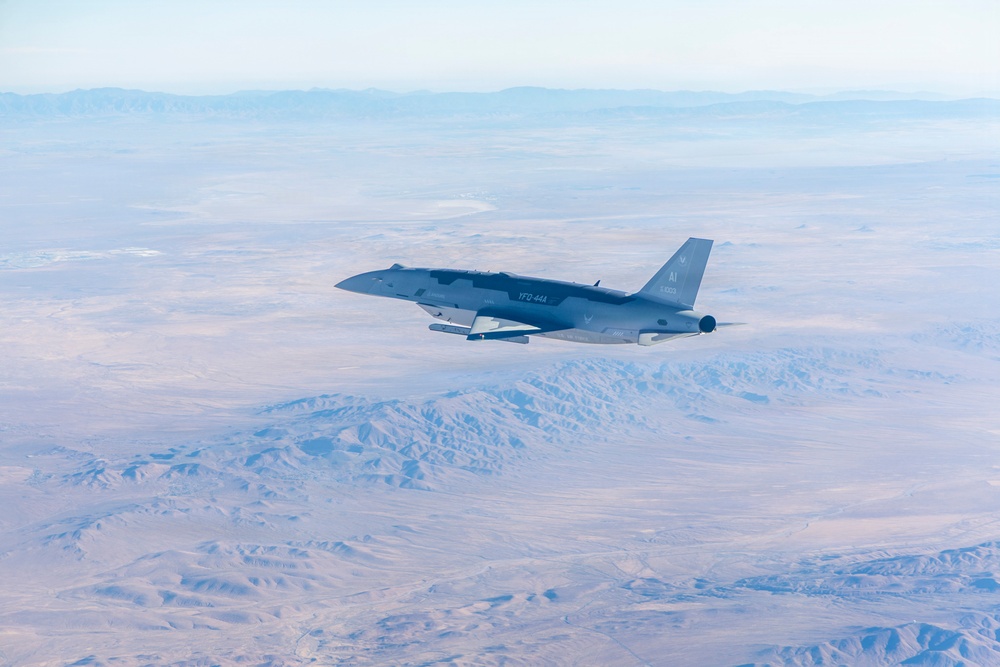
Germany will not buy Boeing's MQ-28 Ghost Bat directly. A Boeing spokesperson told Breaking Defense that the German Ministry of Defence had "informed" the company of the decision. Politico first reported the change. It reverses a path that, as recently as March, had the Ghost Bat "under consideration" in Berlin.
The ministry has not said why. When Breaking Defense asked, a German MoD spokesperson said that as a matter of principle the ministry cannot provide information on potential procurement projects, citing procurement and public contracting law and the requirement that such matters first be addressed by parliament. Boeing deferred questions about the reasoning to the ministry. The company said it "stands ready to support" Germany on next steps.
The bigger effect is on timing. Germany had set a target of fielding a collaborative combat aircraft (CCA) by 2029. Politico's reporting, as relayed by Breaking Defense and DefenseMagazine, says the capability may now not arrive until the early 2030s, with aircraft testing starting in 2027. UASFeed has not reviewed the Politico report itself. Those details come from the outlets that cite it.
What exactly did Germany decide?
The decision is narrow. The German Ministry of Defence has formally notified Boeing that it will not directly procure the MQ-28. Breaking Defense reports that the 2027 tests are a chance for other competitors and Boeing to fight to be selected for the CCA acquisition, so the aircraft does not appear to be shut out of a later contest. Nothing in the cited reporting says Germany is dropping the drone wingman requirement itself. What has ended, at least for now, is the idea of buying the Ghost Bat outright.
DefenseMagazine reads the change as a move away from a fast-track purchase and toward a wider competition. That fits the new schedule. Testing from 2027 and fielding in the early 2030s looks more like an evaluation program than an off-the-shelf buy, though no source describes the program's structure.
How did the Ghost Bat get to the front of the line?
According to Envanter, Defence Minister Boris Pistorius said in March 2026 that the Ghost Bat was "under consideration" for the Luftwaffe. Rheinmetall subsequently signed on as the aircraft's German systems integrator. That gave the MQ-28 a domestic industrial partner.
Seven months later, the direct-buy route is closed. Envanter notes that the reversal puts that March 2026 partnership in question. The sources do not say what happens to the Rheinmetall arrangement now.
Who benefits?
A wider competition helps the rivals that had been waiting behind Boeing. Breaking Defense names three.
- Helsing CA-1 Europa. The German defense technology company says its CA-1 Europa will be ready for operations by 2029. That date matches the target Berlin now appears to be leaving behind. The claim comes from the company and has not been independently shown.
- Airbus and Kratos U740 Valkyrie. The Airbus and Kratos partnership announced the drone's first flight on Monday, according to Breaking Defense. In that statement, the European prime said the milestone confirms the team is on track to deliver a combat-ready uncrewed CCA by 2029. That is the company's own claim. A flight milestone landing in the same week as the Boeing news gives the pair an obvious talking point.
- General Atomics Gambit. Breaking Defense says General Atomics Aeronautical Systems could also offer a wingman from its Gambit family. A company spokesperson told the outlet in June that it has spoken to Germany "many, many times" about its CCA.
Each option has a different industrial setup. Helsing is a German firm. Airbus is paired here with US manufacturer Kratos. General Atomics is a US company. DefenseMagazine suggests a broader competition could let Berlin compare American, European and hybrid industrial options. The reporting does not say how Berlin will weigh domestic industrial share against cost, schedule or capability, and the ministry has declined to discuss its reasons. Readers should be careful with any account that claims to know which factor decided the matter.
Is this only a German story?
No. DefenseMagazine frames Germany's rethink as part of a wider European race for uncrewed airpower, and Envanter points to Turkey's TUSAS ANKA-3, designed to fly alongside the KAAN fighter, as a parallel wingman effort. Envanter argues that the episode shows how fragmented and unsettled Europe's approach to loyal-wingman drones remains, and that the difficulty lies less in the technology than in contracting structures and industrial policy. That is the outlet's analysis rather than an established finding, but it captures why a single country's change of course draws attention across the market.
Why It Matters
There are three reasons this matters.
First, the schedule. If the reporting relayed from Politico is right, Germany's first-in-Europe 2029 fielding goal is now in doubt. Breaking Defense says Germany had hoped to be the first European country to field such a capability. Testing from 2027 and arrival in the early 2030s would push German pilots' first service with an uncrewed partner past the original date, though the exact slip is not stated.
Second, industry. Rheinmetall's role as German integrator for the Ghost Bat gave the aircraft a domestic partner. With that arrangement now in question, the European entrants have a fresh opening, especially Helsing, which claims a 2029 readiness date. So do Airbus and Kratos, whose U740 has just flown and who also cite 2029. Envanter says the setback means an unexpected delay for Boeing and Rheinmetall in securing a foothold in the European market.
Third, transparency. The ministry has cited procurement law and parliamentary rules as its reason for saying nothing. As a result, the public record holds the decision but not the reasoning behind it. Until Berlin explains more, or a formal competition is announced with stated requirements, any claim about what tipped the balance against a direct MQ-28 buy is speculation.
What to watch
The next markers are clear enough. Watch for whether Germany formally announces a competition and on what timeline. Watch whether the MQ-28 is entered in that competition, with or without Rheinmetall. And watch whether the 2027 test start relayed from Politico holds. Boeing says it stands ready to support. Whether Germany takes that offer up is now an open question.
