
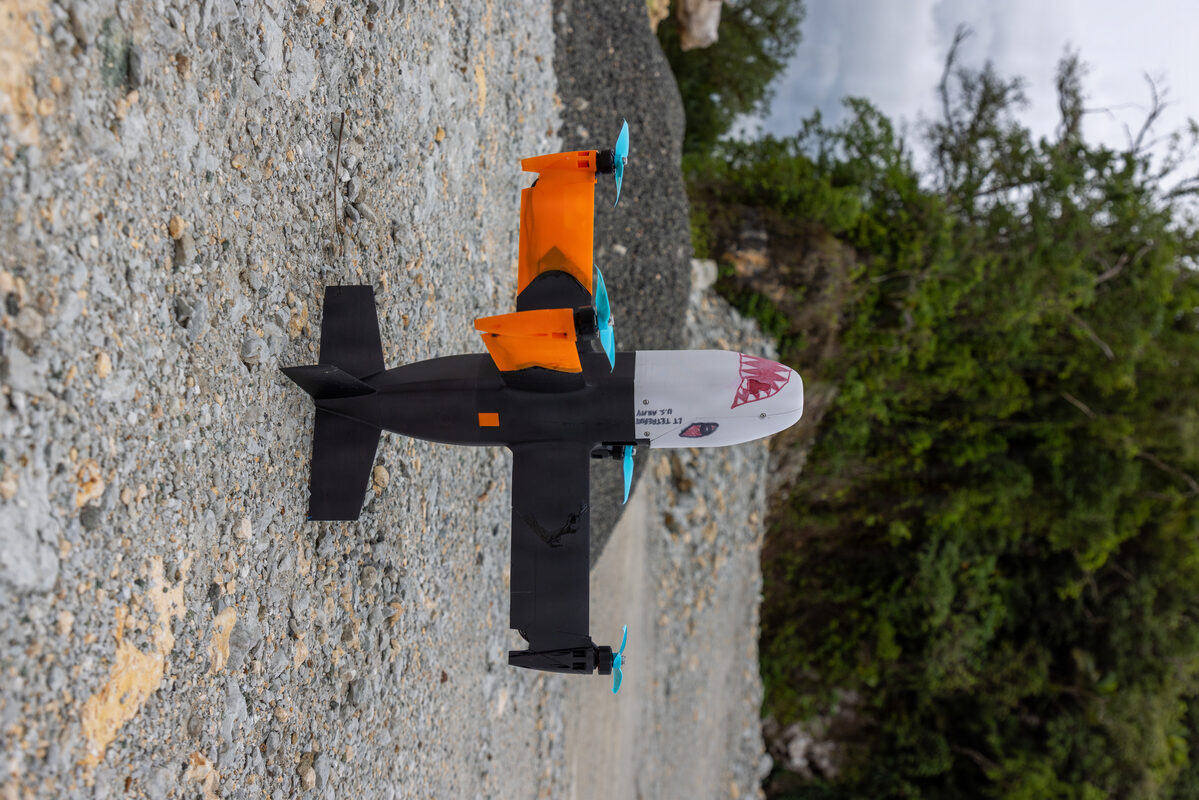
Helsing, the German defense AI company, moved into air defense on Monday, Oct. 26, 2026. At an event in Berlin, CEO Gundbert Scherf presented Contra, an autonomous air defense system, along with two new interceptors: the jet-powered AD-1 Inferno and the rocket-powered AD-2 Ambush. The company's main pitch is cost. Helsing says each interceptor will sell for less than EUR 100,000, against what DroneXL, citing German outlet hartpunkt, reports as EUR 500,000 to 4 million for existing interceptors.
The caveats are significant. According to DroneXL, neither interceptor has finished flight testing, and the earliest deliveries are expected in the second quarter of 2027. The price ceiling, the production rate and the performance figures all come from Helsing. None has been independently demonstrated.
What Helsing Showed
Contra is built around two missiles meant for different parts of the engagement envelope.
AD-1 Inferno is the slower, more persistent of the two. DroneXL reports it is jet-powered, can loiter, tops 700 km/h, and has a 20 km range and a 9,000 m ceiling. A wire report carried by Yahoo says the Inferno can circle, swarm and re-engage. German outlet defence-network.com describes the same behavior: an interceptor that misses can turn around and attack again. That is the main difference from a conventional one-shot surface-to-air missile. Helsing says AD-1 mass production will reach 1,000 units a month.
AD-2 Ambush uses a solid rocket motor for speed. DroneXL says it flies faster than Mach 2, defence-network.com gives Mach 2 (about 2,500 km/h), and the wire report puts it at about 3,000 km/h. DroneXL lists the same 20 km range and 9,000 m ceiling as the Inferno, and the wire report gives a range of more than 20 km. DroneXL describes Ambush as built for threats beyond the AD-1's reach.
Both interceptors use the same sensing approach. DroneXL reports an active radar seeker built from commercial off-the-shelf parts, which Helsing says costs less than a tenth of comparable seekers, paired with an optical sensor. defence-network.com describes the wider Contra system as fusing optical, infrared and acoustic sensors with radar.
How It Deploys
Helsing packages Contra in 20-foot containers. According to DroneXL, one box holds either 20 AD-1 or 40 AD-2 interceptors. defence-network.com reports that the containers can be moved by rail, ship or truck. Helsing also showed a concept for a border "wall" made of these containers, a distributed line of launchers rather than a few high-value batteries.
The wire report quotes the company as saying Contra can detect and engage hundreds or thousands of targets at the same time and integrate other systems within days. These are design goals stated at a product launch. They have not been shown in testing.
What It Is Meant to Shoot Down
According to the wire report, Helsing designed the two missiles to counter jet-powered attack drones and cruise missiles, and defence-network.com also names cruise missiles as a target, saying the AD-2 is meant to reach subsonic cruise missiles at high altitudes beyond the AD-1's reach. DroneXL says both missiles are aimed at the jet-powered Geran drones Russia launches at Ukraine, and cites Helsing's figure of 4,000 Geran-4 and Geran-5 jet drones used per month. That fits the two-missile design: a loitering jet interceptor for drones, and a faster rocket for high-altitude threats.
Questions Still Open
Does it work? Not yet shown. DroneXL reports that neither interceptor has completed flight testing. The speed, range and ceiling figures are Helsing's claims until test results are published.
Who is buying? DroneXL reports one customer has already signed a contract for the Contra command system. Helsing has not named that customer, and DroneXL says the first contract covers the command software, not the missiles.
Is the price real? "Less than 100k" per interceptor, as defence-network.com quoted it, is Helsing's own figure. DroneXL says the saving comes from the low-cost commercial radar seeker, and Helsing ties the price to the 1,000-a-month production rate for AD-1. Neither has been shown at scale.
Why the emphasis on supply chains? defence-network.com calls Contra ITAR-free, and DroneXL reports that Helsing describes its supply chains as free of US export restrictions and mostly European. The apparent selling point for European buyers is less exposure to US export controls over how or where the system is used or re-exported.
Why It Matters
Air defense against drones has a cost problem. If an interceptor costs far more than its target, a defender can run out of money and missiles long before an attacker runs out of drones. Helsing's own comparison, sub-EUR 100,000 against EUR 500,000 to 4 million for existing interceptors, is designed to show that gap. If the figures hold up, Contra would give European militaries an interceptor priced well below existing missiles, packed into shipping containers, and marketed as free of US export restrictions.
That outcome depends on several things Helsing has not yet shown: completed flight tests, a working radar seeker built from commercial parts, a production line running at 1,000 units a month, and first deliveries in the second quarter of 2027. Until then, Contra is an ambitious industrial bet from a company with a signed first contract for its command software, not a fielded capability. Its unit price and production claims should be read as targets, not results.
