
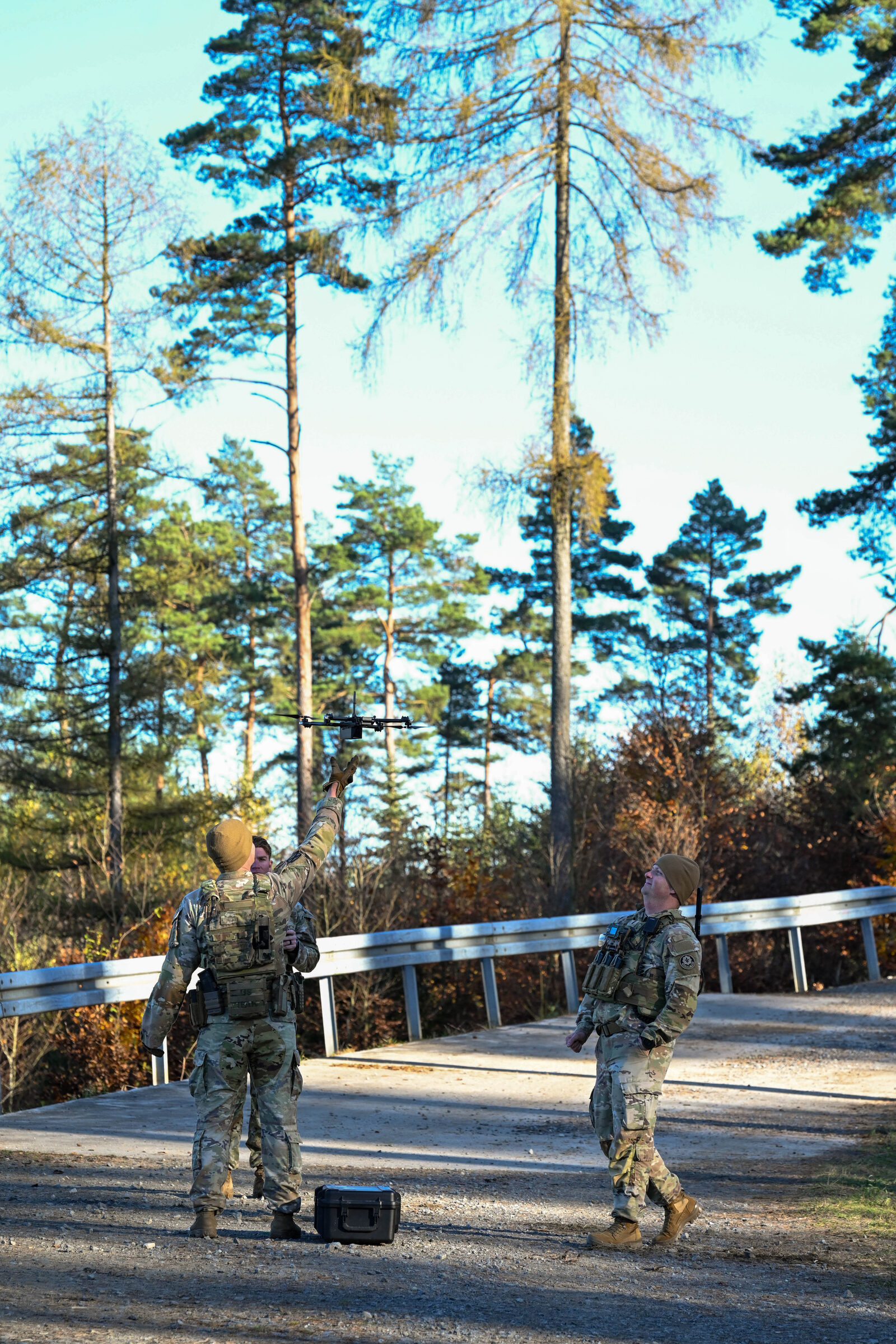
On March 16, 2022, as Russian armored columns stalled on the approaches to Kyiv, the Biden administration announced an $800 million military aid package that buried a tactically significant line item among the artillery shells and Stingers: 100 Switchblade loitering munitions. Few Western observers knew what to make of them. The weapon that arrived in Ukrainian hands was a munition weighing approximately 2 kilograms — smaller than a mortar round — collapsible into a launch tube, carried in a standard rucksack, and deployable in under two minutes. It could fly out to 10 kilometers, orbit a target at 101 km/h, feed live video to a tablet fire-control unit, lock onto a vehicle or a personnel cluster, and — at the last second — stand down if the commander changed his mind.
That last capability is the defining feature of the Switchblade family, and the one that separates it from nearly everything else in the loitering munition category.
A loitering munition flies to an area, circles until it identifies a target, then dives to destroy it, expending itself in the process. What AeroVironment built into every Switchblade variant is a wave-off and recommit capability: the system maintains continuous proportional-integral-derivative (PID) guidance throughout the terminal approach, allowing the operator to abort at any point before impact, reacquire, and re-engage. No fire-and-forget munition offers this. In contested urban terrain — where a civilian vehicle enters the frame at the last moment, or intelligence proves wrong — the abort capability carries both operational and legal weight. It is the feature that most visibly distinguishes Switchblade from Russia's Lancet, Iran's Shahed series, and the majority of competing systems on the market.
Three Warhead Tiers, One Abort Architecture
The Switchblade 300 Block 10C entered U.S. Army service following an initial development contract in June 2011 and a first Air Force production order in early 2012. The munition deploys via ground, maritime, or airborne platforms in under two minutes and carries a warhead effective against soft targets and personnel. Its 15-minute endurance covers more than 10 kilometers at up to 101 km/h; a tablet-based fire-control interface handles launch, target tracking, and wave-off functions throughout flight.
The Block 20, announced March 28, 2023, extends the platform substantially. Endurance grows to more than 20 minutes; range reaches 30 kilometers; top speed increases to 161 km/h. A new digital data link and an EO/IR panning camera replace the earlier sensor suite, and a left-hand commit control with continuous PID tracking refines the terminal sequence. AeroVironment positions it as the lightest and most backpackable loitering missile system in its class. A variant with an explosively formed penetrator (EFP) warhead — which would meaningfully extend the 300's reach against light armor and crew-served weapons — was in certification as of 2025. The Block 20 is one of the named variants covered under the current Army indefinite-delivery contract.
The Switchblade 600 operates in an entirely different weight class. The munition masses 15 kilograms (33 lbs); the complete All-Up Round — munition, launch tube, and associated hardware — runs 29.5 kilograms (65 lbs). Baseline range exceeds 40 kilometers; a forward-pass relay configuration extends coverage beyond 90 kilometers. Endurance at loiter speed (112 km/h) exceeds 40 minutes, with a sprint and dive capability of 185 km/h for the terminal phase. Setup from a fixed position or vehicle takes under 10 minutes. The warhead is an anti-armor design employing a top-attack profile to strike the thin roof armor of main battle tanks. Encrypted communications and, on Block 2, M-code GPS harden the system against jamming and spoofing in contested electromagnetic environments. Block 2 also adds automated target recognition (ATR), reducing operator workload in time-compressed engagements. Approximately 3,000 Block 1 systems had been produced as of October 2025; Block 2 deliveries began in early 2026.
The newest tier, the Switchblade 400, was selected by the Army on May 4, 2026, under the Low-Altitude Stalking and Strike Ordnance (LASSO) program via an Other Transaction Authority prototype agreement. The program is explicitly framed as a battalion-level replacement for tube-launched anti-tank missiles such as the Javelin. Per AeroVironment’s investor announcement, the All-Up Round comes in under 40 pounds. Range reaches 65 kilometers; endurance is approximately 35 minutes; loiter speed is 113 km/h with a 145 km/h sprint. The anti-armor warhead masses approximately 12 kilograms. An optical sensor identifies targets at 5.5 kilometers; a thermal channel classifies them at 1.4 kilometers — both sufficient to discriminate armored vehicles from decoys before any commit decision. An Aided Target Recognition system reduces cognitive load on the single soldier operating from sensor acquisition through terminal engagement. The 400 uses a Modular Open Systems Approach (MOSA), integrates with AeroVironment's AV_Halo command-and-control architecture, and fits existing common launch tubes. AeroVironment describes the 400's anti-armor effect as comparable to the Switchblade 600 Block 2.
"This award reflects the Army's confidence not only in Switchblade 400, but in AV's ability to deliver at scale." — Trace Stevenson, President, Autonomous Systems, AeroVironment
The LUS Directed Requirement and the $990 Million Contract
On August 28, 2024, Army Contracting Command-Aberdeen awarded AeroVironment a $990 million indefinite-delivery/indefinite-quantity contract formalizing what the Army calls the Lethal Unmanned Systems (LUS) Directed Requirement — described officially as "the Army's first effort to equip soldiers in infantry battalions with lethal, man-portable loitering munition systems." The contract ceiling is $990 million over five years, with an estimated completion of August 26, 2029. Named variants covered include the 300 Block 20, 400, 600, and 600 Block 2. The contract was awarded sole-source.
A protest filed September 6, 2024, was denied by the Government Accountability Office. The Army's Replicator initiative — which aims to field large numbers of attritable autonomous systems at speed — planned to procure more than 1,000 Switchblades by August 2025 as part of that demand signal.
Building the Arsenal: From 500 a Month to FreedomWerx
Contracted demand at this scale requires industrial capacity that did not previously exist. As of October 2025, AeroVironment was producing approximately 500 Switchblades per month across facilities in Los Angeles (primary), Simi Valley, and Arlington. The company is targeting what Brian Young, VP for Loitering Munitions, characterized as "several thousand" units per month. To enable that expansion, AeroVironment is constructing a dedicated facility in Salt Lake City branded FreedomWerx, targeted for operational status in late 2026 or early 2027.
"This market isn't going away," Young said. "It's not going to flatten. It's going to increase."
Ukraine, the Shahed Comparison, and the Precision Calculus
Ukraine's operational experience with Switchblade is both instructive and incomplete. The 100 Switchblades in the March 16, 2022, package were among the first Western loitering munitions to reach a peer-on-peer conflict at scale. Reportedly more than 700 had been committed to Ukraine by July 2022, though that figure comes from unverified reporting and should be treated accordingly. The variant primarily fielded has been the 300, which, as Breaking Defense noted at the time, "cannot destroy most armored vehicles, due to its small munition." Where the 300 proved effective was in short-range urban combat and ambushes on unarmored convoys — supply logistics, command vehicles, exposed infantry. The Switchblade 600 Block 1, with its Javelin-class warhead, has also seen use in Ukraine.
The sharpest contrast in the Ukrainian theater is with Russia's Shahed-136. The Iranian-origin one-way attack drone has been launched in mass salvos against Ukrainian power infrastructure and population centers. CSIS analysis places the Shahed-136's unit cost between $20,000 and $80,000, with a midpoint near $35,000. Russia launched more than 14,700 one-way attack drones between September 28, 2022, and December 28, 2024. Ukraine has intercepted approximately 90 percent of incoming Shahed-136s — but defending against a $35,000 drone with a surface-to-air missile costing $1 million to $3 million creates a cost exchange ratio that is deeply unfavorable for the defender, regardless of the intercept rate. The Shahed achieves strategic effect through volume and expendability rather than individual precision.
Switchblade's design philosophy is the inverse. Precision over volume; human-in-the-loop over fire-and-forget; abort authority over commitment. The wave-off and recommit capability — the feature that most visibly separates Switchblade from the Shahed-136 and the Lancet — also imposes a ceiling on the rate at which the weapon generates effects: a fire-and-forget salvo requires no sustained operator attention after launch, while Switchblade demands a trained operator maintaining situational awareness through terminal engagement. Unofficial estimates put the Switchblade 300's unit cost in the range of $6,000 to $10,000, and the 600 between $70,000 and $90,000; no official per-unit figures have been disclosed.
The $990 million IDIQ, the LASSO selection, and the FreedomWerx production ramp represent the Army's working answer: build the precision weapon at industrial scale, rather than choose between the two attributes. A system that was an experimental capability in March 2022 is now a planned standard-issue asset for infantry battalions. The bet is that the wave-off — the thing that makes Switchblade fundamentally different from everything Russia has launched at Ukraine — is worth building a factory for.
Sources
- AeroVironment — Switchblade 600 product page
- AeroVironment — $990M Army contract announcement, Aug. 28, 2024
- AeroVironment IR — Army selects Switchblade 400 / LASSO, May 4, 2026
- AeroVironment — GAO denies $990M contract protest, 2024
- DefenseScoop — Army, AeroVironment sign ~$1B loitering munition contract, Aug. 2024
- Army Technology — Switchblade tactical missile system
- Breaking Defense — Ukraine is getting Switchblade, Mar. 2022
- Defense News — AeroVironment eyes new factory, drone launches for Switchblade, Oct. 2025
- CSIS — Calculating the cost-effectiveness of Russia's drone strikes
