
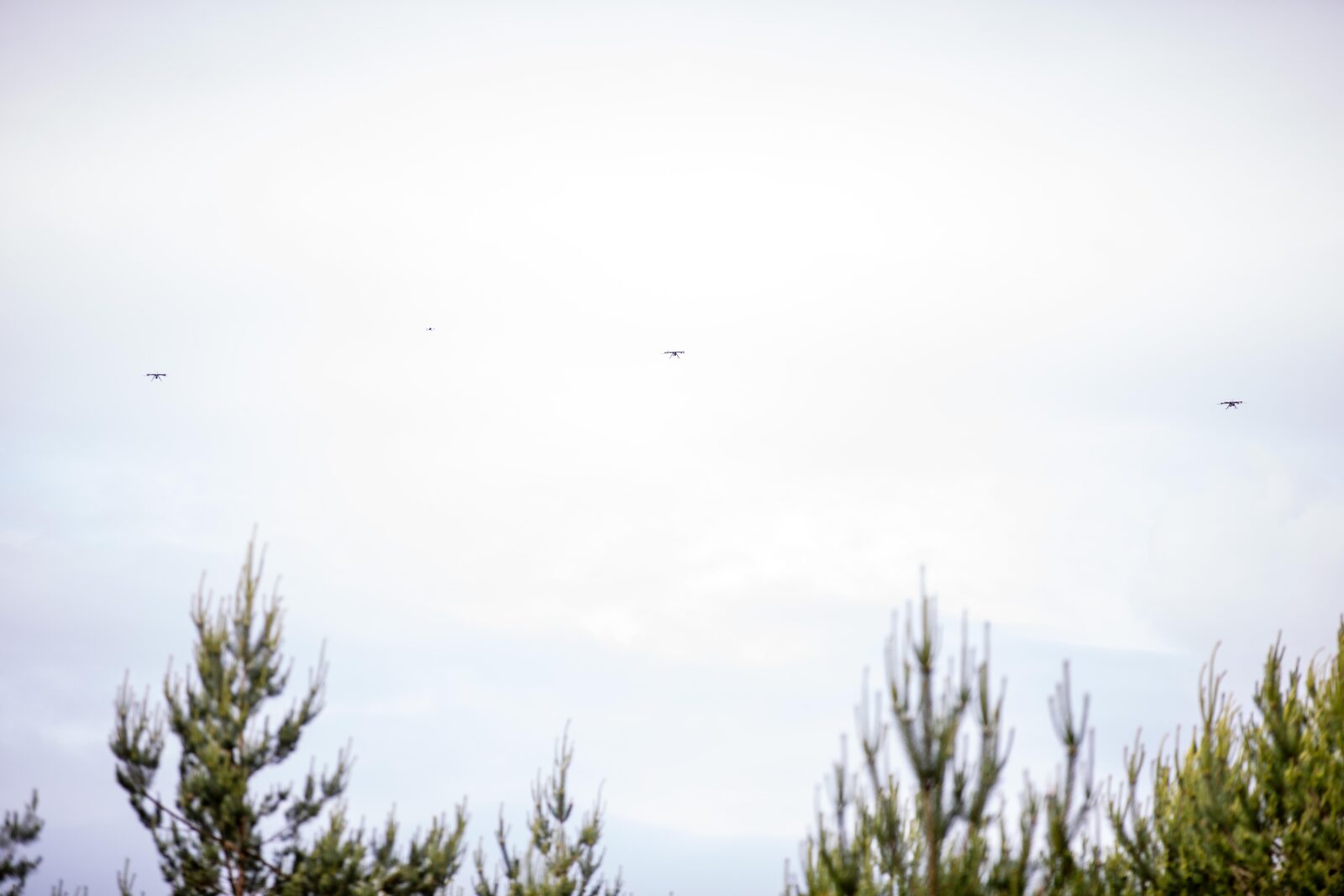
The images are familiar by now: hundreds of drones tracing constellations across a night sky, every unit holding its assigned position with the precision of a mechanical ballet. Those shows are not swarms. A central ground computer tracks each aircraft individually and dictates movement commands—sophisticated air traffic control masquerading as emergent intelligence. The engineering reality behind genuine autonomous swarms is categorically different, and the gap between the two architectures is precisely where the hardest problems in defense-relevant autonomy live.
The Architecture of True Autonomy
True autonomous swarms run on decentralized decision-making: each drone acts on programmed rules, local sensor data, and neighboring drones' behavior, with no hierarchy and no single command node whose loss collapses the mission. As The Robot Report characterizes this architecture: "Each drone makes decisions on its own based on programmed rules, local conditions, and other drones' behavior. There is no hierarchy." Collective behavior emerges from local interactions rather than global coordination—in principle, drones don't even need explicit peer-to-peer messaging for every action; synchronization arises from shared rules operating on locally observed state.
This distinction carries structural consequences for resilience. In a choreographed system, any disruption to the central controller or its uplinks can cascade across the entire formation. In a genuine swarm, losing a subset of nodes degrades capability without collapsing coordination. The swarm degrades gracefully because coordination authority was never centralized to begin with.
Hierarchical architectures occupy a middle ground that balances command reach against single-point-of-failure risk. Master drones—typically medium or large UAVs—act as cluster heads relaying traffic to a command node, while smaller subordinate units operate within their cluster. Critically, if the master node is jammed or destroyed, a subordinate is promoted automatically. Self-organizing Flying Ad Hoc Network (FANET) structures dynamically reconstruct topology when nodes join, leave, or fail, maintaining mesh connectivity without manual intervention and without re-centralizing authority in a replacement command node.
How the Mesh Actually Works
The networking substrate for autonomous swarms is the FANET—a specialized subclass of Mobile Ad Hoc Networks (MANETs) adapted to the physics of airborne nodes. Where ground-based MANETs cope with pedestrian or vehicular mobility, FANETs face rapid velocity and wildly dynamic topology: a 120-knot fixed-wing platform transiting through a grid of hovering multirotors rewrites the network graph in seconds. Traditional routing protocols designed for static or low-mobility environments fail here.
Fraunhofer IIS's current swarm mesh architecture replaces the conventional star topology—where every drone routes through a central mobile communications link—with a fully decentralized mesh. Each node updates local routing tables at regular intervals via periodic heartbeat advertisements. Multi-hop routing then propagates data packets iteratively through the swarm: if node 1 needs to reach node 7, the packet relays through intermediate nodes 2 through 6, each hop updating local state. The consequence is that "individual drones can continue communicating with one another even when no external communications link is available"—no cellular tower, no satellite relay, no ground infrastructure required.
Operational swarm mesh systems draw on a broad frequency portfolio to cover competing demands of range, bandwidth, and GPS independence. Sub-GHz bands penetrate terrain and structures; Wi-Fi and 5G Sidelink carry high-throughput short-range links; UWB (ultra-wideband) enables centimeter-level relative ranging through precise timing without satellite dependency; L-band and U-band dual-frequency configurations extend command reach; millimeter wave handles high-capacity close-proximity links; and LoRa covers long-range, low-bandwidth status telemetry. No single band spans the full military mission envelope, which is why heterogeneous radio payloads are the norm in serious swarm architectures rather than an added complication.
Surviving Contested Airspace
Swarm mesh networks face a structurally distinct threat from reactive jamming. Broadband jamming—suppressing all RF activity in a zone—is power-expensive and indiscriminate. Reactive jammers are more surgical: they selectively disrupt inter-agent communications and undermine formation integrity while leaving adjacent conventional radio links relatively unaffected. Tuned to the swarm's inter-node signaling protocol, a reactive jammer can silence coordination traffic without the power budget required for wideband suppression. The attack targets the emergent behavior layer specifically, not individual platforms.
The countermeasure coming out of recent research is multi-agent reinforcement learning. Work published in arXiv:2512.16813 demonstrates that QMIX—built around a
"centralized but factorizable action-value function that enables coordinated yet decentralized execution"
—lets each swarm node jointly select transmit frequency and power in a coordinated but decentralized manner, achieving throughput near the theoretical genie-aided bound. No central controller is required even for the anti-jamming response; the countermeasure behavior emerges from the same distributed architecture as everything else. The upshot: MARL-based anti-jamming is effective for securing autonomous swarms in contested environments precisely because it requires no coordination overhead from a central node that might itself be the jammer's target.
When link congestion exceeds 95%, protocols automatically switch to adjacent multi-hop links—threshold-based failover that operates without any central coordinator. In GPS-denied environments, RSSI-based (Received Signal Strength Indicator) relay placement allows drones to determine relative positions through signal-strength measurements rather than satellite positioning. The combination of frequency-agile MARL countermeasures, automatic failover, and RSSI-based positioning is what makes the architecture plausibly functional in the environments military planners actually care about: urban canyons, electronic warfare corridors, and deep-denied areas where GPS and clear spectrum are both contested.
Scale introduces its own class of problems. The DARPA OFFSET CCAST paper, published in Field Robotics' 2023 Special Issue on "Dynamic Large-Scale Swarm Systems in Urban Environments," addresses deployment of 250 unmanned aerial and ground vehicles launched simultaneously from a constrained zone. At that scale, GPS error accumulation across the growing swarm creates spatial constraint challenges with no single-platform analogue—errors compound across the network graph, and the geometric footprint of 250 vehicles departing from a limited launch area generates interference patterns no individual platform would encounter operating alone.
Compute is the binding constraint. Current systems cannot simultaneously analyze radar and sensor data and coordinate swarm behavior in real time within the weight and power budget of a small platform. Cell-Free Massive MIMO (CF-mMIMO) cloud-edge-end architectures applied to swarm communications show over 30% latency reduction by offloading compute from power-constrained UAVs to edge infrastructure—but that edge infrastructure assumption breaks down in the environments where military swarms are most operationally relevant, which is precisely the problem Replicator's ORIENT track is trying to solve.
Why It Matters
DARPA's OFFSET program (Offensive Swarm-Enabled Tactics) ran from concept to live field demonstration with the explicit goal of equipping small infantry units with swarms of 250 or more robotic aircraft and ground vehicles simultaneously—not at a test range, but in simulated urban close-combat scenarios. The sixth and final field experiment (FX-6) deployed more than 300 total platforms: backpack-sized rovers, multirotors, and fixed-wing aircraft, all heterogeneous, mixed-domain, and operating alongside virtual swarm agents in the same exercise to enable seamless simulation-to-real integration. Johns Hopkins APL demonstrated multiple fixed-wing aircraft with onboard collision avoidance, while Michigan Tech Research Institute integrated acoustic spoofing and see-through-wall sensing capabilities in the virtual portion of the experiment. "We have demonstrated in the field that these swarm capabilities are rapidly nearing availability for future operations, and the lessons learned from OFFSET will certainly contribute to future swarm advancements," said DARPA OFFSET program manager Timothy Chung.
OFFSET's architecture was deliberately designed to accelerate an ecosystem alongside the specific capability. External "sprinters"—third-party innovators—contributed new swarm tactics every six months through a community-driven tactics exchange portal. A physics-based swarm tactics game served as a virtual development environment for rapidly exploring collective approaches before committing to real-world deployment. The open architecture meant that the program's outputs weren't a single proprietary capability but a maturing field with multiple contributors working against a common interface.
The follow-on is Replicator, the Pentagon's initiative to field thousands of attritable uncrewed systems across all domains. DIU received 251 company proposals for the swarm software contracts—a rough proxy for the commercial and defense investment now concentrated on this problem. The program divides into two parallel tracks: ACT (Autonomous Collaborative Teaming—awarded to Anduril Industries, Swarm Aero, and L3Harris) covers the coordination problem itself, and ORIENT (Opportunistic, Resilient and Innovative Expeditionary Network Topology—awarded to Aalyria, Viasat, Higher Ground, and IOT/AI) addresses the resilient command-and-control backbone. ACT is designed to enable coordination of thousands of uncrewed assets in denied and degraded environments. FY24 and FY25 Replicator budget requests totaled $1 billion combined.
The gap between a choreographed drone show and a combat-capable autonomous swarm is the networking layer—MANET routing, anti-jamming autonomy, GPS-denied positioning, and onboard compute under severe size, weight, and power constraints. That's what a billion dollars is chasing, and OFFSET's field data is the clearest evidence yet that the problem is solvable in principle. The engineering gap between principle and operational reality is exactly what the next decade of swarm networking research will close.
Sources
- DARPA — Offensive Swarm-Enabled Tactics (OFFSET) program page
- DARPA — OFFSET Swarms Take Flight (FX-6 field experiment)
- DSIAC / DTIC — DARPA OFFSET: Autonomous Drone Swarms for Warfighters
- arXiv / Field Robotics — OFFSET CCAST: Large-Scale Swarm Deployment in Urban Environments (2023)
- arXiv — QMIX MARL Anti-Jamming for Autonomous Swarms (2025)
- Fraunhofer IIS — How Mesh Networks Help Control Drone Swarms (June 2026)
- Defense News — Pentagon Picks Programmers to Connect Its Replicator Drone Swarms (November 2024)
- GreyB Research — Mesh Network Topologies for Multi-Drone Communication
- The Robot Report — Drone Swarms: How They Actually Work
