
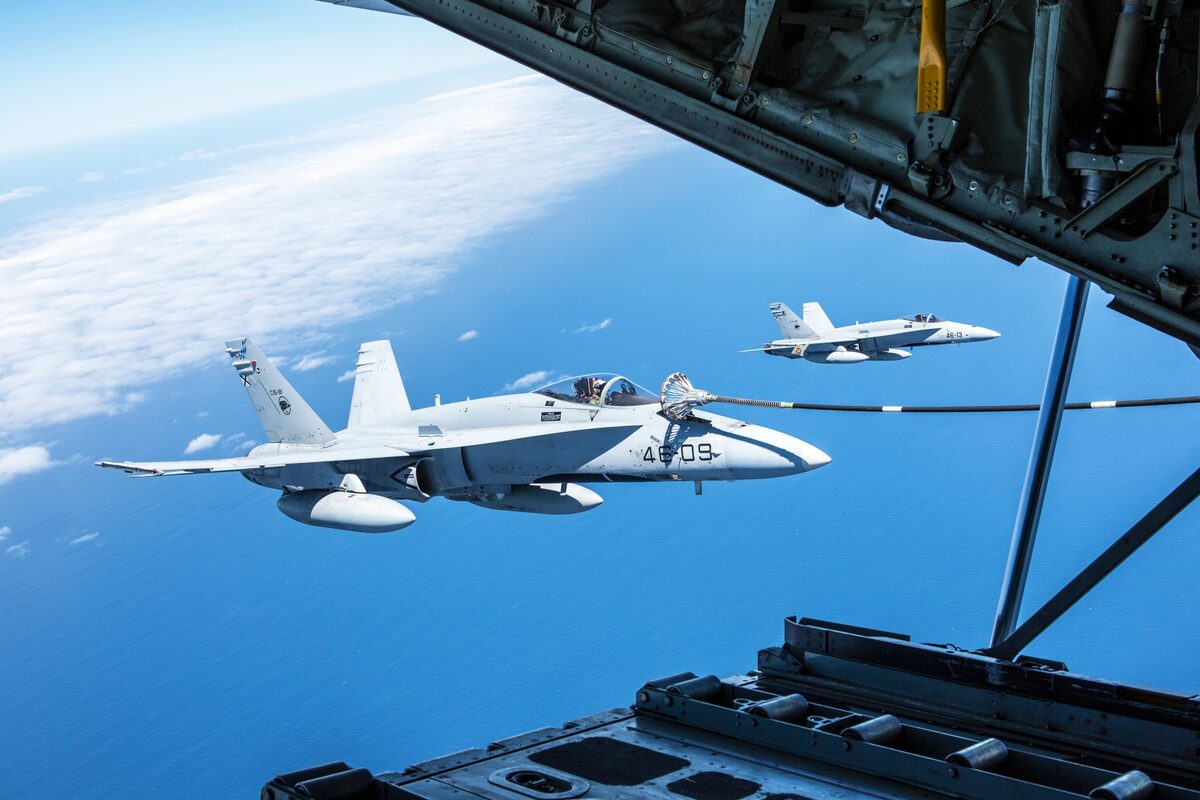
Before dawn on August 16, 2026, a pair of Spanish EF-18M Hornets scrambled from Mihail Kogălniceanu Air Base tracked an unidentified drone as it crossed from Moldovan into Romanian airspace near the Danube-delta city of Galați. Within seventeen minutes, Bucharest's tactical air controllers cleared the jets to engage, and one Hornet destroyed the aircraft with an air-to-air missile. It was the fourth time in 2026 that a NATO fighter has shot a drone out of Romanian skies — and the second time in three weeks.
The intercept unfolded fast. NATO's Jane's-reported timeline shows the drone was first detected at 04:44 local time, roughly 24 kilometers north of Galați, close to the point where it had crossed from Moldova. By 05:01, it was gone. The two Hornets belonged to Spain's 12th Wing, flying under NATO's enhanced Air Policing mission designated eAP-72 and operating from Romania's 57th Air Base at Mihail Kogălniceanu, the host installation for the rotation. Acting Defence Minister Radu Miruță personally congratulated the pilots afterward for what he called "the successful mission," according to Ukrainian outlet Pravda.
What Happened on the Ground
The shootdown didn't end the incident — it started a recovery operation. Romania's Ministry of National Defence and Ministry of Internal Affairs ran a joint response, sending explosive ordnance disposal teams to neutralize fragments of the missile that brought the drone down, while separate forensic teams fanned out to collect the UAV's wreckage. Debris was ultimately located in an uninhabited area between the villages of Băleni and Cudalbi in Galați County, southeast Romania.
NATO and Romanian officials have not published a definitive forensic identification of the drone's origin as of this writing, though officials have characterized it as likely Russian. That mirrors the pattern from Romania's first confirmed shootdown of the year, on July 24, when a fighter jet downed a UAV that was later confirmed to be an Iranian-designed Shahed-type attack drone — the same family Russia has mass-produced and launched by the hundreds against Ukrainian cities and infrastructure. Two more shootdowns followed, on July 25 (10 kilometers west of Sfântu Gheorghe) and July 26, making July 24–26 a run of three separate intercepts on three consecutive days.
A Pattern, Not an Anomaly
The August 16 intercept did not occur in isolation. It capped a run of airspace violations along Romania's and Bulgaria's Black Sea-adjacent borders that stretches back through the summer: a drone crash inside Romania on August 14 (the same day allied jets shot down a separate drone over Latvian territory); an unidentified device that entered Bulgarian airspace from Romanian territory and exploded near the border in early August; and, further back, a Russian drone strike that injured two people in Galați on May 29 — the same city near which this latest intercept took place.
Romanian Acting Defence Minister Radu Miruță framed the shootdown as evidence the country's air defenses are functioning as intended. "Romania is defending its airspace," he said, "with the backing of its allies." NATO Secretary-General Mark Rutte struck a similar note after the May 29 Galați strike, vowing the alliance was ready to "defend every inch of allied territory" against this type of threat — language consistent with the alliance's broader messaging since Russian drones and jets first breached Polish and Estonian airspace in September 2025.
The timing is notable for another reason: the intercept happened the same night Moscow claimed it had been targeted by more than 600 drones launched by Ukraine, an attack Russian officials said left three people wounded on Russian territory, according to Euronews reporting on the broader operational picture that week. Whether the Galați incursion was a stray, a deliberate probe, or spillover from that exchange remains unconfirmed — but it lands in a summer where NATO's eastern members have stopped treating each incursion as an isolated event.
Eastern Sentry: The Framework Behind the Response
The rapid detect-authorize-engage sequence on August 16 — just 17 minutes from first radar contact to a confirmed kill — reflects the posture NATO built out under its Eastern Sentry initiative. According to NATO's own account, Eastern Sentry launched in September 2025 directly in response to an unprecedented wave of Russian airspace violations that month, including Russian drones entering Polish airspace and Russian fighter jets entering Estonian airspace — incidents that triggered security consultations under Article 4 of the North Atlantic Treaty. The initiative layers fighter jets, helicopters, transport aircraft, ground-based air defense systems, surveillance aircraft and frigates along the alliance's eastern flank, building on the earlier Baltic Sentry mission stood up in January 2025 to protect undersea infrastructure in the Baltic Sea.
NATO has been explicit about the rationale, stating that Russia "has been testing NATO's resolve and responsiveness along the eastern flank for many years, and its reckless and escalatory actions have been increasing in recent months." The Spanish detachment operating out of Mihail Kogălniceanu under the eAP-72 rotation is one visible piece of that architecture — allied jets, not just host-nation aircraft, now standing ready to intercept over Romanian soil.
Why It Matters
Four shootdowns over Romania in under a month of calendar time this summer — three in the July 24–26 span and now this one in mid-August — is a frequency that would have been unthinkable on NATO's eastern flank before 2025. Each incident individually is containable: a single drone, intercepted, debris recovered, no reported casualties. But the cumulative pattern is the story. Romania, Bulgaria, and now Latvia have each logged drone or airspace incidents in 2026, on top of the Polish and Estonian incursions that pushed NATO to invoke Article 4 consultations back in September 2025 — and the alliance's response has shifted from diplomatic protest to routine armed intercept, carried out by rotating allied squadrons rather than host-nation air forces alone.
That shift carries real consequences. Every engagement is a live-fire event over NATO member territory, using air-to-air missiles against drones whose provenance is not always immediately confirmable — the July 24 wreckage took time to identify as Shahed-type, and the origin of the August 16 drone remains an assessment rather than a confirmed fact at publication. A misidentification, a missile fragment landing in the wrong field, or an incident involving a manned aircraft rather than a drone would raise the stakes considerably. NATO's Eastern Sentry framework is designed precisely to absorb this tempo of low-end drone incursions without escalating to a wider confrontation — but the frequency of 2026's incidents is testing how sustainable that absorption capacity actually is, both operationally and politically, for the alliance members bearing the brunt of it.
