
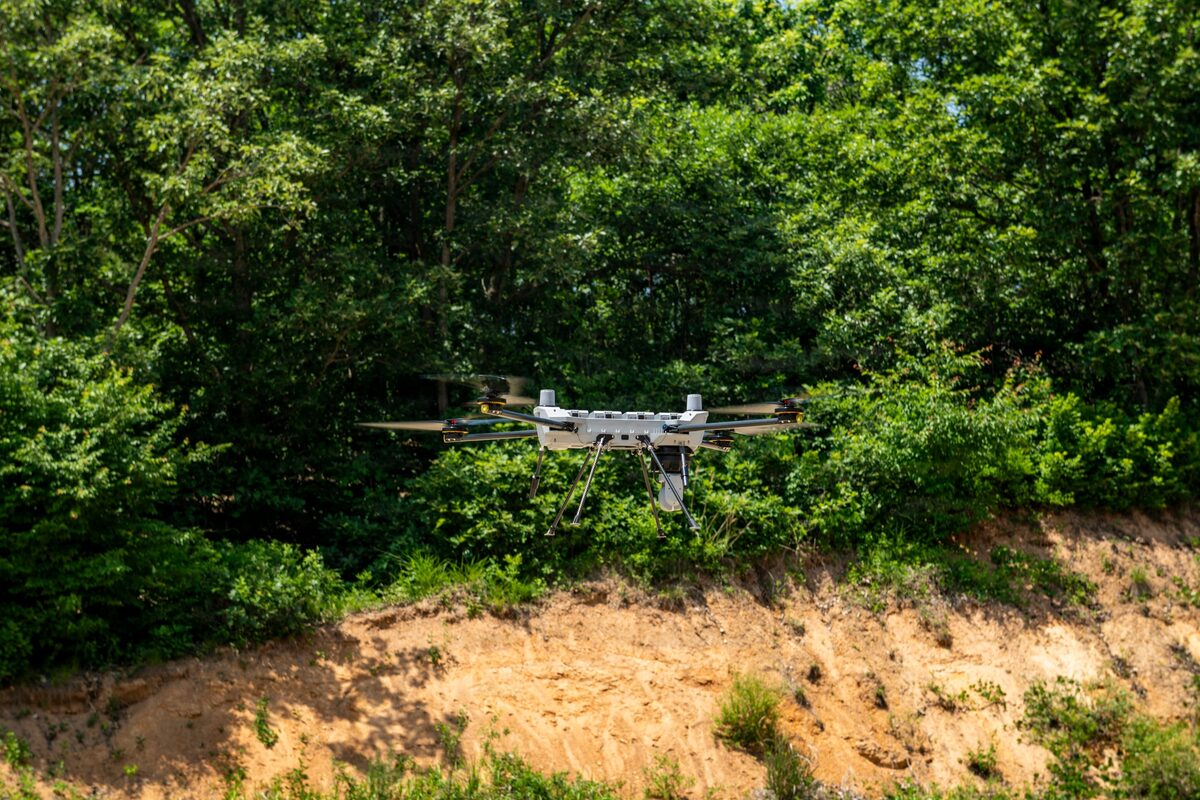
South Korea spent the middle of September making two very different statements about its drone industry, one day apart. On 15 September, the country's defense procurement agency approved a decade-long, KRW2.16 trillion (about USD1.5 billion) programme to develop a home-built VTOL reconnaissance drone for army divisions. On 16 September, at the Defense Ministry's first Defense Drone Technology Exhibition in Pocheon, Gyeonggi, a jet-powered unmanned aircraft from Korea Aerospace Industries (KAI) crashed shortly after takeoff, and other drones and a drone-launched guided missile also failed to perform.
The two events are not directly connected. None of the reporting used here says the failed aircraft had anything to do with the reconnaissance programme. But they landed in the same news cycle, and they frame a question Seoul will have to answer as it leans on domestic development: can it show that its drones work when the audience is watching?
What Seoul approved
According to Janes (reporting by Akhil Kadidal, 16 September), the Defense Acquisition Program Administration (DAPA) announced, following a committee meeting on 15 September, that it would put KRW2.16 trillion (USD1.5 billion) between 2027 and 2036 into a VTOL reconnaissance UAV for divisional-level units of the Republic of Korea Army. The aircraft is to be developed domestically.
The committee approved the programme's basic strategy after re-examining its performance requirements. Janes notes that the updated requirements build on a 2021 strategy for a reconnaissance VTOL UAV. Two requirements stand out. DAPA wants a UAV that can operate in confined environments, particularly mountainous areas, and one whose surveillance capability is "four times greater than existing divisional-level reconnaissance UAVs in the army," in DAPA's words as reported by Janes.
The same meeting cleared a separate KRW3.24 trillion programme to buy MH-60R helicopters for the Navy by 2032. That is outside the scope of this piece.
What happened in Pocheon
The next day, Wednesday 16 September, the Defense Ministry held its first Defense Drone Technology Exhibition in Pocheon. An account in a Korea JoongAng Daily editorial, published 18 September, describes a series of crashes of Korean-made drones. The KAI jet-powered unmanned aircraft went down shortly after takeoff. The editorial also cites problems with a direct-impact attack drone and with a drone-launched guided missile.
Because that piece is an opinion editorial, its characterisations are the newspaper's own judgment rather than a neutral tally. Its factual claims are useful, though, and they line up in broad terms with a second account. The Drone Front, writing on 18 September and citing local reports, says the small jet-powered KAI aircraft crashed right after takeoff and that the backup aircraft also went down after operators reportedly lost control. It adds that an attack drone, several rotary-wing systems and a drone-launched missile from other makers also malfunctioned, and that all of the failed systems were said to be developed by private companies.
Two counts that do not match
The two outlets disagree on the scale of the failures and on the size of the crowd. UASFeed has not been able to reconcile the figures, and reports both as attributed.
- Korea JoongAng Daily (editorial): "Five of 12 drones failed to operate properly" before some 2,200 spectators, including officials from the United Arab Emirates and Saudi Arabia.
- The Drone Front (citing local reports): "Six of the 17 planned demonstrations encountered problems," with around 1,500 people in attendance, including foreign representatives.
The denominators differ (12 drones against 17 planned demonstrations), and so do the failure counts and the attendance. Differences in what was counted could explain some of the gap: an aircraft is not the same unit as a demonstration, and a backup aircraft going down could be tallied differently. Neither source explains its method, and this article does not choose between them. Both point the same direction: a substantial share of the showcase did not go as planned, in front of foreign guests.
The official explanation, and the editorial's rebuttal
Officials offered two lines of explanation. According to the JoongAng Daily, the Defense Ministry said some failures were part of the technology development process, and that frequency interference caused by the large crowd may have been a factor. The Drone Front likewise reports that military officials investigating the incidents identified frequency interference as a possible factor.
The JoongAng Daily editorial does not accept that external factors are the whole story. Its headline frames the crashes as undermining trust in "K-defense", and it points to a wider pattern rather than a one-off. It cites a 25 August incident in which two suicide drones tested by the Navy and the Agency for Defense Development crashed seconds after launch, which investigators attributed to a defect in the launch tube. It argues that if problems have occurred repeatedly at sea and on land within a month, the entire system, including design, components, communications and testing and evaluation, needs scrutiny. It also notes that the Drone Operations Command, established under the Yoon Suk Yeol administration, was abolished under the current government, and says the Korean military appears to be falling behind as drone warfare grows in importance. Those are the newspaper's arguments, not established findings.
The Drone Front's report mentions two further incidents without detailing them: a medium-sized loitering munition that crashed into the sea during a separate test after a reported launch-tube defect, and an August near-shootdown of a military drone by the 1st Army Corps. The sources do not say whether the loitering-munition incident is the same event as the 25 August suicide-drone crash the JoongAng Daily describes, and this article does not assume that it is.
Why It Matters
The reconnaissance programme is a long bet. Funding runs from 2027 to 2036, and DAPA has set demanding targets: operation in confined environments, particularly mountainous areas, and surveillance capability it describes as four times greater than the divisional-level reconnaissance UAVs the army has now. What the requirement asks for is a reliable aircraft in a hard operating environment, not a demonstrator.
That is why the Pocheon showcase matters beyond a bad day. The JoongAng Daily's editorial argues that Korea needs rigorous testing before it promotes its drone capabilities abroad, and notes that officials from the UAE and Saudi Arabia were among the spectators. On that reading, a first-of-its-kind exhibition is a shop window as much as a domestic test. Public failures there carry reputational cost regardless of whether the cause was crowd-related radio interference, as the ministry suggests, or something deeper, as the editorial argues.
Three questions are worth watching, none of which the current reporting answers:
- What actually caused the failures? The frequency-interference explanation is stated as a possibility only. If it holds, it points to a range-management and spectrum-planning problem that any future public event, or any crowded operating environment, would share.
- Who owns the outcome? The Drone Front says all of the failed systems were said to have been developed by private companies. Whether the ministry, the companies or the test organisers carry responsibility for readiness before such a display is not addressed in the material available.
- Do the numbers get settled? With five of 12 and six of 17 both circulating, an official tally from the ministry would resolve which figure is right, and would show whether the failure rate was closer to 42 percent (five of 12) or to 35 percent (six of 17).
Seoul has now put real money and a ten-year timeline behind a domestic recon UAV. The showcase suggests the harder part may be proving, in public and on schedule, that the domestic ecosystem can deliver aircraft that keep flying.
