
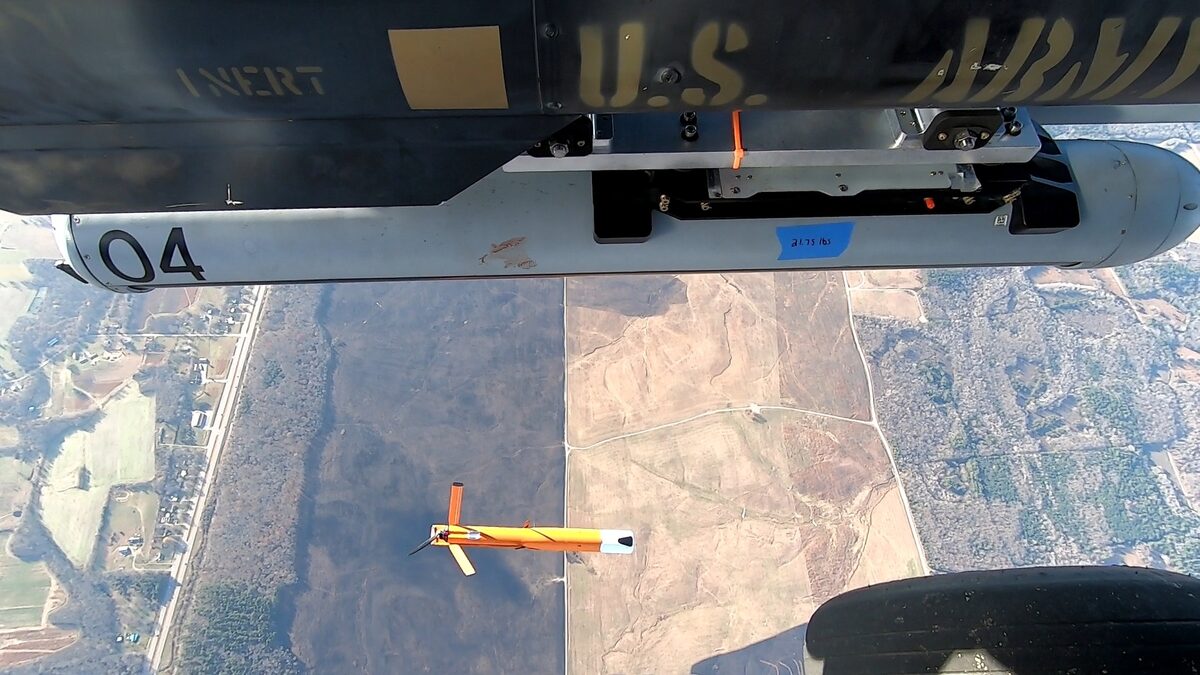
U.S. Special Operations Command is shopping for a new kind of kamikaze drone — one that a gunship crew could kick out at altitude, fly deep into contested airspace, park over a target for the better part of an hour, and then dive into it, all while stitched into a government-owned autonomy network rather than tethered to a single operator.
In a Request for Information posted to SAM.gov in late June 2026 and first reported June 30, SOCOM laid out its interest in an "Air Loitering Munition," or ALM. The requirement reaches well beyond the command's existing Stand-Off Precision Guided Munition (SOPGM) portfolio, and it comes with a specific demonstration platform in mind: the AC-130J Ghostrider.
What SOCOM is asking for
The RFI reads less like a wish list and more like a threshold spec sheet. According to the SAM.gov notice and trade-press reporting, the ALM must:
- Fly at least 75 nautical miles from the point of release.
- Loiter 40 minutes or more over a target area at altitudes between 500 and 3,000 feet.
- Weigh under 95 pounds.
- Launch from fixed-wing aircraft at release altitudes of 5,000 to 30,000 feet.
- Preferably deploy via Common Launch Tube (CLT), though the command says it is open to lugged or alternate launch arrangements.
SOCOM frames the effort as "spiral development," with a demonstration aboard the AC-130J Ghostrider gunship. The command also wants industry to put numbers on scale: the RFI requests cost estimates for orders of 500, 1,000 and 3,000 units. Responses are due July 27.
Taken together, those thresholds describe a weapon that behaves differently from the hand-launched and tube-launched loitering munitions special operators already field. A 75-nautical-mile reach launched from a gunship at up to 30,000 feet lets aircrews strike deep without pushing the launch platform — or the operators aboard it — into the teeth of enemy air defenses. Army Times framed the requirement as letting gunships and other aircraft hunt targets deep inside enemy lines while remaining out of range of enemy air defenses.
The FANTOM Core mandate
The detail that sets this RFI apart is less about the airframe than about the software it has to talk to. The ALM is required to integrate with FANTOM Core, SOCOM's government-owned collaborative mission-autonomy platform, via a machine-to-machine (M2M) API or a compatible Battle Management System.
That mandate, emphasized in SOFX's reporting, turns the munition into a node on SOCOM's autonomous command network rather than a stand-alone fire-and-forget weapon. Government ownership of the autonomy layer matters here: rather than each vendor bolting on its own proprietary brain, the requirement pushes industry to build to a common, command-controlled interface. In practice, that means an ALM should be able to receive tasking, share what it sees, and coordinate with other platforms through infrastructure SOCOM controls — not a black box the government would have to buy back later.
It also signals where SOCOM's loitering-munition thinking is headed: toward networked, collaborative effects that can be retasked in flight, rather than single-shot weapons pointed at a set of coordinates before release.
A growing family of Ghostrider standoff weapons
The ALM would not arrive on the AC-130J alone. SOFX notes that the Ghostrider is also being fitted with the AGM-190A "Havoc Spear," a small cruise missile unveiled by Air Force Special Operations Command in May 2026. That places the loitering munition within an emerging family of Ghostrider-launched standoff effects — a mix of cruise missiles and networked loitering drones that would let a single gunship hold targets at risk from far outside the range of many short-range air defenses.
It is a notable evolution for a platform whose reputation was built on close-in fires. The AC-130 lineage is synonymous with orbiting a target and raining down cannon and precision-guided munitions from overhead. Adding a 75-nautical-mile loitering weapon points toward a Ghostrider that can also reach out and touch targets well beyond its own overhead orbit.
Why It Matters
This is a fresh, air-launched, network-tethered requirement that reaches beyond SOCOM's existing SOPGM portfolio. Two things make it worth watching.
First, the range-plus-launch-altitude combination changes the geometry of a special-operations strike. Kicking a sub-95-pound munition out of an aircraft at up to 30,000 feet and flying it 75 nautical miles to loiter over a target lets crews prosecute deep targets while keeping the launch platform and its operators farther from threat rings. That is a direct response to contested-airspace environments where flying a crewed gunship overhead is increasingly untenable.
Second, the FANTOM Core mandate is a statement about how SOCOM wants to buy and fight with autonomy. By requiring integration with a government-owned mission-autonomy platform via open M2M interfaces, the command is trying to avoid vendor lock-in on the software that matters most — the collaborative brain — while making each new munition an interoperable node rather than an isolated weapon. If that model holds, it shapes not just this program but how future SOCOM drones and munitions get plugged into the same network.
For now, the ALM is still an RFI — an information-gathering step, not a contract. But the specificity of the thresholds, the named demonstration platform, and the tiered 500/1,000/3,000-unit cost request all suggest a command that already knows the weapon it wants. Industry has until July 27 to tell SOCOM whether it can build it.
Sources
- SAM.gov — SOCOM Air Loitering Munition (ALM) Request for Information
- SOCOM interested in developing long-range kamikaze drones (DefenseScoop, June 30, 2026)
- SOCOM Wants 75-Mile Loitering Munition Tied to Autonomous Command Network (SOFX)
- SOCOM is seeking a long-range kamikaze drone (Army Times, June 30, 2026)