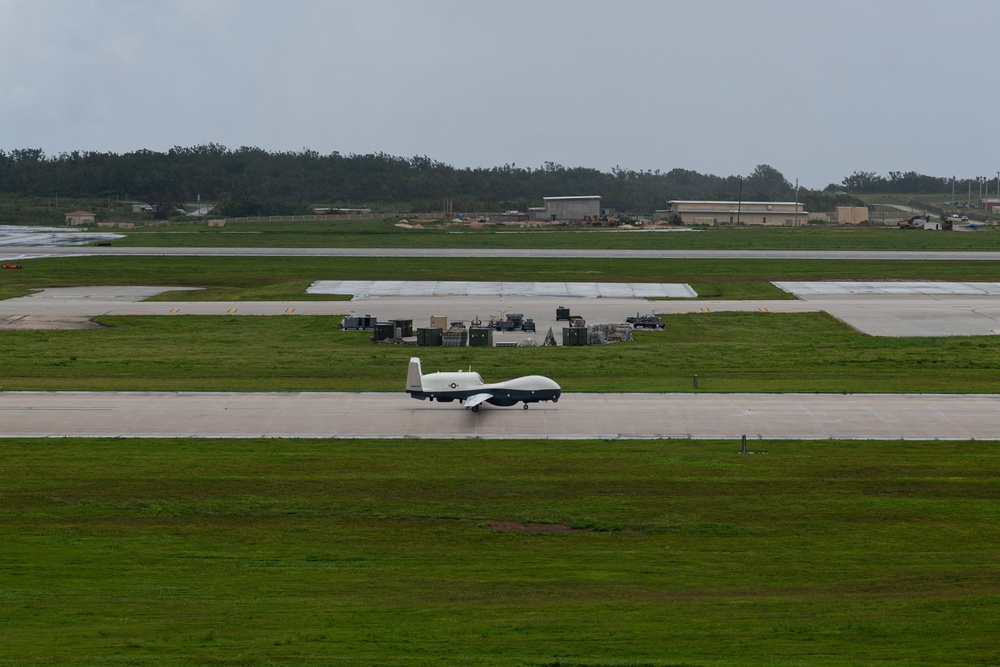
The MQ-4C Triton has never taken its orders from the cockpit of another airplane. The high-flying surveillance drone is flown and monitored by operators on the ground, and a P-8A Poseidon crew that wanted it to look at something had no way to task it directly. A demonstration announced August 5 by Northrop Grumman and Boeing — and picked up August 9 by Interesting Engineering — shows what happens when that arrangement changes.
In what the companies describe as the first automated collaboration between the two platforms, a P-8A Poseidon operator issued mission instructions directly to an MQ-4C Triton using the Universal Command and Control Interface, or UCI — a standard built around machine-readable, machine-actionable messages rather than bespoke point-to-point links. The Triton took the tasking and ran with it: it autonomously planned its transit to the assigned area, employed its sensors, processed the collected data using AI algorithms, and transmitted its findings back to the Poseidon. A satellite relay was incorporated into the exchange to simulate operational conditions.
"The P-8A cued the Triton transit to a specific area... processed findings onboard, and reported results back," is how Boeing summarized the sequence, per The War Zone's reporting on the demonstration.
According to Northrop Grumman, the Triton's system "used AI algorithms to collect, process and share intelligence data with P-8A Poseidon in response to a request sent by the P-8A Poseidon system" — a machine-to-machine exchange of maritime intelligence aimed at coordinated intelligence, surveillance, reconnaissance and targeting (ISR&T) and anti-surface warfare, with reduced operator workload as a design goal.
Why Standards Are the Story
The demonstration's technical substance is less about any single new capability than about how the two aircraft talked to each other. Instead of a bespoke connection engineered specifically for the Triton–Poseidon pairing, the companies used standardized interfaces: UCI is based on Open Mission Systems (OMS) and the Autonomy-Government Reference Architecture. Northrop Grumman's argument is that a shared interface makes "integration across platforms quicker and more cost effective" — the aviation equivalent of agreeing on a common plug rather than soldering a custom cable for every pairing.
That framing matters because manned-unmanned teaming (MUM-T) efforts have historically been point solutions: one manned platform, one drone, one purpose-built link. A standards-based approach means the plumbing demonstrated here is not inherently limited to the Poseidon and the Triton.
"MQ-4C Triton and P-8A are the backbone of the U.S. Navy's maritime patrol and reconnaissance force," said Jane Bishop of Northrop Grumman, adding that the demonstration "underscores the flexibility of our systems, our unwavering industry investment and the strength of our industry relationships."
Boeing's Tory Peterson said the companies are "investing so that current and future global P-8A operators can expand the scope and effectiveness of their missions," and that the demo "unlocks real-world capability and interoperability for the U.S. and allies."
What Was Actually Demonstrated — and What Wasn't
A necessary caveat, reported by The War Zone: the demonstration was completed in a laboratory environment. No aircraft flew. The timing of real-world flight testing will depend on "customer requirements" and acquisition processes — the standard gauntlet between a lab proof-of-concept and a fleet capability.
Even so, the operational logic is straightforward to see. The Triton is built for persistence: it flies above 50,000 feet for more than 24 hours at a stretch. The P-8A, a crewed maritime patrol and anti-submarine aircraft, operates far lower and for far shorter durations. As The War Zone notes, the ability to task the uncrewed aircraft directly in flight would offer new flexibility, especially in responding to sudden changes in the battlespace. A P-8A crew prosecuting a contact could, in principle, redirect a Triton's sensors onto an area of interest and receive processed findings back while still on station.
The P-8A community includes units like Patrol Squadron Five — the VP-5 "Mad Foxes" — at Naval Air Station Jacksonville, Florida, which would be well placed to make use of such a capability.
The Allied Angle: NATO's New Triton Buyers
The timing of the demonstration is notable for reasons beyond the U.S. Navy. At the NATO Summit 2026 in Ankara on July 7, Denmark, Finland, Germany and Norway announced the procurement of up to five MQ-4C Triton high-altitude long-endurance UAVs to enhance NATO's owned ISR Force, according to Janes. The aircraft will complement NATO's Alliance Ground Surveillance fleet operating from Sigonella Airbase in Italy.
That growing allied Triton user base is exactly the audience for an open-standard tasking interface. Because UCI rides on Open Mission Systems and a government reference architecture rather than proprietary hooks, the same integration path demonstrated between a U.S. Navy P-8A and a U.S. Navy Triton could, in principle, extend to allied platforms that adopt the interface — which is presumably what Peterson meant in framing the demo as unlocking interoperability "for the U.S. and allies."
Why It Matters
Maritime patrol is a coverage problem: oceans are enormous, and crewed aircraft are expensive, sortie-limited and human-endurance-limited. The Navy's answer has been to pair the P-8A's on-scene judgment and weapons with the Triton's altitude and persistence — but until now, the Triton has been flown and monitored by operators on the ground, not tasked directly from the Poseidon's cabin.
This demonstration attacks that seam. If a Poseidon crew can fire off a machine-readable tasking and get back processed intelligence — with the drone doing its own route planning, sensor employment and AI-assisted data processing — the manned aircraft effectively gains a second set of eyes it can steer in real time, over satellite relay, from anywhere in the pattern. Reduced operator workload and accelerated commander decision-making are the near-term payoffs the companies cite; coordinated ISR&T and anti-surface warfare are the missions they say it serves.
The longer-term significance is architectural. Open standards like UCI and OMS are how MUM-T scales beyond one-off demos: every platform that speaks the interface becomes a potential teammate without a new integration program. With four NATO nations lining up behind up to five Tritons for the alliance's shared ISR force, the demonstration lands at the moment when a standards-based tasking pipeline stops being a U.S. Navy convenience and starts looking like coalition infrastructure. The gap between a laboratory event and fleet capability remains real — flight testing still hinges on customer requirements and acquisition timelines — but the direction of travel is unambiguous: the ground station's monopoly on drone tasking is ending.
Sources
- US' unmanned plane shares battle intelligence with submarine-hunter aircraft — Interesting Engineering, Aug 9, 2026
- Tech Demo Proves Out MQ-4C Triton and P-8 Poseidon Enhanced Interoperability — Northrop Grumman, Aug 5, 2026
- P-8 Poseidon Crews Controlling MQ-4C Triton Drones Becoming A Reality — The War Zone, Aug 5, 2026
- NATO Summit 2026: Alliance selects GlobalEye, brings Triton into shared ISR fleet — Janes, Jul 7, 2026