
Modern electronic warfare doesn't merely degrade GPS signals — it erases them. Russia's jamming infrastructure across Ukraine has been dense enough to blind commercial UAVs entirely; adversary doctrine across the Indo-Pacific assumes the same at larger scale. The military of the near future will operate routinely in environments where satellites are contested, datalinks severed, and onboard decision-making is the only option. Shield AI was founded, specifically, to build for that environment.
A SEAL's Question, a Bus Ride, and an $800,000 Bet
Brandon Tseng spent seven years as a Navy SEAL with two tours in Afghanistan. The operational problem he couldn't shake was prosaic and lethal: soldiers clearing buildings with minimal situational awareness, walking into rooms they knew nothing about. Fellow SEALs died in those situations. Tseng — a U.S. Naval Academy graduate — left the military with a central question: what does the military of 2030 look like with AI autonomy fully integrated?
In 2015, he co-founded Shield AI in San Diego with his brother Ryan Tseng and Andrew Reiter. Ryan brought complementary credentials — he had previously founded a wireless charging company that was acquired by Qualcomm. Early fundraising was grueling; the defense-tech stigma in Silicon Valley was real, and the brothers faced consistent rejection. Their breakthrough came when Ryan rode an overnight bus to Oakland to meet David Frankel of Founders Collective, who provided the company's first term sheet: $800,000 in seed capital in 2016.
Hivemind: Four Modules, No GPS Required
Shield AI's flagship product is Hivemind, an AI pilot software stack that enables aircraft to operate without GPS, communications, or human input. The architecture breaks into four modular components: EdgeOS, the edge-deployed operating system running onboard the vehicle; Pilot, the core decision-making engine; Commander, which handles mission planning and control; and Forge, the simulation and reinforcement-learning environment where the AI trains. Hivemind is not an autopilot — it doesn't require a persistent datalink or GPS coordinates. It reasons from onboard sensors alone.
Hivemind went into continuous combat use in 2018, aboard the Nova quadcopter, flying for U.S. Special Operations Command in building and tunnel clearance missions — precisely the scenario Brandon Tseng had watched claim lives. In 2021, Shield AI made two acquisitions that extended the platform's reach: Heron Systems, whose AI agent had beaten a human F-16 pilot in simulation during DARPA's AlphaDogfight Trials in August 2020, and Martin UAV, which brought the V-BAT VTOL into the portfolio.
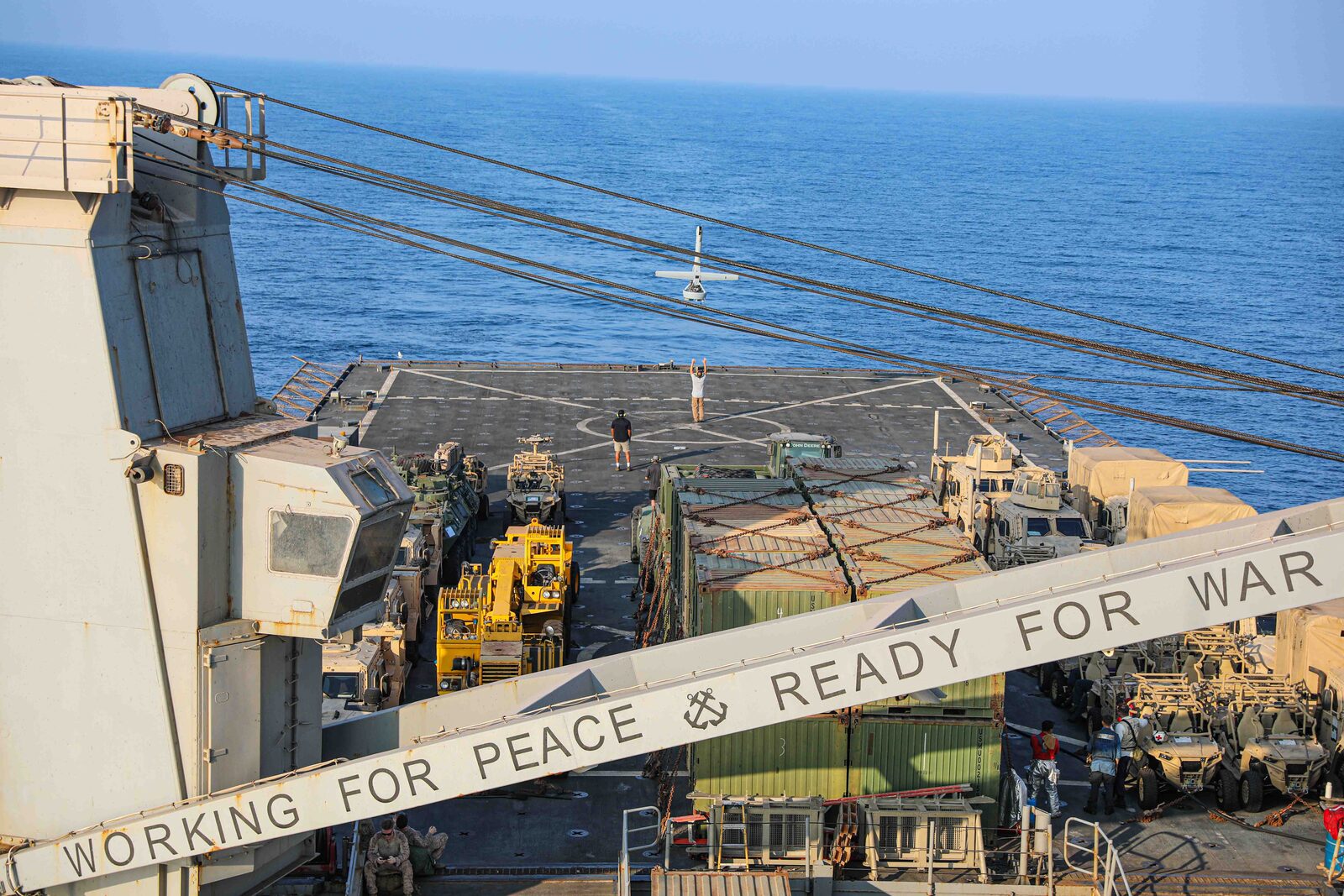
The V-BAT, formally designated MQ-35A, is a Group 3 tail-sitter with over 13 hours of endurance, an 18,000-foot ceiling, a 10-foot height and wingspan, and a ducted-fan design that lets it launch and land in a 12-by-12-foot footprint deployable by a two-person team. With Hivemind onboard, the aircraft requires no GPS or persistent communications to operate. A STRATFI-funded capability called V-BAT Teams, developed in 2023, extends that further: a single operator can coordinate drone swarms covering up to 30,000 square miles.
Tested in Actual Wars
Shield AI deployed V-BAT to Ukraine in 2024, partnering with Ukraine's Unmanned Systems Forces (USF). By April 17, 2025, the platform had surpassed 130 sorties. Shield AI maintains a Kyiv-based operations team, has hired Ukrainian military veterans, and conducts advanced operator training in Texas.
"The war in Ukraine is the front line of modern warfare. For defense companies, legitimacy is no longer earned in labs, test ranges, or exercises. It is earned on the battlefield." — James Lythgoe, Ukraine Managing Director, Shield AI
Ukraine's Unmanned Systems Forces praised V-BAT's ability to operate without GPS or communications and its precision targeting capabilities, calling it a decisive advantage over other UAVs in the region.
The second live test environment was Edwards Air Force Base. DARPA's Air Combat Evolution (ACE) program, launched in 2019, aimed to develop trusted, human-level AI autonomy for air combat. In early December 2022, four teams — EpiSci, PhysicsAI, Shield AI, and Johns Hopkins APL — conducted the first live ACE flight tests aboard the X-62A VISTA, a heavily modified two-seat F-16 operated by the Air Force Test Pilot School that can simulate the flight characteristics of other aircraft types. On May 2, 2024, Secretary of the Air Force Frank Kendall sat in the X-62A's front seat while Hivemind autonomously engaged a manned F-16 in within-visual-range dogfighting; a human safety pilot occupied the rear seat.
Kendall described the mechanics afterward: "…I was in the front seat and I had a button on my stick where basically I initiated the automation." He initiated approximately ten to twelve separate engagement scenarios. DARPA announced on April 17, 2024 that the ACE tests had achieved "the first-ever in-air tests of AI algorithms autonomously flying an F-16 against a human-piloted F-16 in within-visual-range combat scenarios." Shield AI's performance figures from the program: greater than 90% kill rate in offensive dogfighting engagements, fewer than 10% losses on defense. Training had run through millions of daily simulation dogfights using an evolving opponent league, with safety protocols maintaining 10,000-foot minimum altitude and 1,000-foot separation between aircraft.
Why It Matters
Shield AI's business runs on two revenue streams: aircraft platforms and software licensing. The company's 2024 revenue was estimated at approximately $267 million with roughly 856 employees. On the contracts side, it holds a $950 million Air Force JADC2 indefinite-delivery contract and falls under the $46 billion EWACC ceiling. V-BAT has accumulated substantial standalone contract value: a $198 million U.S. Coast Guard ISR services contract (July 2024), approximately $25 million from Japan for East China Sea reconnaissance (January 2025), a U.S. Navy competition worth up to $800 million, and a $90 million JSW Group investment in November 2024 to establish V-BAT manufacturing in India.
The valuation trajectory is the clearest signal of investor conviction. Shield AI raised a $165 million Series D in 2022 at a $2.3 billion valuation and a $240 million Series F-1 in March 2025 at $5.3 billion — with strategic investors L3Harris, Hanwha Asset Management, and Andreessen Horowitz. L3Harris CEO Christopher Kubasik's assessment: "Shield AI is proving that autonomy at scale is not only possible but inevitable."
The company's stated ambition runs beyond aircraft. CTO Nathan Michael described Hivemind Enterprise as "about supercharging the industrial base to build and monetize autonomy, enabling a world of millions of autonomous systems in the next ten years" — a projection that implies deployment on ships, satellites, submarines, and any platform that could lose GPS and communications in a contested theater. The macro driver is not a marketing claim but a documented adversary capability: GPS-denied warfare is becoming the baseline assumption of high-end conflict, not the exception. CEO Ryan Tseng's thesis is unsparing: "Air power is the only way to deter war; it's the only way to win war." Shield AI's wager is that whoever builds the AI pilot controls the next generation of air power.
Sources
- DARPA — ACE Program Transition (2023)
- DARPA — ACE AI Aerospace (April 17, 2024)
- Shield AI — Autonomy for the World: X-62 VISTA
- Shield AI — Inside the AI-Enabled Pilot That Flew Air Force Secretary Kendall Through a Dogfight
- Shield AI — Shield AI Surpasses 130 V-BAT Sorties in Ukraine (April 17, 2025)
- Shield AI — Shield AI Raises $240M at $5.3B Valuation (March 6, 2025)
- Contrary Research — Shield AI Company Profile
- Aerospace America (AIAA) — Shield AI Co-Founder Shares 10-Year Journey Reimagining Air Power
- DefenseScoop — AI Pilot: Frank Kendall F-16 Flight VISTA Shield (May 17, 2024)
- Defense Security Monitor (Forecast International) — Briefer: Shield AI V-BAT (February 10, 2025)
