
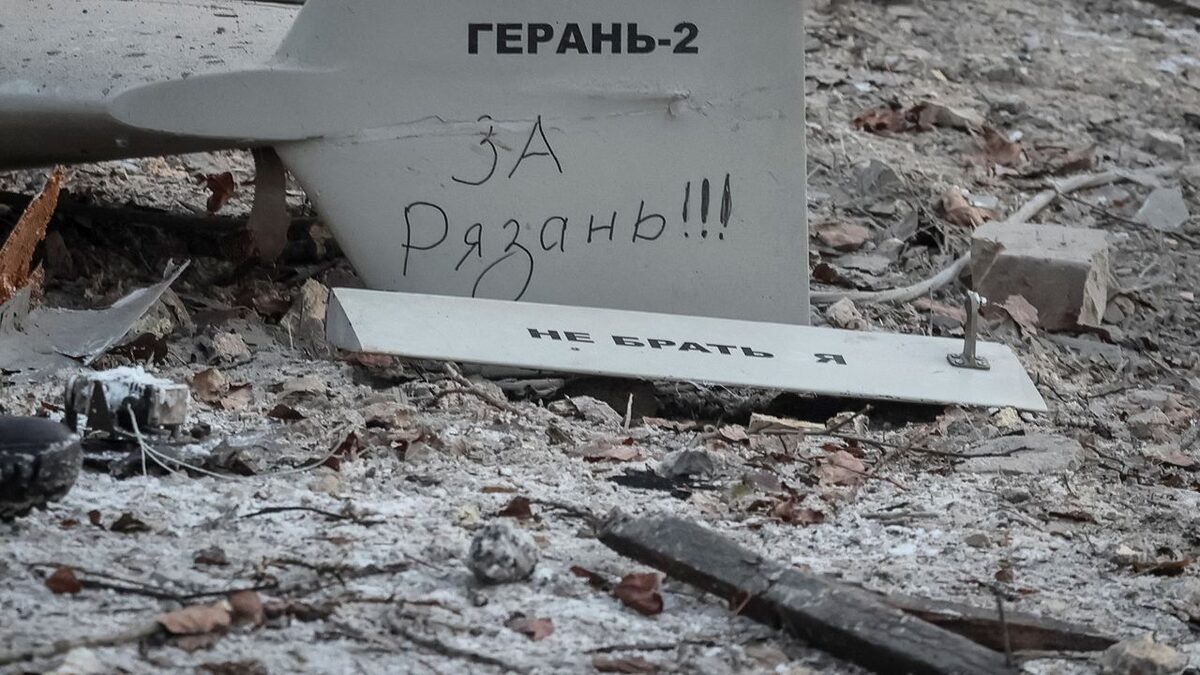
Somewhere over Ukraine, a drone the size of a dining table is boring through the night at 185 km/h, its single-cylinder pusher prop producing the unmistakable chainsaw buzz that has become the war's ambient soundtrack. It costs roughly the same as a used car. The interceptor sent to kill it may cost a hundred times more. That arithmetic — not the warhead, not the guidance package, not any particular target struck — is the strategic logic of the Shahed-136, and it is why 54,538 of them were launched in 2025 alone.
The campaign's duration has already exceeded the WWII London Blitz. That is not a rhetorical flourish; CSIS analysts have used the comparison in formal research. What makes the Shahed-136 worth a definitive reference entry is not just what it is, but what it has validated: a doctrine of mass, low-cost aerial attrition that Iran conceptualized, Russia industrialized, and that two other actors — the Houthis and, quietly, the United States — have now adopted as their own.
What It Is: Airframe, Engine, and the Sound That Precedes It
The Shahed-136 is a one-way attack drone — the manufacturer's euphemism is "loitering munition," though it does not actually loiter — developed by Iran's Shahed Aviation Industries Group and conceptually derived from Israel's Harpy anti-radiation drone. It first appeared in Iranian service in 2021. The basic airframe is a delta-wing configuration: 3.5 m long, 2.5 m wingspan, ~200 kg gross mass (Russian Geran-2 variants have crept to 240 kg). Launch is rocket-assisted from a containerized rail; once airborne it transitions to the pusher prop and sustains cruise at ~185 km/h.
The engine is the detail most revealing of the platform's origins. It is an Iranian Mado MD-550 — a reverse-engineered copy of the German Limbach L550E four-cylinder piston engine producing roughly 50 hp. By October 2024 recovered examples had been simplified further: one captured drone contained an engine described by CSIS analysts as built "without even a starter or a flywheel." The acoustic signature of this engine — that distinctive chainsaw drone — is the basis of Ukraine's distributed acoustic detection network, a fact that became a liability when Iran introduced the Shahed-101, an electric-propulsion variant revealed in March 2026 that the acoustic network cannot hear.
The standard warhead is approximately 40 kg, with variants ranging up to 50 kg. A heavier Russian 90 kg variant appeared in May 2024, trading range down to ~650 km for increased blast effect; a thermobaric 52 kg configuration and tungsten-ball shrapnel variants have also been documented. Quoted range figures vary widely by source: CSIS Missile Defense Project cites DIA estimates of 2,500 km at the high end, with typical operational employment in the 1,000–2,000 km band. Radar cross-section is estimated at 0.01–0.1 m² in the X-band, making detection difficult but not impossible for capable air-defense sensors.
The Guidance Arms Race
At its baseline the Shahed-136 is not a precision weapon. The original guidance package is a commercial inertial navigation system augmented by GPS/GLONASS, following pre-programmed waypoints. Against fixed infrastructure targets — power stations, transformer yards, fuel depots — that is adequate. But GPS jamming over Ukraine expanded rapidly, and the platform has evolved in direct response.
By December 2023 recovered drones contained SIM cards and 4G modems, indicating some capacity for mid-flight communication. Kometa-M controlled-reception-pattern antennas — which resist jamming by shaping their reception beam — became increasingly standard in the same period. By September 2024, Starlink hardware had been found inside recovered drones; real-time operator control via Starlink was confirmed in January 2026. The guidance progression in under three years — from waypoint-following to satellite-jam-resistant real-time control — reflects the kind of iterative wartime engineering cycle that peacetime procurement rarely achieves.
The Shahed-238 (Geran-3) family extends the variant tree further: sub-variants carry an INS/GNSS package, an electro-optical/infrared seeker for terminal homing, or a radar-homing seeker specifically designed to home on air-defense emitters — making it an anti-SEAD threat in the traditional sense of SEAD being what your radar does to you. An AI-enabled MS-series variant with an infrared camera and Nvidia Jetson processor for autonomous targeting was identified in June 2025.
The Alabuga Scale Story
The Shahed-136 was first used against Ukraine on September 13, 2022. By November 2022 Iran and Russia had concluded a domestic-manufacture agreement, and production began at a Special Economic Zone facility in Alabuga, Tatarstan — approximately 1,300 km from the Ukrainian border — under the Geran-2 designation. The factory opened in July 2023; by April 2024 it had produced 4,500 units. By late spring 2025, cumulative production had reached ~26,000 and the daily output rate was approximately 170 units. A second facility, IEMZ Kupol in Izhevsk, supplements Alabuga production according to ISIS Online analysis.
The output trajectory is striking: roughly 256 per month in 2023, rising to ~444/month in 2024, and reaching an estimated 3,000/month (including Gerbera decoys) in late 2025 to early 2026 against an estimated facility ceiling of 5,000–5,500 per month. That production ramp occurred despite Western export controls. Ukraine's National Agency on Corruption Prevention found 55 US-origin parts per Geran-2 in December 2023; Ukrainian military intelligence identified 200 Chinese-made components beginning in late 2023. Approximately 90% of the platform's chips and electrical components were originally Western-made at the start of the war — a procurement pipeline the US Treasury has repeatedly targeted, including OFAC designations against an Iranian UAV procurement network in March 2023.
The workforce supplying Alabuga has drawn international attention of a different kind: reporting documents student labor including minors, over 1,000 women recruited from Africa, and North Korean laborers arriving from mid-2025 — a supply chain controversy that compounds the sanctions-evasion dimensions of the program.
The unit economics shifted as production scaled and hardening was added. Leaked 2022 documents showed Iran charging Russia $193,000 per unit; CSIS cost-effectiveness analysis puts the Iran-produced estimate at $20,000–50,000, the Russian Geran-2 initially at ~$35,000, rising to ~$80,000 by April 2024 as hardening was incorporated. The Gerbera decoy — structurally similar but carrying no warhead — costs approximately $10,000 and serves an explicit role in exhausting interceptor stocks.
How It Is Actually Used: Saturation, Decoys, and the Cost-Imposition Logic
The employment doctrine matters as much as the hardware. Russia launches Shahed-136s in mass salvos from dispersed sites across Krasnodar, Crimea, Kursk, Bryansk, Oryol, Millerovo, and Yeysk — geographic spread that complicates intercept geometry. Between 40 and 60 percent of some salvos are Gerbera decoys, which force air-defense systems to engage regardless. Tempo escalated from roughly 200 per week before September 2024 to over 1,000 per week by March 2025. A "Wolfpack" swarm tactic emerged in mid-2025; by 2026, 24–32 hour continuous attack cycles had become standard. The largest single attack recorded was March 24, 2026: 948 Shahed-type drones in a single 24-hour cycle.
"It doesn't matter if an individual Shahed hits its target. What matters is the compound effect the terror weapon has on civilians and the stress it places on air defenses." — Benjamin Jensen and Yasir Atalan, CSIS Futures Lab
The primary targets are energy infrastructure, logistics nodes, and urban areas — not Ukrainian military formations. The explicit logic is cost-imposition: exhaust expensive interceptors, degrade power generation, and impose civilian hardship at a cost the attacker can sustain and the defender cannot match indefinitely. As CSIS's Kateryna Bondar framed it in analysis of the parallel Gulf campaign, Iran deployed drones "less to inflict direct military damage and more to disrupt infrastructure while forcing defenders to expend costly interceptors."
The intercept rates tell the story. CSIS baseline analysis places approximately 90% of launched Shahed-136s as shot down or mechanically failed; Ukraine's own claims range from 65–85% across the war. But the economics of getting that remaining 5–10% through are ruinous for the defender. A Patriot PAC-3 MSE costs approximately $4.2 million — an 80:1 to 310:1 cost ratio against the drone it kills. NASAMS missiles run roughly $1 million. Even Iron Dome's Tamir interceptor at $40,000–50,000 is at best cost-neutral. The only genuinely cost-favorable intercept layer proved to be FPV drone interceptors, at $800–3,000 each; by January 2026 they accounted for over 70% of Ukrainian Shahed kills. Ukraine produced 100,000+ FPV interceptors in 2025, reaching approximately 950 deliveries per day in December 2025. Mass on the attacking side, CSIS's analysis concludes, can only be answered with mass on the defending side — the one doctrine that has kept pace.
The aggregate cost-per-target calculation reinforces how even a poor hit rate can serve the attacker's purpose. CSIS estimates the cost per target actually struck — accounting for all intercepts and failures — at approximately $350,000. That is a fraction of the cost of a conventional cruise missile, against a platform that simultaneously exhausts air-defense magazines worth multiples of its own cost.
Variants, Proliferation, and the Doctrine That Survived Its Maker
The Shahed-136 is no longer a single product; it is a design philosophy with a growing variant tree. The Shahed-131 is a smaller sibling. The Gerbera is the dedicated decoy. The Shahed-238/Geran-3 is jet-powered, reaching 500–600 km/h, unveiled in November 2023 and deployed by January 2024; recovered examples contained a Czech turbojet and US chips. The Geran-4/5 extends into cruise-missile configuration with a January 2026 deployment date. The Shahed-101 electric variant, announced March 2026, defeats the acoustic detection networks that the gasoline-engine variants trained Ukraine to build. The MS-series AI-targeting variant closes the loop on autonomous terminal guidance.
Geographically, the platform has propagated. Iran used it against US facilities at Al-Tanf in August 2022 and in direct strikes on Israel in April 2024. Houthi forces deployed a local derivative — the Waid-2 — in Red Sea shipping attacks from early 2024. A Gulf campaign in early 2026 saw the UAE absorb 1,422 detected drones plus 246 missiles in the single week of March 1–8; drones accounted for approximately 71% of recorded strikes, with the opening wave on March 1 comprising 867 drones out of 1,206 total strikes.
Most telling is what the United States has done: the LUCAS program is a reverse-engineered Shahed copy, priced at approximately $35,000 and Starlink-capable, with first confirmed combat use on February 28, 2026. The country that fields the Tomahawk — the ~$1.3 million missile the Shahed-136 cost-ratios at 37:1 — has built its own version of the drone it is fighting against.
Vlad Sutea, OSINT analyst for the Kyiv Independent, identified the root of the strategic problem: the threat persists because production remains "uncontested." Ukraine conducted at least four strikes on Shahed storage and launch sites in 2025; ISIS Online analysis found no perceptible impact on launch rates. The Alabuga factory kept building. The doctrine survived every tactical counter thrown at it, and three militaries now manufacture derivatives of the concept. That is the Shahed-136's real legacy: not any individual strike, but the proof that mass, cheap, and accurate enough — delivered at scale against an economically mismatched defense — constitutes a viable strategic instrument.
Sources
- U.S. Treasury / OFAC — Iran-related designations targeting UAV procurement (March 9, 2023)
- CSIS Missile Defense Project — Shahed-131 and Shahed-136
- CSIS — Calculating the Cost-Effectiveness of Russia's Drone Strikes
- CSIS Futures Lab (Jensen & Atalan) — Drone Saturation: Russia's Shahed Campaign
- CSIS (Kateryna Bondar) — Unpacking Iran's Drone Campaign in the Gulf
- Institute for Science and International Security — Comprehensive Analytical Review of Russian Shahed-Type UAVs, 2025
- ISIS Online — Monthly Analysis of Russian Shahed-136 Deployment Against Ukraine
- drone-warfare.com — Shahed-136 Research
- drone-warfare.com — Countering the Shahed-136
- Kyiv Independent (Vlad Sutea) — The Shahed Is an Evolving Threat That Will Keep Haunting Ukraine and the Rest of Us
