
Two terms govern the bloody math of penetrating defended airspace. Suppression of Enemy Air Defenses — SEAD — is the threat of destruction: force a radar operator to shut down or face a missile, and that operator's radar-off state degrades the entire integrated air defense system whether the weapon ever fires or not. Destruction of Enemy Air Defenses — DEAD — removes hardware permanently. The distinction matters operationally: SEAD can be achieved by inducing fear, while DEAD demands a kinetic kill, and that difference has driven six decades of doctrine, purpose-built aircraft, and now autonomous systems architecture.
The Wild Weasel Inheritance
The modern SEAD mission crystallized on August 12, 1965, when the U.S. Air Force authorized Iron Hand — originally codenamed Project Ferret — to address a crisis: North Vietnamese SA-2 surface-to-air missiles were destroying American aircraft at rates the Pentagon could not absorb. The answer was to send a dedicated crew directly at the radar, betting that operators would either shut down and lose situational awareness, or fire and reveal their position to a waiting aircraft with an anti-radiation missile.
The first aircraft into that role was the F-100F Super Sabre, Wild Weasel I. According to historical accounts, the 354th Tactical Fighter Squadron lost all but one aircraft in 45 days — four killed in action, two taken prisoner, three wounded out of sixteen aircrew. The first confirmed SEAD kill is historically recorded as coming December 20, 1965, when Captains Al Lamb and Jack Donovan destroyed a SAM site at the Yen Bai railyard, roughly 75 miles northwest of Hanoi. The airframe evolved fast. The F-105F became Wild Weasel III in summer 1966, with approximately 61 aircraft reportedly upgraded to F-105G standard. The AGM-45 Shrike, the first dedicated anti-radiation missile — retired 1992 — gave crews a weapon that homed on enemy emissions and introduced the fundamental tension that would define the mission for decades.
The Shrike's successor, the AGM-88 High-speed Anti-Radiation Missile, reached full production approval in March 1983 and deployed operationally in 1984. At 13 feet 8 inches and 800 pounds, capable of exceeding 2,280 km/h to a range beyond 30 miles, the HARM is a serious weapon. The program ran to 19,607 missiles and $6.212 billion total cost. The F-4G Wild Weasel V — cannon removed to install the AN/APR-47 radar-homing system, operational in 1978 — flew HARM in its only combat deployment during Desert Storm, with reported figures of 3,942 sorties, roughly 1,000 missiles fired, and approximately 200 Iraqi sites destroyed. The F-16 Block 50/52 took over the mission afterward; the F-35 is slated to assume it gradually, on no fixed timeline. Operation Desert Fox, in 1998, added more than 80 HARM shots to the weapon's combat record. Lt. Col. Robert "Muskrat" McNeese, an F-4G Wild Weasel pilot who flew over Baghdad, is quoted as summarizing what that duty felt like:
"I had my 40th birthday over Baghdad with fireworks and everything."
HARM's structural problem, though, is categorical rather than fixable through aerodynamic refinement. The weapon needs active radar emissions to home on. An operator who recognizes an incoming HARM can shut down and wait. The missile, deprived of guidance energy, misses or passes wide. The radar comes back up. Nothing is destroyed. HARM's Block V variant, introduced in 1999 with tighter flight-path control, and its range-known mode — which can guide the weapon to a GPS-derived position even after emissions stop — partially mitigate this. But the underlying dynamic persists: a patient adversary who times emissions tightly forces every HARM sortie toward suppression rather than destruction. That distinction costs lives and sorties the next time the radar comes back on the air.
Loitering Munitions and the End of Radar Patience
The answer to the emissions-timing problem is a weapon with endurance. Israel Aerospace Industries' Harpy is a fully autonomous anti-radiation loitering munition capable of up to nine hours on station at up to 225 knots, 200-kilometer range, 16-kilogram warhead. The Harpy's passive seeker autonomously identifies radar signatures against a preprogrammed database and attacks — but critically, it aborts if the radar shuts down. A radar operator facing a Harpy launch cannot blink the system off for 30 seconds and survive. The question shifts: can you stay silent long enough to outlast an asset with a nine-hour loiter clock?
The Harop occupies a complementary niche. At 2.5 meters long, 3-meter wingspan, 23-kilogram warhead, and 1,000-kilometer range with up to six hours of endurance, the Harop was built specifically for SEAD and pairs a man-in-the-loop operator with a dual electro-optical payload — FLIR plus 360-degree color CCD — alongside its anti-radiation seeker. Two modes: autonomous homing on radar emissions, or operator-directed EO/IR terminal guidance. The operator retains positive identification before strike. Customers include India (ten units, approximately $100 million, September 2009), Germany in partnership with Rheinmetall, and Turkey, reported as the original launch customer in 2005. Harop can be launched from vehicle-mounted canisters, naval platforms, or the air.
Nagorno-Karabakh in 2020 is where these capabilities crossed from procurement documents into doctrine. Azerbaijan assembled a layered suppression campaign against Armenian Soviet-legacy air defenses combining Turkish electronic warfare assets to deceive, saturate, and geolocate IADS equipment; converted AN-2 Colt biplanes stripped down and flown unmanned as radar-baiting decoys — Armenia largely responded with MANPADS, but in doing so activated radars and revealed launcher positions; Harop strikes specifically optimized against radar targets including the SA-15 Tor; and TB-2 Bayraktar drones carrying Canadian EO/IR sensors and MAM-L precision munitions to prosecute detected sites. Azerbaijan achieved de facto air superiority over the theater. military expert John Antal described it as "the first conflict in history won primarily by robotic systems," a framing CEPA's report cited.
The Broader Kill Chain: Decoys, Jamming, and Crewed EW
Loitering munitions address the endurance gap but do not operate alone. The suppression toolkit integrates standoff decoys, active jamming, and crewed electronic attack — each filling roles that current autonomous platforms cannot replicate at operational scale.
The ADM-160 Miniature Air-Launched Decoy attacks the radar-activation problem from a different angle: rather than killing a radar, MALD mimics the radar cross-section of a real aircraft using its Signature Augmentation Subsystem, saturating IADS engagement queues and forcing operators to light up radars to discriminate real threats from decoys — at which point anti-radiation weapons get their shot. DARPA's ACTD began in 1995; a development contract followed in November 1996. The ADM-160A (Northrop Grumman) flew first in January 1999, weighing 45 kilograms, with GPS navigation supporting up to 256 waypoints and more than 460-kilometer range at Mach 0.8. The ADM-160B (Raytheon) pushed range to 925 kilometers at Mach 0.91, with first powered flight in June 2007 and deliveries beginning in 2009. The ADM-160C MALD-J added active jamming to the decoy function — suppressing and spoofing simultaneously — reaching initial operational capability in 2015. The Air Force planned 3,000 total (2,400 in MALD-J configuration), for use on the B-52H, F-16C, and planned B-1B integration. The MALD-N variant entered Navy service in 2022. MALD was reportedly used in combat in Ukraine in 2023.
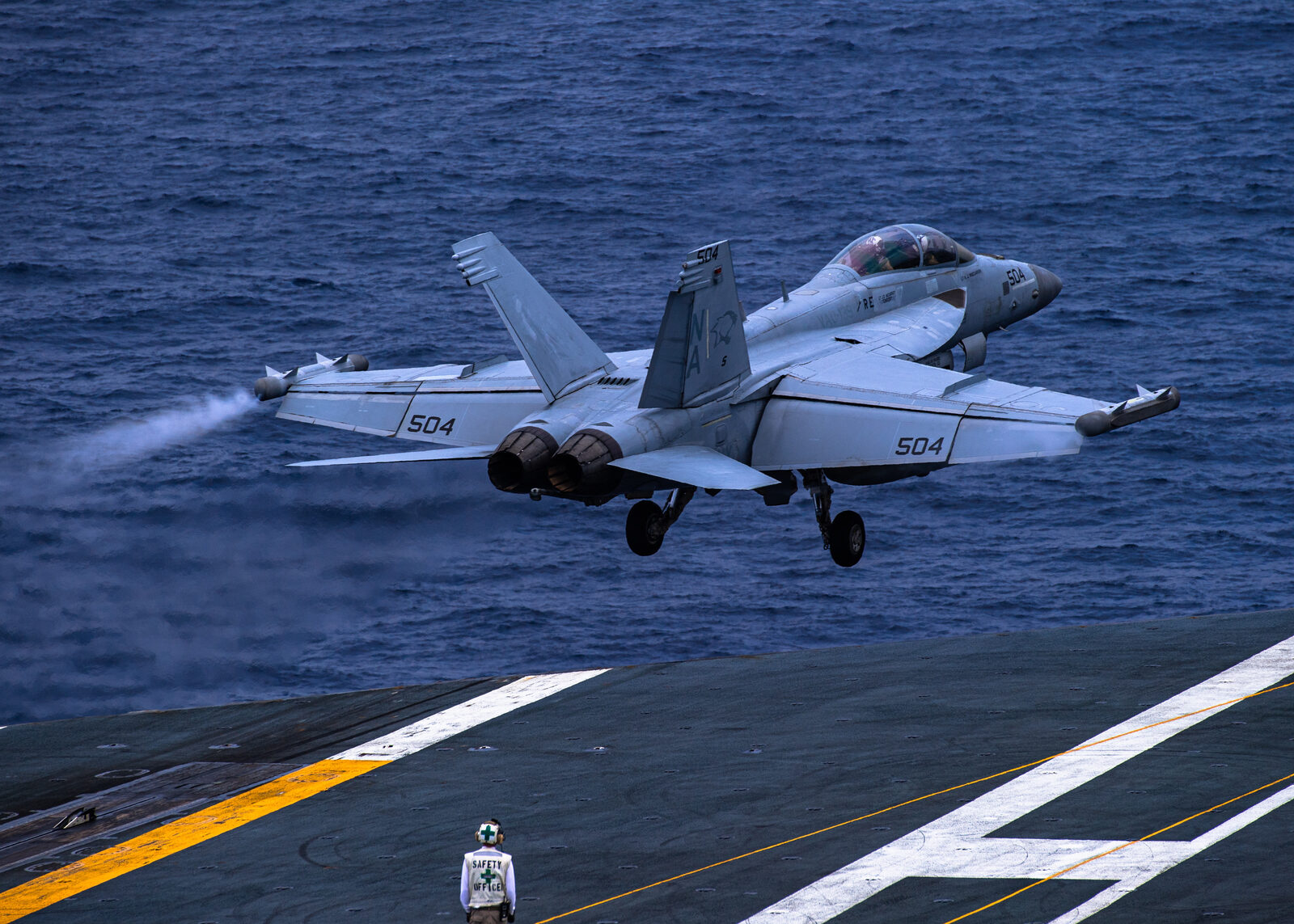
Crewed electronic attack remains indispensable for adaptability that preprogrammed seeker libraries cannot yet match against a modern, reactive adversary. The EA-18G Growler replaced the EA-6B Prowler after the Prowler's retirement in March 2019. Derived from the F/A-18F, the Growler carries a two-person crew, up to three AN/ALQ-99 tactical jamming pods, an APG-79 AESA radar on Block 2 aircraft, and up to eleven hardpoints capable of mixing AGM-88 HARMs with AIM-120 air-to-air missiles. Range is 1,570 kilometers at Mach 1.6. First flight was August 2006; service entry late 2009. Australia became the first foreign operator, with twelve aircraft reaching Royal Australian Air Force initial operational capability in April 2019. The Growler is particularly valued at the outset of a conflict, when an adversary IADS is intact and adaptive jamming — not a preprogrammed database — is what allows the penetrating force to survive initial ingress.
Autonomous Platforms and the Readiness Gap
The U.S. Air Force's Collaborative Combat Aircraft program — roughly $6 billion budgeted across 2024–2028, with FY26 alone at $804.4 million and a goal of more than 1,000 AI-driven platforms entering service around 2030 — explicitly includes electronic warfare among its mission sets. Increment 1 puts two designs in competition: the Anduril YFQ-44A, which completed its first flight in October 2025, and the GA-ASI YFQ-42A, which flew first in August 2025. The implication is that a suppression role once requiring F-4G crews willing to absorb a SAM site's full attention migrates toward expendable autonomous wingmen — compressing the human cost of the first lethal hours of a contested-airspace campaign.
CEPA's April 2024 assessment of NATO drone readiness is a useful corrective to overclaiming. The analysts noted bluntly that "drones are not game changers by themselves," and concluded:
"NATO has too few drones for a high-intensity fight against a peer adversary."
Azerbaijan's 2020 campaign worked because loitering munitions, electronic warfare, conventional fires, and command-and-control were integrated into a coherent combined-arms effort — not because autonomous platforms operated independently. The hard problems that remain — integrating drone swarms with crewed electronic attack aircraft like the Growler, MALD saturation campaigns, and the deliberate human-in-the-loop judgment that Harop-style designs preserve — are the actual engineering and doctrine gaps separating a successful proof-of-concept from a repeatable campaign against a peer adversary with a modern, adaptive IADS. The Wild Weasel crews of 1965 bet their lives on a simple premise: stay in the adversary's radar cone long enough, and something breaks. Six decades later, the bet still holds. The question is only which platform is making it.
Sources
- Federation of American Scientists — AGM-88 HARM
- Designation Systems — ADM-160 MALD
- Air & Space Forces Magazine — ADM-160 MALD
- Naval Technology — EA-18G Growler
- Defense.info — Drones in the Nagorno-Karabakh Conflict (June 2021)
- Airforce Technology — Harop Loitering Munition
- Automated Decision Research — IAI Harpy Loitering Munition
- CEPA — An Urgent Matter of Drones (April 2024)
- Naval Air Systems Command (NAVAIR) — EA-18G Growler fact file
