
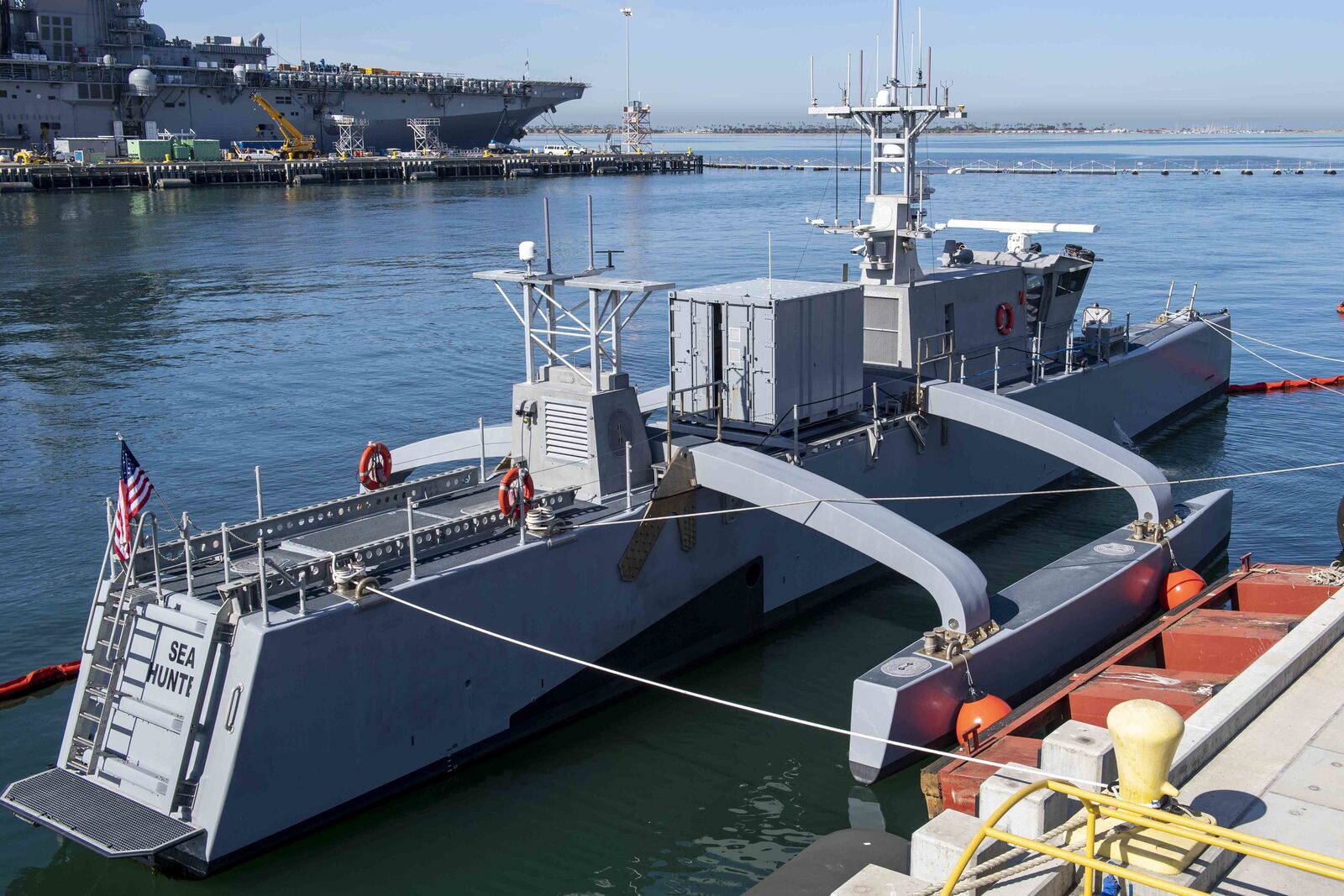
On January 31, 2024, a Tarantul-III-class guided-missile corvette named Ivanovets — a multi-hundred-million-dollar warship capable of launching Moskit anti-ship missiles — was sunk in the Black Sea. No aircraft carrier launched the strike. No submarine fired a torpedo. No naval task force steamed into range. Instead, a swarm of Magura V5 uncrewed surface vessels, each roughly the length of a large SUV and carrying 300 kilograms of explosives, ran the corvette down and detonated. The ship went under in minutes.
That engagement crystallized something analysts had theorized for years but never watched unfold at operational scale: a relatively cheap, expendable drone boat could locate, close on, and destroy a warship worth orders of magnitude more. The Black Sea, from 2022 onward, became the world's first sustained proving ground for uncrewed surface vessel combat — and the lessons it produced are now reshaping naval doctrine from Bahrain to San Diego.
Two Platforms, Two Agencies, One Campaign
Ukraine fields two distinct drone-boat families, developed by separate intelligence agencies with different design philosophies. Understanding the distinction matters because the two platforms are often conflated in coverage despite serving complementary rather than identical roles.
The Magura V5 was developed by SpetsTechnoExport, Ukraine's state-owned arms trading enterprise, and is operated by Ukraine's Main Directorate of Military Intelligence (HUR). It is a fifth-generation multi-purpose naval drone: 5.5 to 6 meters long, built from plastic for a low radar cross-section, and driven by electric or hybrid propulsion to minimize thermal emissions. Maximum speed reaches 42 knots; operational range extends to 800 kilometers. Payload capacity is up to 320 kilograms of explosives. Unit cost is estimated at $250,000 to $300,000.
What distinguishes the Magura beyond raw specs is its networking architecture. Multiple units can coordinate attacks and share targeting data even when individual drones lose contact with their operators — a critical resilience in electronic-warfare-saturated environments. Navigation is redundant: manual wireless mesh control, encrypted satellite communications, inertial navigation, and visual navigation all run in parallel. The platform can optionally carry electro-optic sensors with gyroscope stabilization, marine radar, and a laser rangefinder. Ivan Sybyriakov of SpetsTechnoExport described it as a multi-purpose platform that can be configured with various sensors and payloads depending on mission requirements.
The Sea Baby, operated by Ukraine's Security Service (SBU) rather than HUR, trades agility for mass. Early configurations carry up to 850 kilograms of explosives; upgraded variants push that figure to 2,000 kilograms — a warhead load that exceeds what any comparably-sized aerial drone can carry. Range in upgraded versions exceeds 1,500 kilometers. Armed configurations include a gyro-stabilized machine gun with automated target recognition and a ten-shot Grad multiple-rocket-launcher system. The platform features a low-visibility gray hull, gimballed optical sensors, and a radome-type satellite communications antenna for beyond-line-of-sight control. It was built entirely in Ukraine, in underground facilities, without Western involvement. SBU Chief Vasyl Maliuk offered a blunt summary: Sea surface drones are a unique invention of the Security Service of Ukraine.
The Scorecard: Ships Sunk, Bridges Struck, Helicopters Downed
The operational record is now extensive enough to constitute a body of evidence rather than a series of incidents.
Magura V5 drones struck the minesweeper Ivan Golubets and the frigate Admiral Makarov in Sevastopol harbor as early as October 29, 2022, in some of the first confirmed drone-boat strikes on the fleet. By January 2024, the Ivanovets was sunk. On February 14, 2024, USVs sank the Ropucha-class tank landing ship Tsezar Kunikov, representing at the time the largest vessel ever destroyed by a naval drone. The patrol ship Sergey Kotov followed on March 4, 2024. By August 2024, Magura V5 drones had damaged or destroyed 18 Russian vessels across 18 months of operations. On December 31, 2024, a Magura V5 equipped with an AA-11 missile shot down two Russian military helicopters — the first confirmed instance in history of a USV downing enemy aircraft.
Sea Baby's record centers on infrastructure as much as hulls. On July 17, 2023, two Sea Baby USVs struck the Kerch Bridge in sequence — the first confirmed drone-boat attack on the span. In August 2023, the platform struck the Russian assault vessel Olenegorskiy Gornyak at Novorossiysk, with the UK Defense Ministry assessing almost certainly serious damage, and separately hit the SIG tanker near the Kerch Strait. The minesweeper Vladimir Kozitsky was destroyed by a Sea Baby on October 27, 2023. On June 3, 2025, Sea Baby drones participated in a third Crimean Bridge attack, with Brigadier General Ivan Lukashevych stating according to United24 Media that they had successfully delivered explosives to the necessary point. Total SBU drone record through mid-2025: 11 Russian ships struck, the Crimean Bridge damaged twice.
Sub Sea Baby and the Third Dimension
On December 15–16, 2025, Ukraine's campaign descended below the waterline. A Sub Sea Baby UUV — a further development of the surface drone family, operating submerged during its attack run as an autonomous torpedo-type weapon — struck a Project 636.3 Improved Kilo-class diesel-electric submarine at Novorossiysk naval base. Defense analysts assessed it as the first combat use of an armed attack UUV in recorded history. The operation was a joint effort between Ukraine's Navy and the 13th Directorate of SBU.
The significance went beyond the single vessel. The Sub Sea Baby can navigate confined harbor spaces and execute turns within port infrastructure — exploiting a vulnerability in defenses designed exclusively against surface threats. Boom barriers that stopped surface drones offered no protection. Video evidence documented a massive explosion at the submarine's stern. H.I. Sutton of Covert Shores assessed: It's almost certain that that submarine is unserviceable.
Strategic Outcome: A Fleet in Retreat
Ukraine operated throughout this campaign without a single conventional warship. The asymmetric pressure was sufficient to force Russia's Black Sea Fleet to withdraw most of its modern assets from Sevastopol, its primary port, to Novorossiysk — approximately 200 miles to the east, on Russian territory. A commander of the Group 13 unit stated in August 2024 that Russia's Black Sea Fleet is effectively paralyzed, with the most modern and vital assets already withdrawn from Sevastopol. Kalibr cruise missile launches from Black Sea surface platforms declined sharply after early 2024. The grain corridor, previously contested, effectively reopened as a result of the USV campaign.
Our drones have changed the balance of forces in the Black Sea and proven their effectiveness. — Vasyl Maliuk, SBU Chief (United24 Media)
The cost-exchange ratio underlying this outcome deserves emphasis. A Magura V5 costs an estimated $250,000 to $300,000. The vessels it has sunk — guided-missile corvettes, tank landing ships, patrol vessels — are worth hundreds of millions of dollars each, and represent years of industrial production capacity that cannot be quickly replaced.
The U.S. Response: Task Force 59, USVRON 3, and Replicator
The U.S. Navy had already begun its own unmanned surface vessel program before Ukraine demonstrated the concept at scale. Task Force 59 was established in 2021 under U.S. Central Command (Fifth Fleet area) as the Navy's first dedicated unit for unmanned systems and artificial intelligence. TF59 deployed eight Saildrone USVs across two locations, covering approximately 5,000 miles from the Suez Canal through the Red Sea, Arabian Sea, and Persian Gulf on missions ranging from counter-piracy to counter-trafficking. Then-Fifth Fleet Commander Vice Admiral Brad Cooper framed the economic logic directly: "for pennies on the dollar we can put unmanned platforms out there … and use our manned ships much more efficiently, much more effectively."
On June 9, 2026, a Saronic Corsair autonomous surface vessel operated by TF59 rescued two U.S. Army AH-64 Apache helicopter pilots from waters off Oman near the Strait of Hormuz — the first publicly confirmed real-world aircrew recovery by an autonomous surface vessel. The Corsair is 24 feet long, capable of speeds exceeding 35 knots, carries a payload of up to 1,000 pounds, and has a range exceeding 1,000 nautical miles, with 360-degree passive sensing for day and night operations. TF59 began fielding Corsairs in theater in late March 2026.
On May 17, 2024, the Navy established Unmanned Surface Vessel Squadron Three (USVRON 3) at Naval Base San Diego under Captain Derek Rader, with 400 warfighters assigned. The primary vessel is the Global Autonomous Reconnaissance Craft (GARC) by Maritime Applied Physics Corp. Admiral Lisa Franchetti had already established a new robotics warfare specialist rating approximately three months prior, designating subject matter experts in autonomous systems operations. Vice Admiral Brendan McLane described the intent: "The Navy is placing unmanned systems in the hands of 400 of our most talented warfighters to help integrate, scale, experiment, and employ these systems."
USVRON 3 aligns with the Pentagon's Replicator initiative, which targets deployment of thousands of attritable autonomous systems across multiple domains to build a distributed, expendable force structured to deter China in the Pacific, where the distances and geography differ dramatically from the Black Sea but the cost-exchange logic is identical.
Sources
- Covert Shores (H.I. Sutton) — Ukraine Invasion at Sea Timeline
- The War Zone — Sea Baby used in Kerch Bridge attack
- DefenseScoop — Navy Unmanned Surface Vessel Squadron Three (USVRON 3) established
- Inside Unmanned Systems — Sub Sea Baby UUV attack on Russian Kilo submarine
- Naval News — Ukraine strikes Russian submarine with Sub Sea Baby drone
- Saildrone — Task Force 59 Unmanned Integration
- Newsweek — Ukraine Sea Baby naval drones, Kerch Bridge, Russia Black Sea Fleet
- DefenseScoop — Autonomous maritime drone rescues Apache pilots after crash
- Defense Express — Magura V5 features and specifications
- Army Recognition — Ukrainian Magura V5 paralyzes Russian Black Sea Fleet, damages 18 ships in 18 months
- United24 Media — Ukraine unleashes missile-ready Sea Baby drones to hunt Russia's Black Sea Fleet
- Congressional Research Service — Navy Large Unmanned Surface Vessels: Background and Issues for Congress (R45757)
