
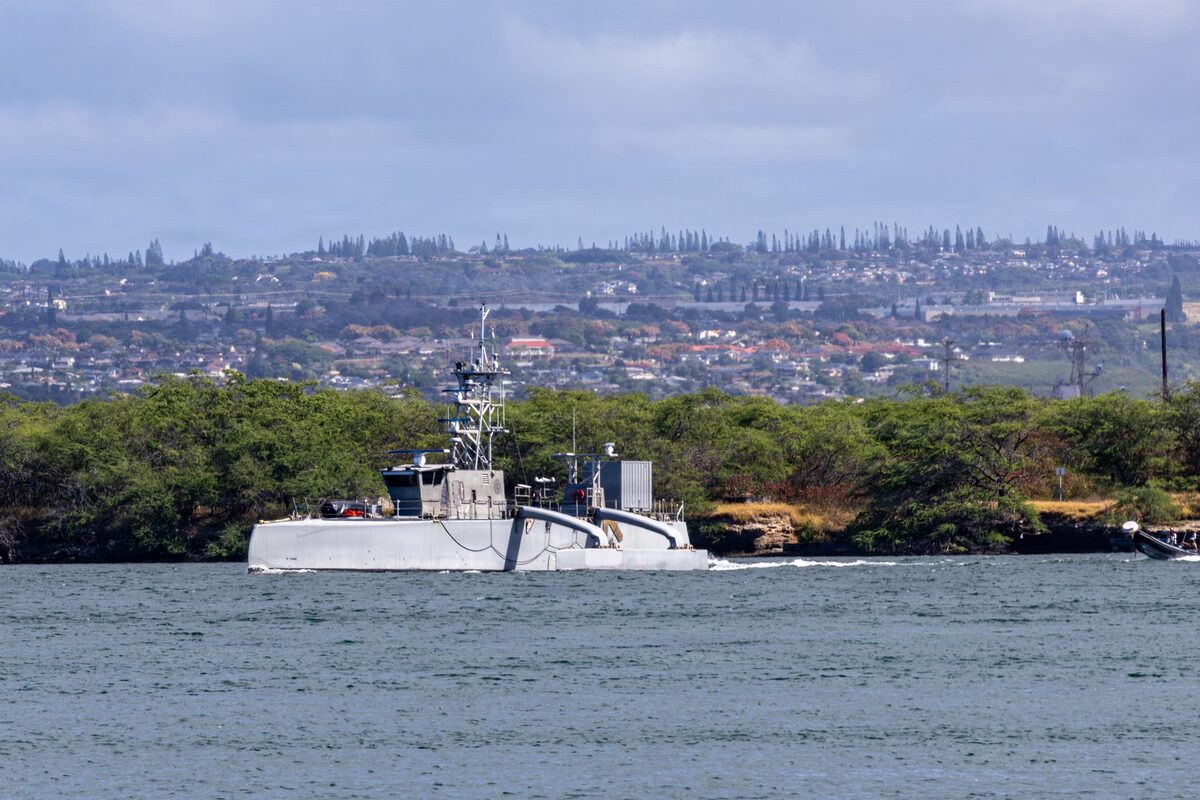
The American drone-boat business and Korean industrial shipbuilding scale collided this week, and the result is a partnership that says a great deal about where autonomous naval warfare is headed. On 23 July 2026, autonomous-warship startup Saronic announced a strategic tie-up with Samsung Heavy Industries (SHI), one of the world's largest shipbuilders. The deal, reported the following day by both Janes and Naval News, pairs Saronic's autonomy software and scalable manufacturing approach with SHI's high-volume yard expertise and vessel design pedigree. The stated goal is nothing less than rebuilding America's shipbuilding industrial base for an era in which uncrewed vessels are expected to make up a growing share of the fleet.
It is a notable convergence. On one side sits Saronic, a fast-rising venture-backed company that has attracted attention and capital for its uncrewed surface vessels and its ambitions to build ships at drone-industry speed. On the other sits Samsung Heavy Industries, a shipbuilder with decades of experience turning steel into large hulls at industrial cadence. The premise of the partnership is that neither autonomy nor shipbuilding capacity is sufficient on its own — you need both, at scale, to matter in a contested maritime environment.
What the two companies actually agreed to
According to Janes, the partnership is aimed at accelerating autonomy-capable maritime systems while strengthening the US shipbuilding industrial base. The division of labor is straightforward on paper: Saronic brings autonomy and a scalable manufacturing model, and SHI brings high-volume shipbuilding capability and vessel-design experience. Naval News, reporting independently, framed the agreement around autonomous maritime systems, robotics-based process automation, and next-generation platform development intended to scale up US and allied maritime industrial capacity — and the workforce that goes with it.
That workforce dimension is worth flagging early. Reindustrialization is a labor problem as much as a capital one. Both outlets describe an effort that is not just about churning out hulls but about the automation and process engineering needed to build them efficiently in the United States. SHI's involvement points to a transfer of shipbuilding know-how — the accumulated practice of running a large yard at cadence — into American facilities.
Where the ships will be built: Franklin and Port Alpha
The partnership plugs directly into Saronic's existing and planned physical footprint. The company already operates a shipyard in Franklin, Louisiana. The bigger prize, however, is Port Alpha, Saronic's planned megashipyard in Brownsville, Texas. Both Janes and Saronic's own newsroom announcement position the SHI relationship as feeding that expansion.
Port Alpha is the centerpiece of Saronic's stated industrial thesis: a facility conceived to produce autonomous vessels at a scale that conventional US naval shipbuilding has struggled to reach in recent decades. Bringing in a partner like Samsung Heavy Industries — a builder that operates at genuinely industrial volume — is a logical move if the goal is to translate a startup's ambitions into steel-cutting reality. The Franklin yard provides near-term capacity; Port Alpha is the bet on scale.
The geopolitical wrapper: the Korea–US Shipbuilding Partnership Center
The Saronic–SHI deal did not appear in a vacuum. Janes reports that it is framed within the Korea–US Shipbuilding Partnership Center (KUSPC), which launched in Washington, DC. The center is the institutional expression of a broader trend: American policymakers and industry looking to allied shipbuilders — South Korea chief among them — to help close the gap between US naval ambitions and US yard capacity.
South Korea's shipbuilders are among the most capable on the planet, and the KUSPC gives a formal home to cooperation between Korean industrial heavyweights and American programs. Slotting a specific, concrete corporate partnership into that structure gives the political framework something tangible to point to. It also signals that the reindustrialization push is being pursued through alliance channels rather than as a purely domestic effort.
Not a weapons platform — a different layer of Saronic's business
It is worth drawing a clear line here, because Saronic is known in defense circles for its uncrewed surface vessels. This partnership is a different animal. The SHI agreement is about industrial capacity, shipbuilding scale, and process automation — the machinery of building vessels in volume — rather than a specific weapons platform. In other words, this is a story about the factory, not the munition.
That distinction matters for readers trying to parse Saronic's trajectory. The company is simultaneously developing combat systems and trying to stand up the manufacturing base to produce maritime platforms at scale. The Samsung Heavy Industries deal belongs to the second effort. It is the plumbing that would, in theory, let Saronic build a lot of anything — autonomous or otherwise — quickly and repeatably.
Why It Matters
American naval shipbuilding capacity has been a chronic strategic worry for years. The US Navy's shipbuilding pipeline has been slow and expensive relative to the pace at which a peer competitor can put hulls in the water. Autonomous surface vessels are widely seen as one way to add mass to the fleet affordably — but only if someone can actually manufacture them at volume. That is the bottleneck this partnership targets.
The significance of the Saronic–SHI deal is that it fuses two things that have historically lived apart: Silicon Valley-style autonomy money and speed, and heavy-industrial shipbuilding scale. A drone-autonomy startup can move fast and raise capital, but it does not, by default, know how to run a yard that produces large steel vessels efficiently. A legacy shipbuilder knows how to build hulls but may not own the autonomy stack that defines the next generation of naval platforms. Combining the two — and routing it through an allied-industrial framework like the KUSPC — is a plausible template for how the US might actually rebuild maritime industrial capacity rather than merely talk about it.
There are open questions the announcements do not resolve. Neither Janes nor Naval News details the full commercial structure of the partnership, specific production targets, timelines for Port Alpha's completion, or the exact vessels the collaboration will yield first. Naval News does report a $300 million investment to expand the Franklin facility and describes Port Alpha as a multi-billion-dollar, next-generation shipyard, but the deeper deal terms remain undisclosed. The involvement of a foreign shipbuilder in strengthening a domestic industrial base also raises the usual questions about technology transfer, workforce development, and how "American" reindustrialization looks when a Korean partner supplies core shipbuilding expertise. Those are the details worth watching as the relationship moves from announcement to steel.
For now, the takeaway is directional. The convergence of USV autonomy and Korean shipbuilding scale, formalized inside a bilateral partnership center in Washington, is a concrete signal that the reindustrialization-of-shipbuilding conversation has moved past white papers and into corporate agreements with physical addresses in Louisiana and Texas. Whether Port Alpha delivers on its promise is the next thing to watch — but the industrial logic behind this pairing is hard to argue with.
Sources
- Saronic partners with Samsung Heavy Industries to bolster shipbuilding capabilities (Janes, 24 July 2026)
- Saronic and Samsung Heavy Industries Partner to Accelerate the Reindustrialization of American Shipbuilding in the Era of Autonomy (Naval News, 24 July 2026)
- Saronic and Samsung Heavy Industries Partner to Accelerate the Reindustrialization of American Shipbuilding (Saronic Technologies newsroom, July 2026)
