
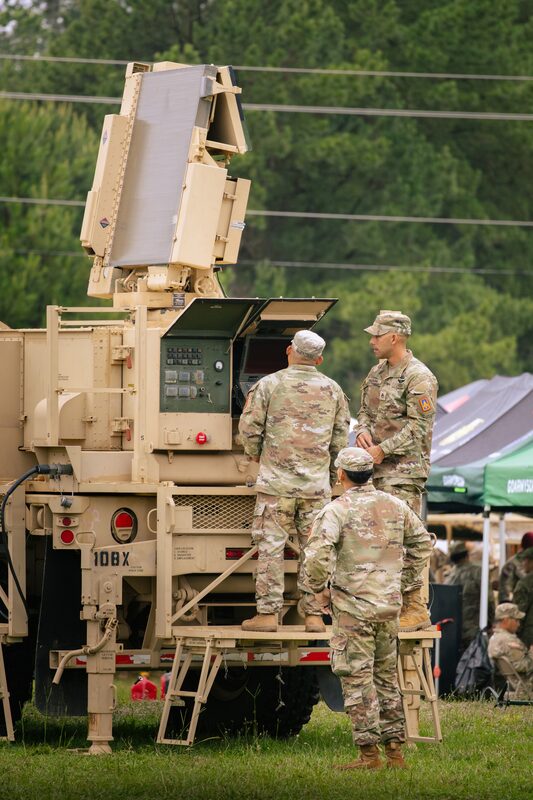
The Royal Air Force has taken delivery of new Saab Giraffe 1X radars, adding another layer of detection capability to its counter-drone posture at a moment when the threat picture from small unmanned aircraft has become impossible to ignore. Saab UK confirmed the handover on September 2, 2026, delivered under an urgent operational requirement intended to close capability gaps quickly rather than through a conventional, multi-year procurement cycle.
The radars are destined for the RAF Regiment, the service's ground-based force protection arm, which will use them to strengthen counter-unmanned aircraft systems (C-UAS) coverage both in the UK and at deployed locations in the Middle East. The urgency behind the order reflects a broader pattern across UK and allied forces this year: drone incursions and loitering-munition threats have moved from a hypothetical planning concern to a persistent operational reality that base defenders now have to answer for daily.
What the Giraffe 1X Actually Is
Giraffe 1X is a lightweight, X-band, three-dimensional active electronically scanned array (AESA) radar designed by Saab for UAV detection, force protection, and ground-based air defense roles. Its defining characteristic is portability: the system weighs under 150 kilograms, a figure that puts it well within range of being carried, emplaced, and repositioned by small teams rather than requiring the heavy logistics tail of a legacy air-defense radar. That weight class matters directly for the RAF Regiment's mission set, which involves protecting airfields and deployed operating locations that may need radar coverage stood up, moved, or torn down on short notice.
The radars supplied to the RAF are being built at Saab UK's Centre of Radar Excellence in Fareham, Hampshire — the same UK production line responsible for an earlier, separate Giraffe 1X order this year. That prior contract, worth nearly £24 million ($31.84 million), was funded through the NATO Security Assistance and Training for Ukraine (NSATU) Trust Fund — a mechanism that directs resources toward improving Ukraine's operational effectiveness and is administered in coordination with Ukraine's armed forces, pointing to those radars being bound for Ukrainian forces rather than the UK's own inventory. The RAF's September delivery is a distinct order that draws on the same Fareham production line, but meeting it evidently required more than that one site: the RAF has said Saab mobilized production capacity across its wider global business to satisfy the requirement quickly.
Why It Matters
The RAF's own framing of this delivery is notable for how little it hedges. A service spokesperson described the radars as "critical in mitigating the risk to life posed by the drone threat" — language that treats small UAS not as a nuisance to be managed but as a threat with a body count if left unaddressed. That framing tracks with a wider shift in how NATO air forces talk about counter-drone capability: what was once bundled into general force protection planning is increasingly being treated as its own urgent line item, funded and delivered on compressed timelines outside normal budget cycles.
The dual-track nature of Saab's UK Giraffe 1X business — one order flowing to Ukraine via NSATU funding, another flowing directly to the RAF — also illustrates how a single production line is now serving both a live combat requirement and a domestic/coalition force-protection requirement at the same time. For a program built around rapid, lightweight deployability, that is arguably the point: the same radar design that can be pushed forward to protect Ukrainian positions can just as quickly be stood up around a UK airfield or a Middle East operating base. It is also a data point on industrial capacity. An urgent operational requirement only works if a manufacturer can actually deliver against it quickly, and Saab's ability to fill two separate UK-linked orders in the same year — while also supplying Giraffe 1X radars elsewhere — is as much a story about production surge capacity as it is about the radar's technical merits.
For the RAF Regiment specifically, the delivery plugs directly into an operational gap: personnel protecting airfields and forward locations in the Middle East have faced drone threats that outpace the coverage older, heavier radar systems can practically provide in expeditionary settings. A sub-150kg AESA radar that can be moved with a small footprint changes what "adequate coverage" looks like for a unit that has to reposition often and cannot always wait for a fixed installation.
The Bigger Picture on UK Counter-UAS
Saab UK Group Managing Director Andy Fraser called the delivery a showcase of "the dedication and expertise of teams across Saab," while an RAF spokesperson credited the company with mobilizing "their global production capacity to rapidly satisfy our Giraffe 1X requirement in support of Counter Drone operations." Read together, those statements point to a procurement environment where speed of delivery is being treated as a capability in its own right — not just a nice-to-have alongside performance specifications.
That urgency is consistent with what allied militaries have been signaling more broadly this year: counter-drone radar orders are being funded and executed on accelerated timelines because the threat is evolving faster than traditional acquisition cycles can match. Whether this delivery represents a one-off surge order or the first tranche of a larger RAF Giraffe 1X buy has not been disclosed. But the pairing of this delivery with the earlier NSATU-funded Ukraine order suggests Saab UK's Fareham line is likely to remain a focal point for UK and allied counter-drone radar demand for some time.