
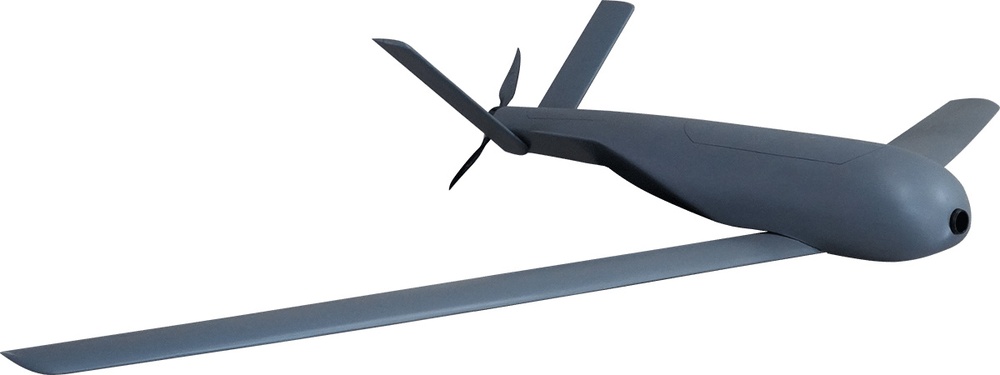
AEVEX Corp. has a jet-powered one-way-attack drone it calls Specter. It now has a first-flight target as well. The company (NYSE: AVEX) announced Specter on Sept. 23 and showed it publicly for the first time at the Association of the United States Army (AUSA) annual meeting in Washington. The aircraft is being built with additive-manufacturing firm Divergent Technologies. AEVEX describes it as a "high-speed, turbojet-powered one-way attack platform" with a modular airframe and a swappable nose meant to carry very different mission payloads.
Several things are still missing from the pitch: range, payload weight, unit cost and how far the autonomy goes. Until AEVEX releases them, most of what follows is the company's own description of its product.
What AEVEX Says Specter Is
The Sept. 23 release, issued from AEVEX's Solana Beach, Calif., headquarters, calls Specter an autonomous platform under development. It names three design principles: a modular airframe, open interfaces and software-defined capability. In AEVEX's account, the turbojet is what allows both ground-launched and air-launched variants. The nose section can be swapped to take kinetic, non-kinetic, electronic warfare (EW), intelligence, surveillance and reconnaissance (ISR), and "future" payloads.
The company says the design draws on lessons from thousands of operational deployments. The release gives no detail on which deployments, or which lessons.
Interesting Engineering's summary of the announcement gives the same basic picture. Turbojet propulsion is built around the modular airframe. The ground- and air-launched versions share one architecture. Mission equipment can be changed without redesigning the aircraft. That last point is the central claim: one airframe, many missions, with the nose as the main variable.
What Came Out at AUSA
The more concrete details came from the show floor. Speaking to The War Zone's Thomas Newdick, AEVEX representative Craig Anders said AEVEX is excited to "up our stats on range and speed" with the turbine engine. He said the aircraft is being designed to reach sub-Mach speeds. Besides warheads, it is meant to carry cameras and non-kinetic payloads. Anders presented it as attritable, with a relatively low price tag that lets commanders send it into dangerous areas without risking costlier assets, though he gave no figure.
Anders also described how the work is split. Divergent handles the digital design and produces the fuselage using its DAPS platform. AEVEX is responsible for the internal systems, mission integration, flight characteristics and navigation. TWZ says AEVEX is also drawing on its CompassX autonomy architecture.
Per TWZ, AEVEX did not disclose range, payload capacity, communications, terminal targeting approach or unit cost.
The test plan
According to TWZ, AEVEX plans a first flight in December 2026. It will be a ground launch using rocket-assisted takeoff (RATO). Anders said early test aircraft will have landing gear so they can be recovered and reused for work on flight characteristics and handling. The air-launched version is planned to follow.
Where AEVEX Is Aiming It
TWZ reports that Anders identified the U.S. Army's Family of Affordable Mass Missiles (FAMM) effort as a primary focus for Specter. He also said the company is looking at opportunities associated with Rapid Dragon and other programs. TWZ stresses that this shows the applications AEVEX hopes to address, not that the aircraft has been selected for any of them, and nothing in the available material indicates a contract.
AEVEX has fielded one-way-attack drones before. TWZ says the company built the Phoenix Ghost family that was rushed to Ukraine in 2022. Specter's turbojet propulsion and sub-Mach speed point to a different class of system aimed at the same broad mission.
Why It Matters
Specter appears to fit a broader push in U.S. procurement, though no cited source says so directly. The idea is to field relatively cheap, expendable strike and effects platforms in large numbers rather than small numbers of costly, exquisite munitions. FAMM, which AEVEX identifies as a primary focus, is a mass-missile effort.
Three parts of AEVEX's pitch line up with that demand.
- Manufacturing. Divergent produces the fuselage on its DAPS platform. TWZ says the partnership is intended to make the aircraft easier to manufacture at scale. Whether it does is an open question until there is a production line to examine.
- Modularity. A swappable nose that can carry a kinetic warhead, an EW package or an ISR sensor would let one production line serve several missions. That matters for a buyer trying to field mass without paying for multiple airframes. It holds only if the payloads really are as interchangeable as the company claims.
- Launch flexibility. If ground- and air-launched variants share one architecture, the same design could support Army ground units and airborne launch concepts such as Rapid Dragon.
For now these are design intentions, not demonstrated capabilities. Specter has not flown. The figures that decide whether a one-way-attack weapon is militarily useful have not been released: how far it flies, what it carries, how it finds its target in the terminal phase and what each one costs. The planned December RATO flight is the next milestone for the aircraft behind the AUSA display. The numbers AEVEX eventually releases will decide whether "relatively low price" holds up against other contenders in the affordable-mass field.
Sources
- AEVEX to Expand Its Unmanned Aircraft Systems Portfolio With Specter (AEVEX news release, Sept. 23, 2026)
- Specter Jet-Powered Drone Aims At Low Cost, Multi-Mission, Single Use (The War Zone, Oct. 13, 2026)
- AEVEX's Specter will support both ground and air launches (Interesting Engineering, Sept. 23, 2026)
