
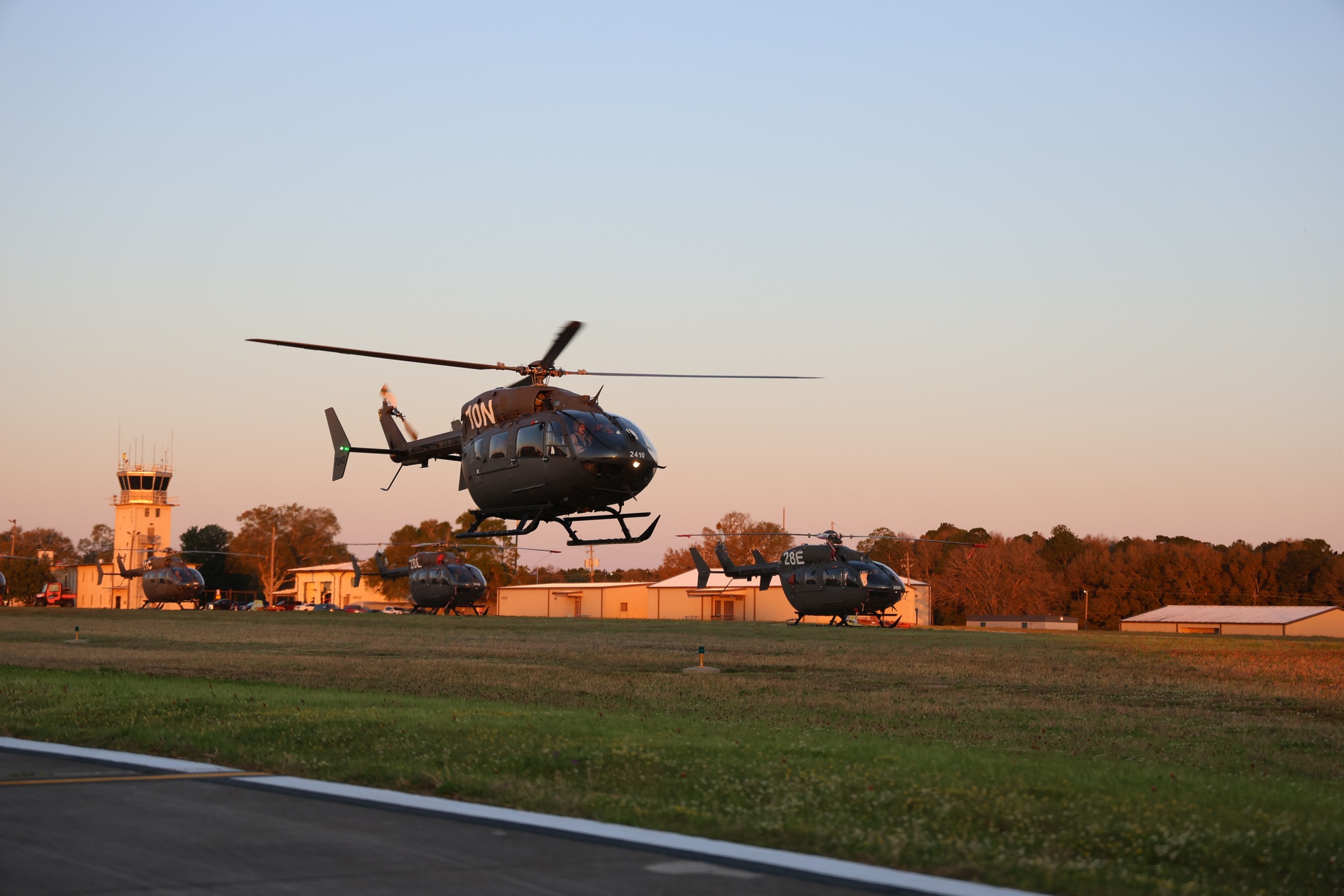
Airbus brought its uncrewed MQ-72C helicopter to Huntsville, Alabama, to show U.S. Army leaders what an autonomous cargo aircraft can do. TWZ reports the Army does not appear to have formalized a requirement for a cargo drone helicopter yet. The company and its partners Shield AI, L3Harris and Parry Labs flew the aircraft at the Yulista Center of Excellence at Huntsville Executive Airport. The Redstone Rocket dates the demonstration to Oct. 7, and TWZ reported it as having taken place "last week."
Airbus paid for the demonstration itself, according to TWZ. Over five flights the aircraft flew hover patterns and traffic patterns on its own. In one test it re-routed around a no-fly zone that appeared during the flight. A pilot sat aboard as a safety margin and, per Airbus, never took control; The Redstone Rocket adds that two people remained in the cockpit in accordance with FAA regulations while flight operations were monitored from the ground. The Rocket also reports that the aircraft recognized a parked truck in its intended landing area and adjusted its landing point.
A Marine Corps aircraft, shown to the Army
The MQ-72C was not built for the Army. The Redstone Rocket reports that the Navy sponsors the program and that it was developed with the Marine Corps for the "last tactical mile," the final stretch of delivering supplies to forward units. It is the aircraft Airbus is offering for the Marine Corps' Aerial Logistics Connector (ALC) effort.
In Huntsville the pitch was about what else the aircraft could carry. "We really see that we're building a truck," Airbus's Jaysen Yochim, a retired Army aviator, told The Redstone Rocket. The paper spells his first name "Jason," while TWZ and Janes use "Jaysen." With the pilot station removed, the open cabin is about 13 feet long, according to the Rocket. The aircraft's digital backbone is designed to make it easier to add mission systems beyond cargo, including launched effects, signals intelligence (SIGINT) and electronic warfare (EW).
Airbus has made this argument before. In coverage of the AUSA 2025 show a year ago, Janes reported that the Marine ALC requirement calls for carrying two Joint Modular Intermodal Containers (JMICs) and that the open cabin can take up to three, though that gets heavy. Janes also reported that the company pointed to air-launched effects, medevac and intelligence gathering as possible Army roles. Rollers on the floor allow cargo or mission systems to be moved through the nose, either side or the rear, Janes said.
What is under the hood
According to TWZ, the MQ-72C is based on the crewed UH-72B Lakota, which is in turn a variant of the Airbus H145. Two LIDAR sensors, facing front and back, and an electro-optical camera at the nose feed Shield AI's Hivemind autonomy software, which interprets the imagery and makes decisions in flight. Parry Labs leads work on the ground control station.
Huntsville was not the aircraft's first time flying without direct crew input. TWZ reports that over the summer the MQ-72C received commands from a ground control station over Starlink, including flights commanded from up to 70 miles away.
Some hardware is still missing. The nose clamshell doors that would allow the pass-through loading Airbus has promoted have been designed and rendered but not flight tested. TWZ reports that integrating them is now expected around 2029-2030, tied in part to delayed Marine Corps ALC funding that shifted the schedule to the right.
The road from here
The Redstone Rocket reports that Huntsville was the last test planned in that area for now. More testing will follow in Grand Prairie, Texas, and Yuma, Arizona, ahead of operational testing with the Marines. The goal is a fieldable solution in 2029-30. TWZ reports that the Marines aim to demonstrate the capability in an operationally relevant context next year.
Airbus has a direct competitor. According to TWZ, Near Earth Autonomy and Honeywell are also under contract for the Marine ALC program with a design based on the Leonardo AW139, and the Marines are expected to pick a single design eventually. Airbus's European arm is also pitching a functionally identical U145 based on the current-generation H145, with a first flight set for late 2026, TWZ reports.
Why It Matters
The Army does not appear to have a formal requirement for a cargo drone helicopter, TWZ notes, though it says comments from Maj. Gen. David Gardner suggest one may be emerging. Airbus spent its own money to fly for Army leaders anyway, which suggests it sees a market worth shaping before a requirement is written.
The Army's interest is tied to distance. TWZ quotes Gardner, who commands the 101st Airborne Division, saying that recent air assaults from Fort Campbell to the Joint Readiness Training Center cover roughly 500 miles, that current helicopters need fuel and rearming stops, and that the division may "need to rely on autonomous logistics delivery systems" to get sustainment to the battlefield at those distances. An aircraft that can be commanded from 70 miles away over a satellite link, and that steers around a newly appearing no-fly zone without a pilot's help, speaks to that concern, although 70 miles is well short of 500.
The "truck" pitch also matters. If the cabin and data backbone can take launched effects, SIGINT or EW payloads as easily as pallets, the aircraft becomes a general-purpose uncrewed platform, and that may be easier to justify in a budget than a single-mission cargo hauler. That case still has to hold up through the Marine Corps' operational testing. The nose doors are years away, the program schedule has already shifted with funding, and a rival design is competing for the same Marine program. TWZ also notes that Sikorsky, Robinson Unmanned and Bell are developing other uncrewed helicopters, so the field is wider than two. For now, the Huntsville flights show that the autonomy works on a real airframe with safety crew aboard. They do not commit any buyer to the aircraft.
