
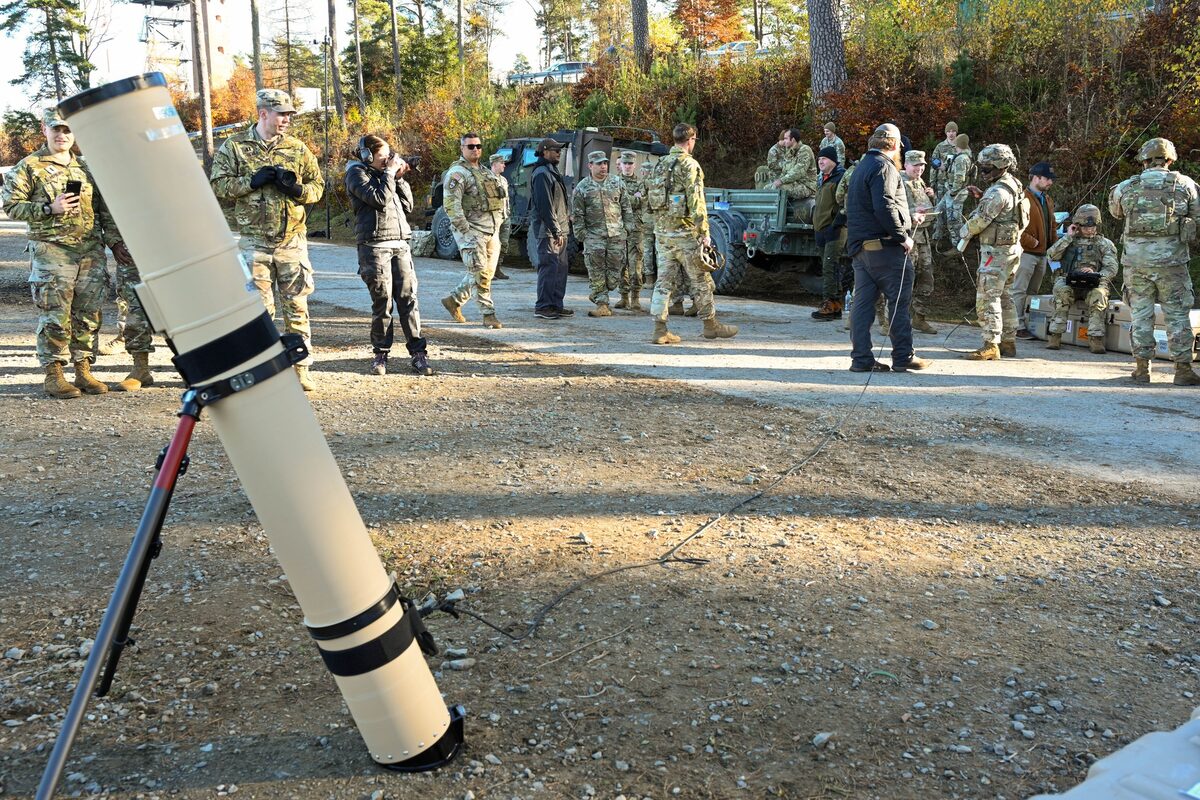
Heaviside Industries made its name detecting drones. At the Association of the U.S. Army (AUSA) annual meeting on Oct. 12, it showed it also wants to fly one into a tank.
The two-year-old US-Norwegian startup unveiled Tyr, a fixed-wing loitering munition small enough for one soldier to carry, armed with Nammo warheads. According to Janes, the weapon weighs under 15 lb (6.8 kg) and flies at up to 150 mph (241.4 km/h). Company president Nils Haagenrud told Breaking Defense that the drone costs "way under $100,000," a figure that excludes the reusable launcher.
The airframe and the warhead
Janes describes Tyr as a "miniaturised" UAV with a wingspan of about 39.5 in and a length of about 31 in. Breaking Defense puts the weight at about 15 lb, slightly different from Janes' "under 15 lb." It also reports that roughly a third of that weight is warhead.
The warheads come from Nammo, the Norwegian-Finnish ammunition maker. Janes says the munition is designed to host anti-armour, anti-personnel, anti-structural and explosively formed penetrator Nammo warheads. Breaking Defense reports that Nammo's anti-tank warheads are all derived from the M72 LAW series of shoulder-fired weapons. That lineage matters for a weapon pitched at armor. Nammo is a supplier, not a shareholder: Breaking Defense says the company is not an investor in Heaviside.
Nammo first appeared as a partner in August. Defence Industry Europe reported then that Heaviside had raised a $60 million Series B at a $600 million valuation. Felicis led the round, with participation from Hedosophia, Menlo Ventures and others. The same announcement named Nammo as the warhead supplier for Heaviside's precision munitions platforms. Janes describes Tyr as the first of a new line of Heaviside loitering munitions.
How it finds a target
According to Breaking Defense, Tyr navigates using electro-optical/infrared (EO/IR) video. The drone flies itself to a human-designated strike zone, searches for targets on its own, then asks the operator for permission before attacking. The human makes the final decision by pressing an engage command. That keeps a person in the loop on the strike itself while the aircraft handles the search.
Heaviside built Tyr to keep working when the link to the operator is jammed or lost. Janes reports that the munition carries the company's own dual-band radios and is designed to fly in denied-communications environments. If comms drop, operators can pre-select one of four behaviors: wave off, continue the mission, land in a safe zone, or self-destruct. Breaking Defense adds that in some tests Tyr has flown to and detonated targets in Norwegian winter weather of 20 degrees below zero.
Haagenrud's explanation for the design comes from Ukraine. Janes quotes him as saying that watching the Russo-Ukrainian conflict showed the need for something man-portable, small enough for every soldier, with the range and penetration to take out a main battle tank.
From RF sensing to strike
The more interesting part of the story is the company behind the weapon. Breaking Defense describes Heaviside as headquartered in Los Angeles, with most engineering and testing done in Norway. Defence Industry Europe lists facilities in both Los Angeles and Oslo and says the company plans to expand in the US. CEO Phillip Walker was quoted in the August funding announcement. Haagenrud, who spoke to Janes in a Sept. 30 interview, holds the title of president.
Until now, Heaviside's only publicly announced defense contract has been for passive sensing, not munitions. Breaking Defense reports it as an Army Rapid Electronic Warfare and Signals Intelligence (REWSI) indefinite-delivery/indefinite-quantity (IDIQ) award with a $99 million ceiling, for MOTH, a handheld spectrum analyzer that detects drone emissions. The company is also developing an underwater vehicle called Nyx.
Haagenrud told Janes that Heaviside is already on contract with the Department of Defense, but he declined to name the service or program. As a result, nothing confirms how far along the munition is in government testing or which buyer, if any, has committed to it.
Why It Matters
Heaviside is entering the competition for low-cost, expendable drones. Tyr's pitch combines a few specific claims:
- A heavy warhead in a small package. If roughly a third of a 15-lb airframe is warhead, Tyr carries a large payload for a man-portable system. Breaking Defense says the warhead has enough explosive power to kill a main battle tank like the Russian T-72 or T-80, and the Nammo warheads' M72 LAW ancestry gives them a known anti-armor pedigree.
- Behavior defined for jammed environments. The four lost-link options are aimed at denied-communications conditions, which Janes says the aircraft is designed to operate in.
- Price. "Way under $100,000" per drone, excluding the launcher, is a company claim, and Haagenrud did not give an exact price. Breaking Defense says commercial off-the-shelf components are used to keep costs down. Whether Heaviside can manufacture at volume is a separate question, and the August funding round and planned US expansion are meant to address it.
There are also open questions. The sources do not give range or endurance figures. Heaviside's DoD customer is unnamed, and its only public contract is for a sensor. Heaviside has the money, an established warhead partner and an RF background that may help it build jam-resistant datalinks. It now has to show the Army that a company known for detecting drones can also build a reliable munition.
