
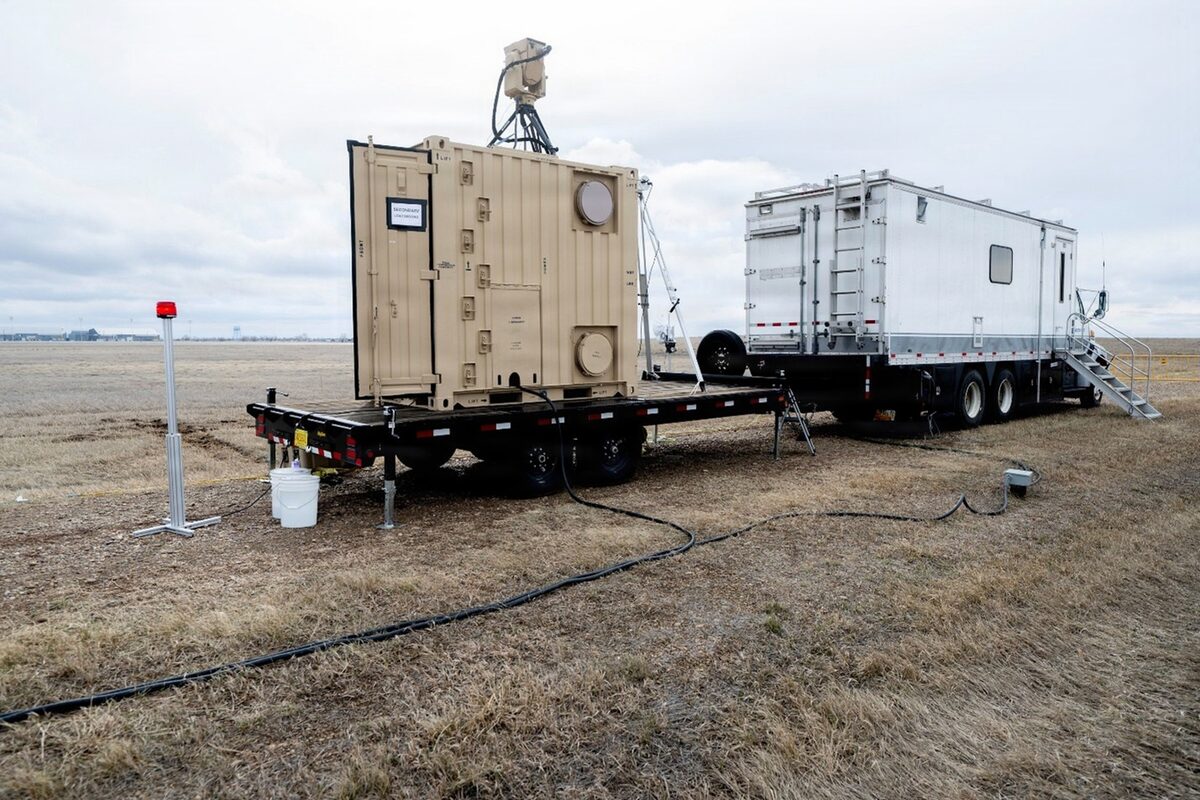
Two announcements, six days apart, just turned AeroVironment's LOCUST laser from a program of record into a program with an export market. On September 2, 2026, the US Army awarded the company a $464.8 million production contract for the Enduring-High Energy Laser (E-HEL) system — the first time the Army has ever put a directed-energy weapon into full production. Then, in the week of September 8, AeroVironment announced its first international customer for the same weapon: a direct commercial sale worth more than $50 million to a foreign buyer the company has not named.
The two deals are related but distinct. E-HEL is the Army's own designation for the program that fields AeroVironment's LOCUST X3 laser; the export sale is a separate, direct commercial transaction with an undisclosed country. Coming so close together, they mark the moment a counter-drone laser that spent years as a demonstrator turned into hardware that both the Army and a foreign government are now paying to field in quantity.
What the Army Bought
According to Defense News' coverage of the contract announcement, the $464.8 million award covers production of LOCUST X3 units — 30-kilowatt high-energy lasers built to counter Group 1 through Group 3 unmanned aircraft systems, the classification bracket that spans small quadcopters up to larger tactical drones weighing several hundred pounds. The weapon is platform-agnostic and fits onto the Army's Joint Light Tactical Vehicle (JLTV), giving maneuver units a mobile directed-energy option rather than a fixed-site-only weapon.
The Army's framing is unambiguous about the milestone: this is the service's first-ever production contract for a directed-energy weapon system. The US military has spent well over a decade testing high-energy lasers — from Navy shipboard demonstrators to earlier Army short-range air defense laser prototypes — but until this contract, none of that work had converted into a production order. E-HEL is the one that did.
The Export Order
Defense Daily broke the news of the international sale, reporting a direct commercial sale — a government-to-company transaction structured outside the Foreign Military Sales pipeline — valued at more than $50 million. AeroVironment has disclosed neither the buying country, the number of units involved, nor a delivery schedule. AeroVironment said it has received the order for what the company is calling the first international sale of its LOCUST system, a distinction the company is treating as a milestone in its own right.
Trade outlet Unmanned Airspace, in its coverage of the same order, filled in more of the system's technical profile: LOCUST is built as a modular weapon that can be deployed in fixed installations, palletized for rapid relocation, or mounted mobile, and it's designed to integrate with external cueing sensors and command-and-control networks rather than operate as a standalone shooter. That architecture — sensor-fed, network-integrated, deployable in more than one physical configuration — is what lets the same core laser serve an Army JLTV mount and, apparently, a foreign customer's fixed or palletized site with comparatively little redesign.
Why Group 1-3 UAS, and Why Now
The Group 1-3 classification the Army and Unmanned Airspace both cite is the threat band that has driven the most urgent counter-drone spending of the past several years: cheap, expendable first-person-view drones and larger tactical UAS that have proven difficult and expensive to defeat with missiles that can cost more than the drone itself. A 30-kilowatt laser offers a different cost curve — the marginal cost of a shot is electricity, not a missile — which is the same logic that has driven interest in directed energy from services and allied militaries watching drone warfare unfold in recent conflicts. LOCUST's ability to plug into existing cueing sensors and C2 networks, rather than requiring a bespoke detection stack, is part of what makes it exportable as a system rather than just a weapon.
What's Still Unknown
The public record on both deals stops well short of full transparency. The Army has not published unit pricing, total quantities, or a fielding schedule beyond "production." AeroVironment has not named the export customer, disclosed how many LOCUST units the $50 million-plus order covers, or given a delivery date. No reporting reviewed here addresses export-control review, End-User Monitoring requirements, or whether the international buyer is a NATO ally, a Gulf state, or a Pacific partner — details that typically surface later in press coverage, congressional notification records, or the buyer government's own procurement disclosures.
Why It Matters
The significance here isn't just one company's sales figures — it's sequencing. A directed-energy weapon moving from "first-ever US production contract" to "first international sale" inside the same week is a signal the counter-drone laser market is no longer stuck in the demonstrator phase that has characterized high-energy laser programs for most of the last decade. Production contracts create the manufacturing base, unit cost curves, and sustainment pipeline that make a weapon system exportable in the first place; without the Army's $464.8 million production order, AeroVironment likely would not have had a production line scaled and ready to sell against. For the broader counter-UAS market, it's also a data point on where buyers are looking: a laser that engages Group 1-3 threats — the exact bracket cheap attack and reconnaissance drones occupy — at the marginal cost of electricity rather than an interceptor missile is a proposition that scales with the volume of drone threats a force expects to face, and that volume has only been going up. Whichever country signed the $50 million order, it did so with the Army's own production commitment as the strongest possible reference sale.
Sources
- AeroVironment Nabs First International Order For LOCUST Counter-Drone Laser System — Defense Daily
- Army awards production contract for Enduring-High Energy Laser System — Army.mil
- AeroVironment receives first international order for LOCUST laser C-UAS system — Unmanned Airspace
- US Army launches laser production with $465M contract award — Defense News
