
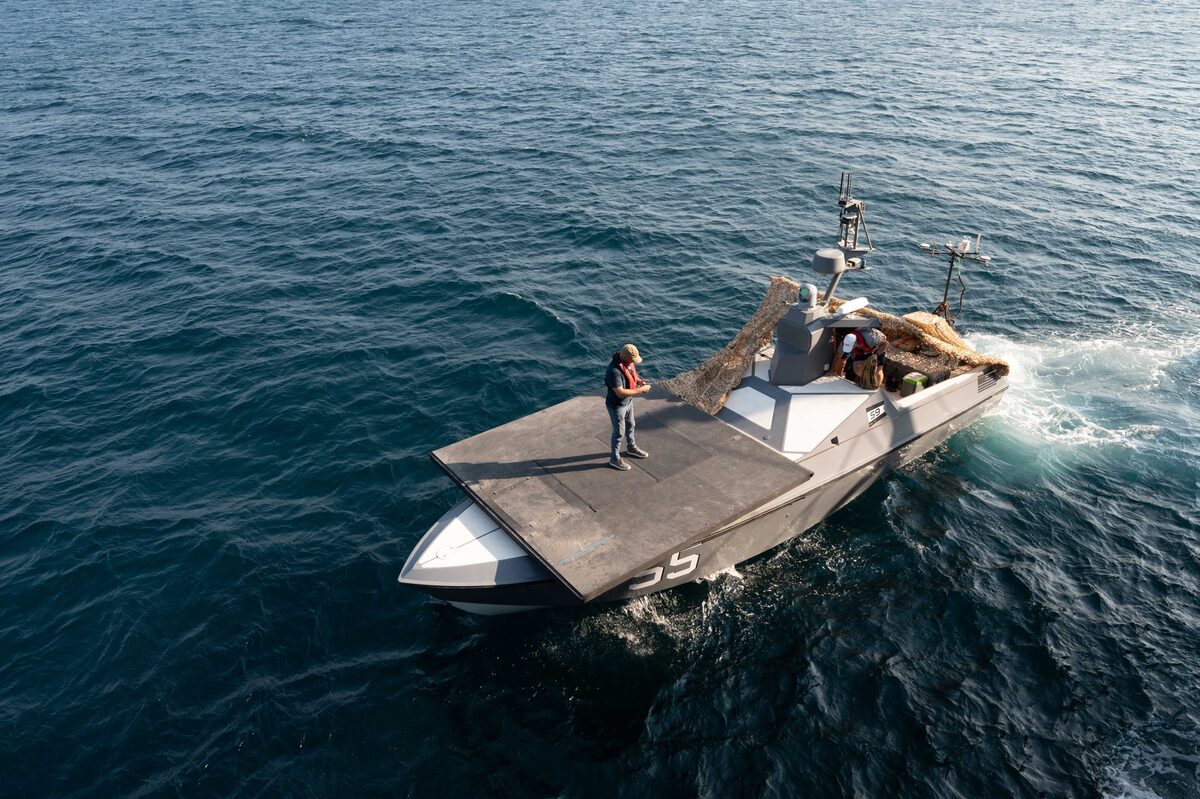
The AH-64 Apache went down at approximately 11:33 GMT on June 8, 2026, somewhere close to the Omani coastline near the Strait of Hormuz. Within minutes, two pilots were in the water. Within roughly two hours, both were out — not pulled aboard a crewed rescue helicopter, not picked up by a destroyer's rigid-hull inflatable, but ferried to a transfer point by a 24-foot robot boat that had been quietly patrolling the Gulf as part of an ongoing unmanned integration experiment. CENTCOM spokesman Capt. Tim Hawkins confirmed what the recovery meant: the first publicly acknowledged use of an unmanned surface vessel to locate and retrieve downed U.S. military aircrew in a real-world operation.
Both pilots were reported in stable condition. A crewed helicopter completed the final hoist extraction once the Corsair delivered them to the transfer point. The entire sequence — splashdown to recovery — closed in under two hours.
What the Corsair Is, and Why It Got There First
The Saronic Corsair is not a typical USV. At 24 feet it is compact enough to deploy quickly, but the specifications suggest a platform designed for serious operational range: a hull design built for speed and persistence, speed exceeding 35 knots, a payload capacity of up to 1,000 pounds, an endurance envelope exceeding 1,000 nautical miles, and 360-degree passive sensing that functions day and night. The jet drive eliminates the propeller-fouling problem that plagues surface vessels operating in debris-strewn or body-recovery scenarios — a detail that matters acutely when the task is approaching ditched aircrew in open water.
Saronic Technologies had already secured a contract worth more than $392 million through a Navy Other Transaction Authority agreement running to mid-2031, giving the program a financial runway well beyond this single deployment. But contracts and capability demonstrations in controlled environments are one thing. The June 8 rescue was the Corsair doing the actual job, autonomously, in the real operational environment, under the kind of time pressure where crewed alternatives might have taken longer to spin up or required putting additional personnel into contested airspace.
The Gulf of Oman and the Strait of Hormuz present a particular problem for conventional combat search and rescue. The strait is one of the most surveilled and contested maritime chokepoints on earth. Sending a manned rotary-wing platform into that environment to conduct a low-and-slow search pattern over open water carries risk that autonomous surface coverage does not. A Corsair on routine ISR patrol can pivot to personnel recovery without the approval chain, force protection calculus, and crew risk assessment that a crewed rescue mission demands. That calculus — unmanned first, crewed assets for extraction — is precisely what played out on June 8.
Task Force 59 and the Ten-Week Mark
Task Force 59 is the 5th Fleet's dedicated AI and unmanned integration unit to stress-test autonomous maritime platforms in the operational environment of the Gulf rather than in simulation. The task force had used Corsairs previously for intelligence, surveillance, and reconnaissance missions across the Gulf — persistent, low-cost sensor presence that would otherwise require crewed hull time. Personnel recovery, however, was a different mission profile entirely, and the Corsairs had not been used for it before.
The timing adds context. Task Force 59 began fielding Corsairs in theater in late March 2026. The rescue happened approximately ten weeks into that first deployment. The platform had barely completed its initial operational period when it was called on to do something no autonomous maritime vessel had done before in U.S. military operations. That it performed the mission successfully on what amounts to an early deployment suggests the capability was further along than a proof-of-concept framing might imply — though CENTCOM's characterization of the event as a historic first also implies it had not been tested in this role before it needed to be.
A Genuine First, a Contested Cause, and What It Changes for CSAR
The crash cause remained under investigation as of June 9 reporting, with flight data, maintenance records, and environmental factors all cited as open lines of inquiry. President Trump publicly stated that Iran shot the Apache down. That claim had not been independently confirmed at the time of reporting, and it should be treated as such — an assertion from the executive, unverified by military investigators or independent sources, made against a backdrop of sharply elevated U.S.-Iran tensions around the strait in 2026. Attribution matters here because it determines whether the rescue took place in a contested-by-adversary environment or in an accident scenario; CENTCOM's public framing did not endorse the President's characterization.
Set the cause aside and the operational significance of the recovery itself remains substantial regardless. Combat search and rescue has always been one of the most dangerous mission profiles in military aviation — slow aircraft, low altitude, known location, adversary who may still be present. The doctrine assumes crewed assets because there was no alternative. The Corsair rescue suggests the architecture is changing: an autonomous platform already forward-deployed on ISR tasking can transition to personnel recovery faster than a crewed asset can launch, cover the initial location and retrieval phase without putting additional crew at risk, and hand off to conventional extraction assets once the survivors are clear of immediate danger.
This is the "last mile" problem in unmanned CSAR. Getting autonomous platforms close enough to downed aircrew to be useful before crewed assets arrive has been a planning aspiration for years. Task Force 59's Corsair did it operationally, under real conditions, in a region where the friction between U.S. forces and Iranian proxy or state action is not theoretical. The fact that it happened ten weeks into the system's first deployment in theater, without apparent planning for this specific contingency, suggests that the broader integration of autonomous surface vessels into personnel recovery doctrine is not a distant future state — it is already catching up to events.
