
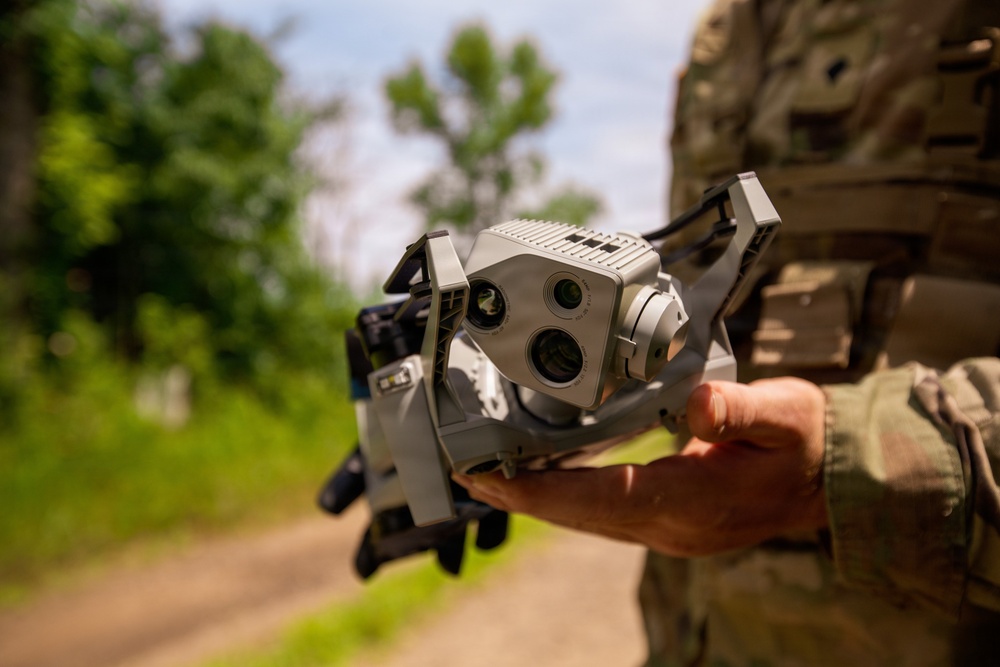
For the first time, state, local, Tribal and territorial (SLTT) law enforcement and correctional agencies have a formal federal pathway to detect, track, disable or seize drones that pose a credible threat — not just watch them fly overhead and hope the FBI shows up. The Department of Homeland Security and Department of Justice published an Interim Final Rule in the Federal Register on July 6, 2026, implementing the SAFER SKIES Act, which was folded into the FY2026 National Defense Authorization Act. The rule took effect retroactively on July 1, and the Federal Communications Commission released four companion actions around the same time addressing the spectrum and equipment side of the equation.
Until now, counter-UAS authority in the United States has been tightly held. Federal law generally treats jamming, spoofing or physically disabling a drone as a violation of statutes governing aircraft, communications and computer access, with narrow carve-outs for a small number of federal agencies — DHS and DOJ among them — protecting specific facilities or events. Local police who spotted a drone loitering over a stadium, a jail, a chemical plant or a motorcade have had almost no lawful mitigation options beyond calling the FBI and waiting. SAFER SKIES is the first statutory move to push some of that authority down to the state and local level, and the Interim Final Rule is the mechanism that turns the statute into an operational program.
What the Rule Actually Authorizes
The Federal Register notice (document 2026-13609) lays out a framework rather than a blanket grant. SLTT law enforcement and correctional agencies can participate only after their personnel complete training and certification, and only using technologies and systems that appear on two federally maintained lists: an Authorized Technologies List and an Authorized Systems List. Both are administered through the FBI's Law Enforcement Enterprise Portal, giving the Bureau a continuing gatekeeping role even after an agency is certified.
The rule also builds in several operational guardrails:
- Spectrum coordination — agencies must coordinate their use of detection and mitigation systems to avoid interfering with licensed spectrum users, a requirement that dovetails with the FCC's parallel actions (below).
- Real-time air traffic control notification — any detection or mitigation activity has to be communicated to air traffic control in something close to real time, reducing the risk that a counter-drone response itself becomes a hazard to manned aviation.
- Privacy protections — the rule includes provisions aimed at limiting how data collected during detection and tracking operations can be retained or used, though the Federal Register notice frames these as part of the broader framework rather than a standalone privacy regime.
Because it was issued as an Interim Final Rule rather than a standard notice-and-comment proposal, the framework is already in effect — but it isn't locked in. DHS and DOJ opened a 60-day public comment period that closes September 4, with comments accepted at regulations.gov under docket FBI-2026-0001. Coverage from DroneLife puts a related comment window closing September 6, suggesting agencies should check the docket directly for the authoritative deadline on any given provision.
Two Tiers: Watching vs. Shooting Down
Not every certified agency will get the same authority. According to reporting from DroneLife, the training and certification structure is split into two tiers: one for detection-and-warning operations — essentially sensing and tracking a drone without touching it — and a second, more demanding tier for mitigation, meaning physically or electronically disabling, disrupting or seizing a drone.
That second tier carries a much higher bar. HSToday reports that mitigation authority requires personnel to complete a separate two-week residential course at the FBI's National Counter-UAS Training Center at Redstone Arsenal in Huntsville, Alabama. Graduates receive a Certified System Operator credential that stays valid for 36 months, after which presumably some form of recertification will be required, though the specifics of that renewal process were not detailed in available reporting. The rule additionally governs how agencies obtain airspace approval before a mitigation operation and what they must report afterward — a paper trail intended to keep mitigation actions auditable after the fact.
The FCC's Role
Detecting and disabling a drone almost always means touching radio spectrum — either passively sensing a drone's control-and-telemetry links or actively jamming or spoofing them. That put the FCC squarely in the middle of implementing SAFER SKIES, and according to DroneLife, the Commission issued four companion actions around the same time as the DHS/DOJ rule — a Special Temporary Authority for eligible agencies, an equipment authorization waiver for RF-based counter-UAS systems, and two Section 333 declaratory rulings clarifying legal protections for non-federal operators and for manufacturers testing this equipment. Full technical detail on those four actions wasn't fully available in the sources reviewed for this article, but their existence signals that equipment vendors seeking a spot on the FBI's Authorized Systems List will also need to clear an FCC equipment-authorization bar — a second regulatory checkpoint layered on top of the DHS/DOJ certification track.
Q&A: What This Means on the Ground
Can any police department buy a jammer and start using it tomorrow?
No. Only agencies whose personnel have completed the required training and certification, using hardware that appears on the Authorized Technologies List or Authorized Systems List, are covered by the new framework.
Does this apply to jails and correctional facilities too?
Yes — the rule explicitly extends to correctional agencies, reflecting years of complaints from prison officials about drones smuggling contraband over facility walls.
Is this permanent?
It's in effect now as an Interim Final Rule, but the public comment period running through early September means DHS and DOJ could still revise specific provisions before the framework is finalized.
What happens if an agency uses mitigation tech without the Redstone Arsenal certification?
The rule establishes a general civil-penalty framework — a fine of up to $100,000 per violation and suspension of an agency's C-UAS authority pending review by the Attorney General or the Secretary of Homeland Security — for agencies that act without the federal coordination the rule requires. The Federal Register notice does not spell out a penalty specifically calibrated to uncertified personnel operating mitigation equipment as its own distinct violation category.
Why It Matters
This is the most significant expansion of domestic counter-drone authority in years, and it changes the operating environment for anyone flying — commercial operators, hobbyists, first responders and bad actors alike. Until now, a rogue or malicious drone over a stadium, jail or public event was almost entirely a federal problem to solve, if it got solved at all, because local police lacked lawful tools to intervene. SAFER SKIES pushes that responsibility toward the agencies actually standing on the tarmac when it happens, but it does so through a deliberately narrow gate: certified personnel, listed hardware, spectrum coordination, and a residential FBI course for anyone authorized to actually take a drone down. For the UAS industry, the Authorized Technologies and Authorized Systems Lists are about to become a real commercial battleground — getting a product certified for local law enforcement use is now a distinct, FCC-adjacent regulatory track separate from ordinary FAA airworthiness or Part 107 compliance. For drone operators of every kind, the practical takeaway is that a wider range of agencies may soon have lawful means to detect and, in some cases, disable an aircraft — which raises the stakes for staying inside authorized airspace and, where applicable, Remote ID compliance. The 60-day comment window is the last formal opportunity for industry, civil liberties groups and public safety agencies to shape the final version of the rule before it hardens into settled law.
