
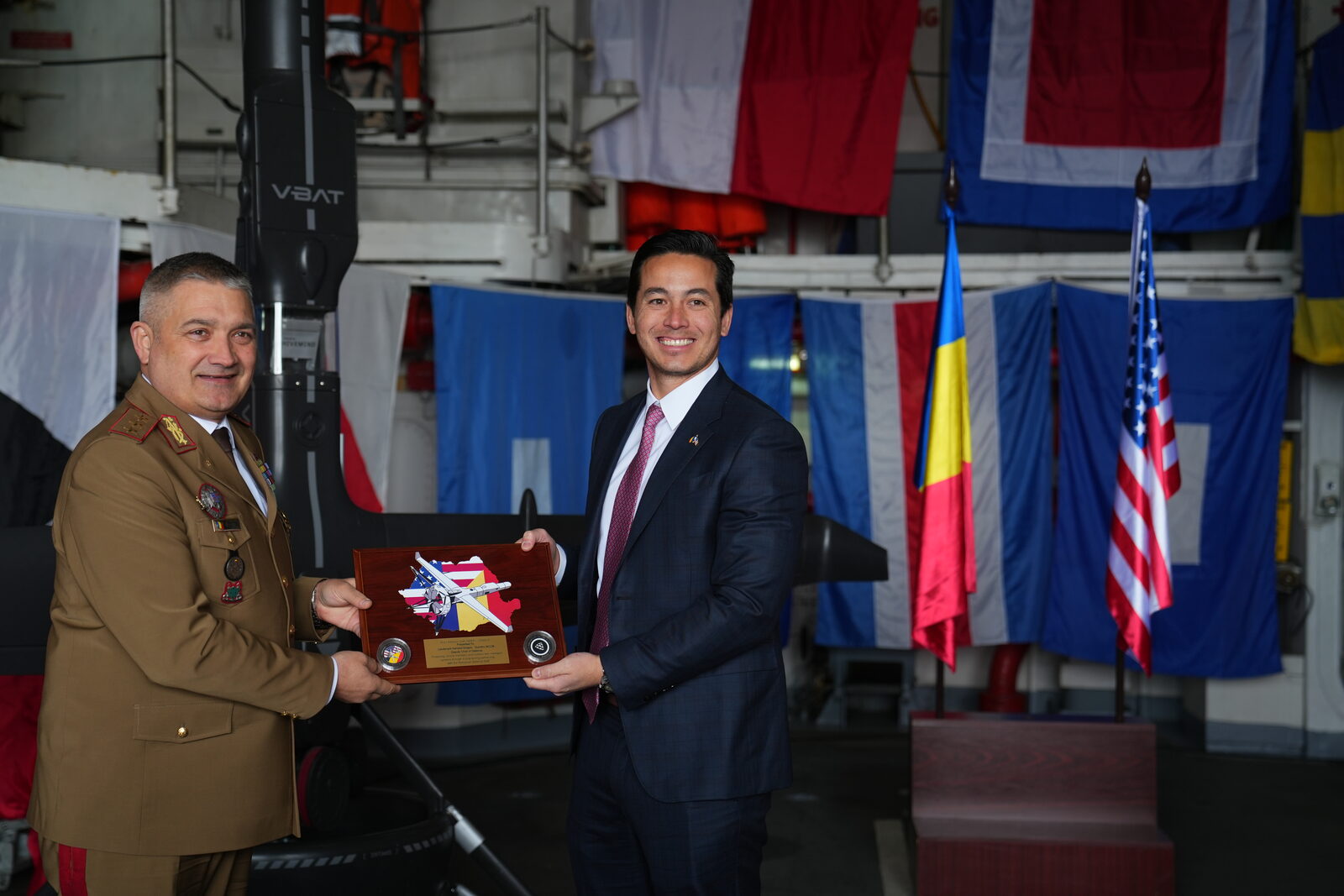
Poland's Armament Agency (Agencja Uzbrojenia) has signed a contract with Shield AI for an undisclosed number of MQ-35 V-BAT unmanned aerial systems destined for the Polish Navy, announced June 23, 2026. The deal makes Poland the latest European navy to field the ducted-fan, ship-deck-capable platform, joining Greece and the Netherlands among a growing list of European nations adopting V-BAT, while expanding V-BAT's footprint across NATO's eastern flank.
Exact unit counts remain undisclosed — all sources describe "several" platforms — and a reported contract value of $16 million has appeared across Breaking Defense, Defence Blog, and defence-industry.eu but has not been confirmed in Janes reporting or by any Polish government official. Delivery is contracted to complete by end of 2026.
What the Polish Navy Is Actually Buying
V-BAT is a NATO Class I VTOL UAS built around an enclosed-rotor pusher propulsion system and a heavy-fuel engine — the kind of propulsion choice that matters for naval logistics, where JP-8 and diesel compatibility beats dedicated aviation gasoline. Janes and Shield AI specs put endurance above 12 hours. The system will be deployed aboard a Polish Navy vessel, though the vessel class has not been disclosed by any source.
The mission profile as stated by the Polish Armament Agency is maritime domain awareness: surveillance, protection of critical infrastructure, and monitoring of communication routes. Given Poland's geography and NATO posture, Baltic Sea operations are the obvious operational context — Warsaw has been accelerating defense spending and procurement across all domains since Russia's full-scale invasion of Ukraine in 2022.
Payload flexibility matters here. V-BAT's hardpoints support electro-optical/infrared camera packages, AIS receivers for vessel identification, and synthetic aperture radar. That combination lets a single airframe track surface contacts, correlate them against maritime traffic databases, and flag anomalies — the core workflow for a Navy trying to maintain persistent awareness over contested littoral waters.
Autonomous Operation: When the Link Dies
The technically consequential feature in the V-BAT package isn't the airframe; it's the onboard autonomy stack underneath. Shield AI's autonomy software is designed to keep the aircraft mission-capable in GPS-denied and communications-jammed environments, operating without constant operator input when the link degrades or drops entirely. For Baltic operations — where Russian electronic warfare assets have been demonstrably active across the region for years, routinely jamming GPS signals that affect civilian aviation and maritime navigation alike — that resilience is not a product-sheet checkbox; it's a fundamental operational requirement.
The distinction matters in procurement terms. Most VTOL UAS on the NATO market require reliable datalink and GPS for navigation, waypoint following, and safe recovery. A platform that loses its link and lands on a ship's deck in the wrong configuration is a liability, not an asset. Shield AI's onboard autonomy is the answer to that operational risk — onboard inference rather than ground-station dependency, allowing the aircraft to continue executing its tasking or return to a safe state autonomously.
"V-BAT has proven its capabilities in Ukraine and beyond, particularly in environments where communications and GPS links are disrupted or denied." — Ryan Tseng, president, Shield AI (Naval News / Naval Today, June 23, 2026)
That Ukraine reference carries weight precisely because it is specific. Reporting confirms V-BAT has seen operational use in the conflict, where it reportedly withstood electronic warfare attacks that downed other UAV systems. Poland is not purchasing a drone that has only been tested in permissive environments — it is acquiring one with verified contested-environment survivability, which is a different and considerably harder claim to make in 2026.
European Naval V-BAT Footprint and What It Signals
The Polish contract continues a pattern. The US Navy and Japan Maritime Self-Defense Force established V-BAT as a proven ship-launched ISR platform; Greece and the Netherlands brought it into European inventories; Poland's Armament Agency is now among a growing list of European nations adopting V-BAT. That cluster of NATO procurement decisions — across eastern and northern European navies specifically — is consistent with a broader push to acquire systems with proven EW resilience and the VTOL signature that makes ship-deck operations practical without catapult or recovery infrastructure.
Ship-launched fixed-wing UAS require either a catapult-and-net system or runway access; neither is available on most surface combatants. Rotary-wing systems handle shipboard launch and recovery more cleanly but typically trade significant endurance. V-BAT's ducted-fan VTOL design occupies the middle ground: vertical departure and recovery without the endurance penalty that defines most multirotor platforms. For a navy operating in the Baltic with limited basing options and a requirement for persistent area coverage, that tradeoff is appealing.
What the Polish Navy gets in practical terms: a ship-launched system capable of 12-plus hours over water, able to continue operating if the communications environment degrades, generating persistent ISR on surface contacts that human crews cannot maintain at the tempo Baltic operations may demand. Whether that translates into operational effectiveness depends on integration, doctrine, and training that will develop after the hardware arrives — but the baseline capability set addresses the stated mission directly.
Why It Matters
Poland is one of NATO's most aggressive defense spenders relative to GDP since 2022, and it is buying V-BAT not as a test article but as an operational naval asset with a hard delivery deadline. That posture — contracted delivery inside six months, Baltic-relevant ISR mission, ship-deck deployment — reflects Warsaw's assessment that persistent maritime surveillance is a near-term operational need, not a future capability to fund in the next budget cycle.
The procurement also extends Shield AI's European naval reference customer list at a moment when that list is actively consulted by other NATO members evaluating ship-launched UAS. Demonstrated interoperability with allied navies — common data links, NATO-standard interface requirements, shared operational context — is an explicit evaluation criterion in European defense tenders, and Poland's contract adds weight to V-BAT's competitive position in any forthcoming procurement by Baltic or Nordic navies facing the same operational problem set. Shield AI now has operational relationships with the US Navy, JMSDF, and three European NATO members; that cluster of reference customers is a meaningful competitive moat in a market where proven track records routinely outweigh paper specifications.
