
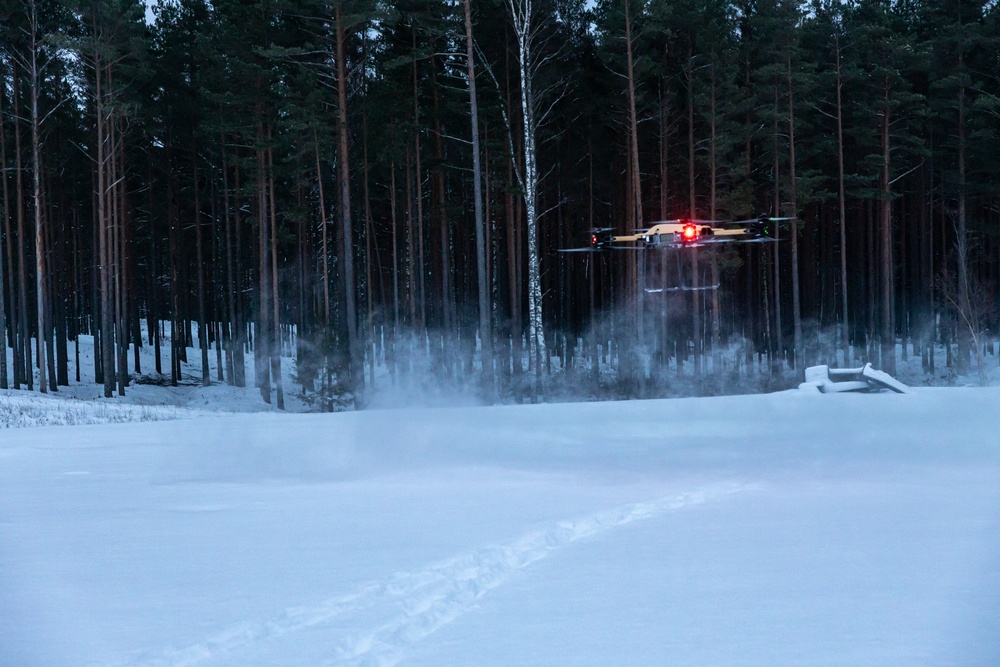
Finland's state-owned defense manufacturer Patria has agreed to team up with Ukrainian drone maker General Cherry to jointly develop unmanned systems and establish drone production inside Finland, the two companies announced over the weekend. The letter of intent, signed Sunday, August 23, 2026, pairs a Ukrainian firm whose systems have been proven in years of frontline combat with a Nordic manufacturer that already has an established unmanned-systems production base — a combination that reflects a broader pattern of NATO-adjacent states seeking to import battlefield-tested drone know-how rather than develop it from scratch.
The announcement was corroborated by Patria's own newsroom, which released the collaboration news in both Finnish and English on August 23, 2026, one day ahead of the wider trade-press pickup.
What Was Announced
According to C4ISRNET's report on the deal, the agreement centers on combining General Cherry's combat experience with Patria's manufacturing capability to produce drones on Finnish soil. Mikko Leino, Patria's executive vice president for defense and weapon systems, framed the partnership in broad strategic terms: "Unmanned defense systems are central to the future of defenses."
Stanislav Hryshyn, co-founder of General Cherry, cast the deal as a transfer of battlefield knowledge into industrial capacity. "Our unique battlefield experience, combined with Patria's technological capabilities, can help drive a fundamental transformation of the European and global security architecture," Hryshyn said.
General Cherry's pitch to a Western manufacturer rests largely on scale of deployment: the company's drones are reportedly already in use by more than 200 Ukrainian military units, giving Patria a partner whose designs have already absorbed years of iteration against real electronic warfare, jamming, and battlefield conditions — the kind of operational feedback loop that is difficult to replicate on a test range.
Notably, Patria itself has not disclosed which specific drone models will be built in Finland or confirmed a production timeline. Those specifics instead come from General Cherry: Janes reported on August 24 that General Cherry said production of two of its UAV models was already underway in Finland, even though Patria has not independently confirmed that status.
The Models: Air Speed and the Bullet Interceptor
While Patria's own statement stayed general, Janes' reporting filled in specifics that go beyond what either company said publicly. Janes reported that General Cherry said production in Finland was already underway for two of its systems: the Air Speed, a first-person-view (FPV) strike UAV, and the Bullet, an interceptor UAV — giving the first concrete look at which platforms are actually in scope, even though Patria itself has not confirmed the model names.
In a separate report, Janes detailed how General Cherry is adapting that same Bullet interceptor for launch from additional platforms: unmanned surface vessels (USVs) such as the Magura naval drone, and fixed-wing "mothership" UAVs that would carry and release the interceptor mid-mission. Speaking to Janes, Hryshyn said General Cherry hopes to show the first battlefield results from that launch concept by the end of 2026. That approach reflects a fast-moving trend in the Ukraine war, where both sides have raced to field cheap, fast interceptor drones capable of shooting down enemy reconnaissance and strike UAVs, including long-range one-way attack drones such as Shahed-type systems. A ship- or mothership-launched interceptor would extend that capability's reach and reaction time, letting a carrier platform deliver interceptors closer to an incoming threat before release rather than relying solely on interceptors launched from fixed ground sites.
Together, the Janes reporting shows General Cherry's Finland plans span both ends of its product line: the Air Speed FPV strike drone, and the Bullet interceptor that Janes reports is now being adapted for launch from ships and larger carrier UAVs rather than only from fixed ground positions.
Why It Matters
The Patria–General Cherry letter of intent is another data point in a pattern that has accelerated through 2026: Ukrainian drone manufacturers, hardened by continuous combat iteration that Western defense primes cannot replicate on a peacetime timeline, are being courted by NATO-member industry as a shortcut to fielding relevant unmanned capability. For Finland — a NATO member since 2023 with a long land border adjacent to Russia — localizing production of combat-proven FPV-strike and interceptor drones has direct territorial-defense relevance, not just export potential.
For General Cherry, a Finnish manufacturing foothold would offer what a wartime Ukrainian production base cannot: a facility outside the reach of Russian strikes on Ukrainian industrial infrastructure, plus access to European supply chains and, potentially, easier routes into NATO procurement processes than a Ukraine-only production line would allow.
The interceptor-drone angle carries its own significance. As one-way attack drone raids have scaled up on the Eastern European front, counter-UAS interceptor technology has become one of the most sought-after capability areas in European air defense circles. A design that can be launched from a ship or a mothership platform — rather than only from a fixed ground battery — would mark a meaningful evolution in how such interceptors are deployed if General Cherry's testing succeeds, and Patria's manufacturing base could give that concept a path to volume production faster than a startup working alone.
Still, the limits of what's confirmed are worth stating plainly: this is a letter of intent, not a signed production contract, and Patria has not independently confirmed a manufacturing start date, the model names in scope, or that production has already begun — those specifics come from General Cherry's own statements to Janes, not from Patria directly. How quickly the partnership moves from announcement to a Patria-confirmed, operating production line in Finland remains an open question.
What to Watch
Key details that Patria has not independently confirmed include the model names in scope, the scale of manufacturing capacity it intends to commit, and whether the partnership will extend to co-development of new designs beyond the Air Speed and Bullet already named by General Cherry and reported by Janes. Also unresolved is whether Finnish production would primarily serve Finland's own defense needs, broader NATO and EU customers, or export back into Ukraine's ongoing war effort.
Sources
- Patria to join with Ukraine's General Cherry to make drones in Finland — C4ISRNET
- Ukraine's General Cherry producing Bullet and Air Speed UAVs in Finland — Janes
- Ukraine's General Cherry plans interceptor UAV launches from UAVs, motherships — Janes
- Patria news release on General Cherry collaboration — Patria Group